
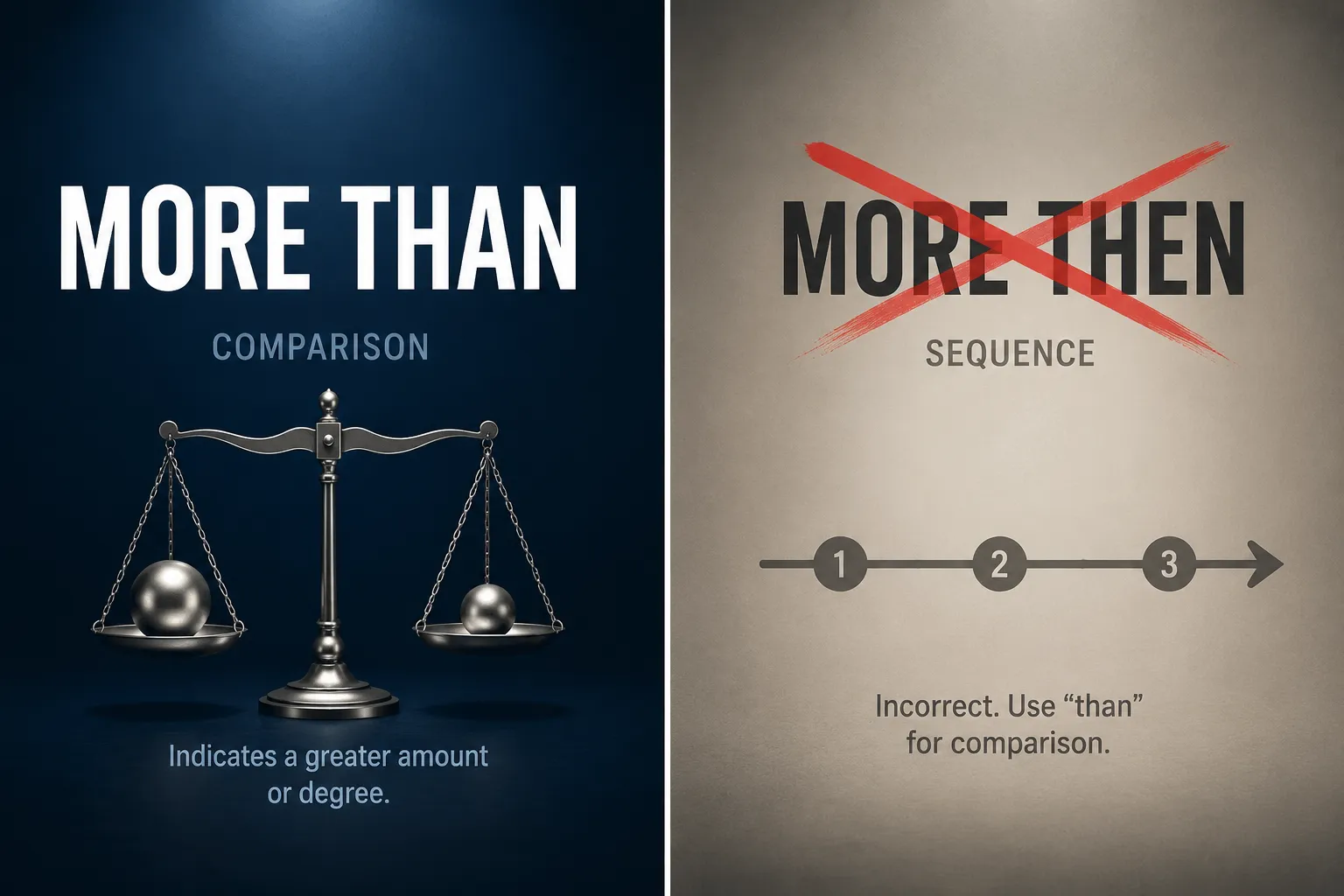
“More than” is almost always the correct choice. It is used to make comparisons, like saying one thing is greater than another. “More then” is a grammatical error in most cases and is not standard English. If you are comparing two things, always use “more than.”
Key Takeaways
- “More than” is a conjunction and preposition used for comparisons.
- “More then” is almost always a spelling mistake, not a valid phrase.
- “Than” connects two things being compared; “then” refers to time or sequence.
- The confusion between “than” and “then” is one of the most common grammar mistakes in English.
- You can remember the rule: if you can replace the word with “compared to,” use “than.”
- “More then” has no standard meaning in modern English grammar.
- Native speakers and professional writers use “more than” in formal and informal writing.
- This mistake often shows up in texting, social media, and quick emails.

What Is the Difference Between More Than and More Then?
“More than” and “more then” sound almost identical when spoken, but they mean very different things on paper. “More than” is the correct phrase for comparisons. “More then” is a typo or grammar error that has no accepted meaning.
Here is a simple breakdown:
- “Than” = used for comparisons (bigger than, faster than, more than)
- “Then” = used for time or order (first this, then that)
Example:
- Correct: She earns more than her brother.
- Incorrect: She earns more then her brother.
The word “than” connects two things you are comparing. The word “then” tells you when something happens or what comes next in a sequence.
When Do You Use More Than vs More Then?
Use “more than” any time you are comparing quantities, sizes, amounts, or qualities. “More then” should not be used at all, because it does not follow standard grammar rules.
Use “more than” when:
- Comparing numbers: “He has more than 100 followers.”
- Comparing qualities: “She is more than capable.”
- Comparing amounts: “This costs more than I expected.”
Avoid “more then” in all writing, including emails, essays, blog posts, and social media captions. It signals a grammar error to readers and can hurt your credibility.
This is a common issue in English writing. If you want to avoid similar mix-ups, check out this guide on Better Than Or Better Then: Which Is Correct in 2026? for more authority-driven insights on the “than vs then” rule.
Is It More Then or More Than? The Grammar Rule Explained
The correct phrase is “more than.” This is not a style choice. It is a grammar rule.
In English grammar, “than” is a conjunction and a preposition. It links two items in a comparison. “Then” is an adverb that refers to time (“I went to the store, then I came home”) or a consequence (“If you study, then you will pass”).
The grammar rule is simple:
- Comparison = than
- Time or sequence = then
Because “more” signals a comparison, it always pairs with “than,” never “then.”
This rule applies across all types of writing, from academic papers to casual blog posts.
Why Do People Say More Then Instead of More Than?
People write “more then” instead of “more than” because “than” and “then” sound almost the same when spoken quickly. This is called a homophone confusion, where two words sound alike but have different meanings and spellings.
Other reasons this mistake happens:
- Fast typing: Auto-correct does not always catch this error.
- Phonetic spelling: Some people spell words the way they sound.
- Habit: If you learned it wrong once, the error can stick.
- Informal writing: Texting and social media make grammar shortcuts common.
This is one of the most frequent errors in English writing. Even experienced writers make this mistake when typing fast. The good news is that it is easy to fix once you know the rule.
For more context on how similar word confusion works, see this breakdown on Say Your Peace or Say Your Piece: Which Is Correct? for a real-world example of how sound-alike words trip people up.
Can You Ever Use More Then?
In standard English, no. “More then” is not a grammatically correct phrase. There is no accepted definition or usage for it in formal writing, grammar guides, or style manuals.
However, there is one rare edge case worth knowing:
If you are writing a sentence where “more” ends one clause and “then” starts another, you might see them appear next to each other. For example:
- “I want more, then I will stop.” (This uses a comma to separate two ideas.)
In this case, “more” and “then” are not a phrase. They are two separate words doing two different jobs. This is not the same as the phrase “more then.”
Bottom line: If you mean “more than” (a comparison), always write “more than.” There is no situation where “more then” is the right choice as a single phrase.
More Than Examples in Sentences
Seeing “more than” used in real sentences makes the rule easier to remember. Here are clear, practical examples:
- “This article has more than 1,500 words.”
- “She studied more than anyone else in the class.”
- “The project cost more than we planned.”
- “He is more than just a good writer, he is an expert.”
- “There are more than 50 countries in Africa.”
- “I care about quality more than speed.”
- “More than half of the students passed the exam.”
Notice that in every sentence, “more than” is doing the job of comparison. You could replace “more than” with “in excess of” or “greater than” and the meaning would stay the same.
Then vs Than: Which Is Correct and How to Tell Them Apart
“Than” and “then” are two different words with two different jobs. Mixing them up is one of the most common grammar mistakes in More Than Vs More Then confusion.
| Word | Part of Speech | Use | Example |
|---|---|---|---|
| Than | Conjunction / Preposition | Comparisons | “She is taller than him.” |
| Then | Adverb | Time, sequence, consequence | “Finish your work, then relax.” |
Quick test: Can you replace the word with “at that time” or “next”? Use “then.” Can you replace it with “compared to”? Use “than.”
This same logic applies to other confusing word pairs. For example, the guide on Mine As Well or Might As Well: Which Is Correct? shows how small word mix-ups can change meaning completely.
How to Remember More Than vs More Then
The easiest memory trick is this: “than” has the letter A, and so does “compare.” When you compare, use than.
Other helpful tricks:
- “Then” = time. Both “then” and “time” start with the letter T-H. If you are talking about time or what comes next, use “then.”
- “Than” = comparison. Think: “greater than, less than, more than.” The A connects them all.
- Substitution test: Replace the word with “compared to.” If the sentence still makes sense, use “than.”
For example: “She is smarter [compared to] him.” That works, so use “than.”
Try it: “First do this, [compared to] do that.” That does not work, so use “then.”
More Than Vs More Then: Common Mistakes in Writing
Even strong writers make this mistake. Here are the most common errors and how to fix them:
Mistake 1: Using “more then” in comparisons
- Wrong: “This is more then enough.”
- Right: “This is more than enough.”
Mistake 2: Using “than” when describing a sequence
- Wrong: “I ate dinner, than I watched TV.”
- Right: “I ate dinner, then I watched TV.”
Mistake 3: Relying on spell-check alone
- Both “than” and “then” are real words, so spell-check will not flag the error. You must read carefully.
Mistake 4: Confusing “no more than” with “no more then”
- Wrong: “There were no more then five people.”
- Right: “There were no more than five people.”
This kind of step-by-step clarity in proofreading is what separates polished writing from sloppy writing. For more grammar guidance, check out the It Is Must Vs It Is A Must: Correct Grammar Guide for another common grammar error explained clearly.
More Than Usage in Writing: Formal and Informal Contexts
“More than” works in every type of writing. It is correct in academic essays, business emails, blog posts, social media captions, and everyday conversation.
Formal writing:
- “The study involved more than 2,000 participants.”
- “Revenue increased by more than 30% in Q3.”
Informal writing:
- “I’ve watched that show more than ten times.”
- “She’s more than a friend to me.”
Content creators and bloggers should pay special attention to this. Using “more then” in a published article can hurt your credibility and signal to readers that the content was not proofread. Search engines also favor well-written, error-free content.
For more grammar tips that matter to writers and creators, see the Its Called Vs It Called: Grammar Guide 2026 for another user-focused breakdown of a common writing error.
What Does More Then Mean If Anything?
“More then” has no accepted meaning in standard English. It is not a phrase you will find in any grammar handbook, style guide, or dictionary as a legitimate expression.
If someone writes “more then,” one of two things is happening:
- They made a typo and meant “more than.”
- They are using “more” and “then” as separate words in a sentence (which is fine, but they are not a phrase together).
There is no context in which “more then” functions as a correct, standalone phrase. If you see it in writing, it is safe to assume it is an error.
Also worth reading for similar grammar clarity: Drier And Dryer: What Is the Correct Spelling in 2026? covers another word pair that confuses even experienced writers.
Conclusion
The More Than Vs More Then question has a clear answer: use “more than” for comparisons, and avoid “more then” entirely. “Than” compares. “Then” refers to time or sequence. They are not interchangeable.
Actionable next steps:
- Proofread your writing manually. Spell-check will not catch this error.
- Use the substitution test: if “compared to” fits, write “than.”
- Bookmark this page as a quick reference when you are unsure.
- Check your past content, especially blog posts and emails, for this common mistake.
- Share this guide with anyone who writes regularly. It is one of the easiest grammar fixes to make.
Getting this right takes about five seconds once you know the rule. And in writing, small details like this build trust with your readers.
FAQ
Is “more than” one word or two?
“More than” is two separate words. It functions as a phrase meaning “in greater quantity or degree than.”
Can I use “more than” at the start of a sentence?
Yes. For example: “More than half of the team agreed with the plan.” This is grammatically correct.
Is “more then” ever acceptable in informal writing?
No. Even in casual writing, “more then” is a grammar error. Use “more than” in all contexts.
Why does spell-check not catch “more then”?
Because “then” is a real word. Spell-check only flags words that are not in the dictionary. It does not always check grammar context.
What is the difference between “than” and “then” in simple terms?
“Than” compares two things. “Then” talks about time or what comes next.
Are there other phrases where “than” is commonly misspelled as “then”?
Yes common examples include “better than,” “rather than,” “less than,” and “other than.” All of these are sometimes written incorrectly with “then.”
Does “more than” work with both numbers and adjectives?
Yes “More than 100 people” (number) and “more than happy to help” (adjective) are both correct uses.
How do I teach kids the difference between than and then?
Use the memory trick: “than” has an A, just like “compare.” If you are comparing, use “than.” If you are talking about time, use “then,” which sounds like “when.”
Is “no more than” correct grammar?
Yes “No more than” is a correct phrase meaning “not exceeding.” Example: “The fee is no more than $50.”
Does this rule apply in British and American English?
Yes. The rule is the same in both British and American English. “More than” is correct in all varieties of standard English.
References
- Garner, Bryan A. Garner’s Modern English Usage. Oxford University Press, 2016.
- Merriam-Webster Dictionary. “Than.” merriam-webster.com. Accessed 2024.
- Strunk, William, and E.B. White. The Elements of Style. Macmillan, 1959.
- Grammarly Blog. “Than vs. Then: What’s the Difference?” grammarly.com. 2021.