
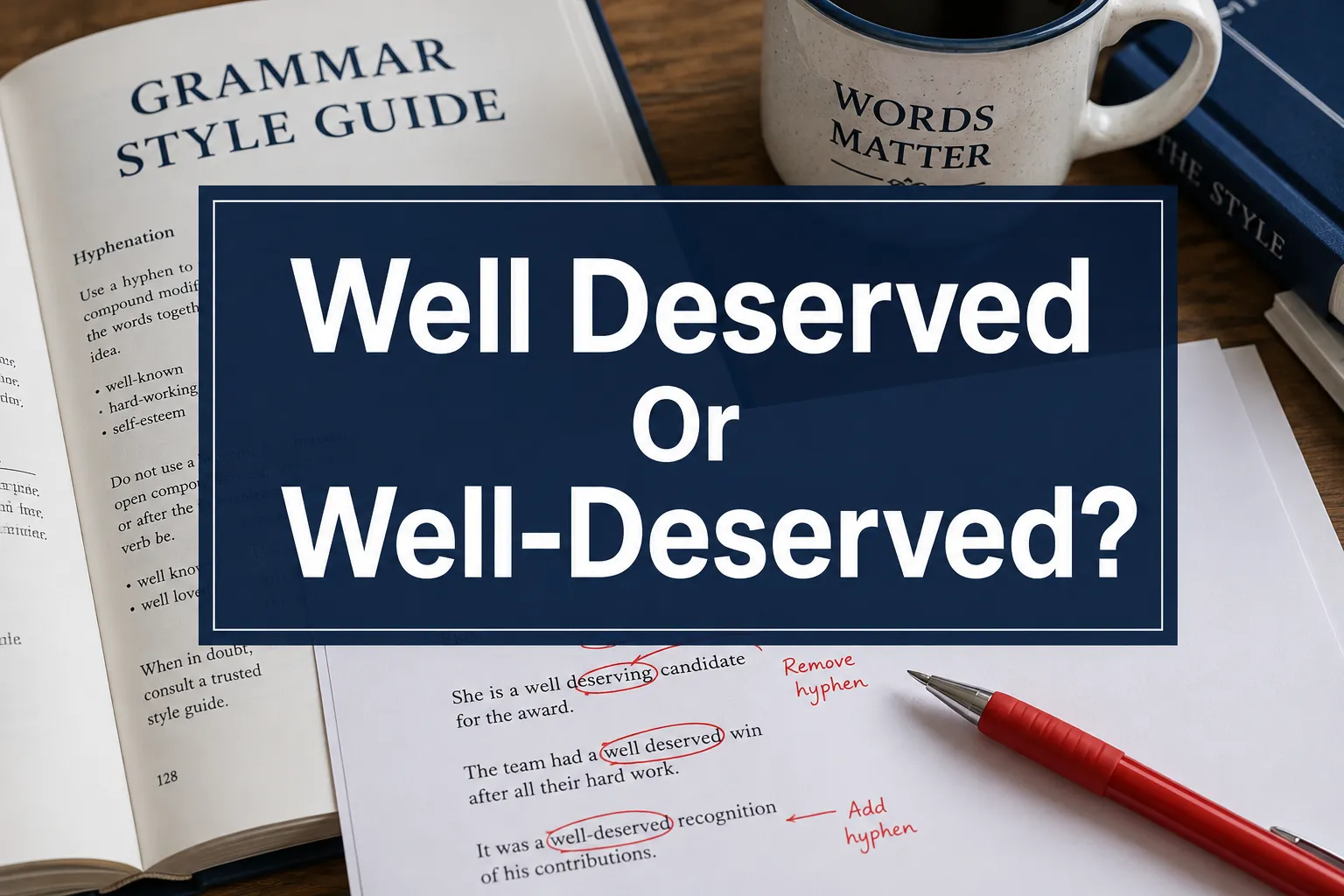
“Well deserved” and “well-deserved” are both correct, the right choice depends on where the phrase sits in a sentence. Use the hyphenated form well-deserved when it comes before a noun (as a compound modifier). Use the unhyphenated form well deserved when it comes after a linking verb like “is,” “was,” or “seems.” This is a standard English grammar rule that applies to most compound adjectives, not just this phrase.
Key Takeaways
- Both “well deserved” and “well-deserved” are grammatically correct spellings.
- Hyphenate to “well-deserved” when the phrase directly precedes a noun: “a well-deserved break.”
- Do not hyphenate when the phrase follows a verb: “The award was well deserved.”
- This rule applies to most compound adjectives formed with “well” (well-known, well-written, etc.).
- “Well-deserved” acts as a compound adjective and modifies a noun directly.
- Formal writing follows this rule strictly; casual writing is more flexible.
- “Well deserved” and “well earned” are near-synonyms but carry slightly different shades of meaning.
- Common mistakes include always hyphenating or never hyphenating, regardless of position.

Is It Well Deserved or Well-Deserved With a Hyphen?
Both forms are correct. The hyphen is not about preference, it follows a specific grammar rule based on where the phrase appears in a sentence.
The short rule: hyphenate before a noun, skip the hyphen after a verb.
- “She took a well-deserved vacation.” (before the noun “vacation”, hyphen required)
- “Her vacation was well deserved.” (after the verb “was”, no hyphen)
This is the same logic used for other “well + past participle” combinations, such as well-known, well-written, and well-respected. The position in the sentence drives the punctuation.
When Do You Use a Hyphen With Well Deserved?
Use a hyphen when “well deserved” works as a compound modifier placed directly before a noun. In that position, the two words join together to describe the noun as a single unit of meaning.
Think of it this way: if you removed “well” and the sentence still made basic sense, but “well” is clearly working with “deserved” to modify the noun together, you need the hyphen.
Use the hyphen when:
- The phrase comes immediately before the noun it describes.
- Both words together act as one adjective.
- Removing the hyphen could create ambiguity (even if slight).
Examples with the hyphen:
- “It was a well-deserved win.”
- “He received well-deserved praise.”
- “This is a well-deserved recognition.”
Skip the hyphen when:
- The phrase comes after a linking verb (is, was, were, seems, feels, looks).
- The noun has already been named before the adjective appears.
Examples without the hyphen:
- “The recognition was well deserved.”
- “Her promotion seems well deserved.”
- “Everyone agreed the award was well deserved.”
For a similar breakdown on another commonly confused grammar pair, check out this guide on better than or better then.
Well Deserved vs Well-Deserved Grammar Rules: The Full Breakdown
The grammar rule behind “well deserved” vs “well-deserved” is called the compound modifier rule (also called the compound adjective rule). It is one of the most consistent punctuation rules in standard English.
Here is the authority-driven breakdown:
The Rule:
When two or more words work together as a single adjective before a noun, connect them with a hyphen. When those same words appear after the noun (in the predicate), leave them separate.
Why it matters:
The hyphen signals to the reader that both words should be read together as one descriptive unit. Without it, a reader might briefly parse “well” and “deserved” as separate ideas.
| Position | Form | Example |
|---|---|---|
| Before a noun | well-deserved | a well-deserved rest |
| After a verb | well deserved | the rest was well deserved |
This same rule applies to: well-known / well known, well-written / well written, well-paid / well paid.
Does Well Deserved Need to Be Hyphenated Before a Noun?
Yes. When “well deserved” appears directly before a noun, standard grammar calls for the hyphen. This is not optional in formal writing.
The compound adjective rule is documented in major style guides including The Chicago Manual of Style and the AP Stylebook. Both confirm that compound modifiers before a noun should be hyphenated to avoid confusion and improve clarity.
Correct:
- “a well-deserved reward”
- “well-deserved recognition”
- “a well-deserved break”
Incorrect (missing hyphen before noun):
- “a well deserved reward”
- “well deserved recognition”
The only exception: if the first word is an adverb ending in “-ly,” no hyphen is needed (for example, “a highly deserved award” does not need a hyphen). Since “well” does not end in “-ly,” the hyphen rule applies.
Well Deserved After a Verb vs Before a Noun
This is the core question most people are actually asking. The position of the phrase in the sentence is everything.
After a verb (predicate position): no hyphen
When “well deserved” follows a linking verb, it is in what grammarians call the predicate position. The words are still working together in meaning, but they do not need a hyphen because there is no risk of misreading.
- “The standing ovation was well deserved.”
- “His reputation is well deserved.”
- “That raise feels well deserved to everyone on the team.”
Before a noun (attributive position): hyphen required
When the phrase comes right before the noun it modifies, it is in the attributive position. The hyphen is required.
- “She finally took a well-deserved day off.”
- “It was a well-deserved compliment.”
Quick decision rule: Ask yourself, “Does the phrase come right before the noun?” If yes, hyphenate. If the noun comes first and the phrase follows a verb, skip the hyphen.
This is the same logic covered in our guide on its called vs it called, small grammar choices that change meaning more than people expect.
Is Well Deserved Hyphenated in Formal Writing?
In formal writing, yes, follow the rule strictly. Use “well-deserved” before nouns and “well deserved” after verbs. Style guides like Chicago and AP are consistent on this.
In casual writing (social media posts, text messages, informal emails), many people skip the hyphen entirely and write “well deserved” in all positions. This is widely accepted in informal contexts and will not confuse readers.
Bottom line for formal writing:
- Academic papers, business reports, journalism: follow the rule.
- Blog posts, social captions, texts: the unhyphenated form is acceptable throughout.
If you are writing for publication or professional use, stick to the rule. It signals attention to detail and editorial care.
Examples of Well Deserved in a Sentence
Here are real-world examples showing both forms used correctly. These cover a range of tones and contexts.
With hyphen (before a noun):
- “After three years of hard work, she finally took a well-deserved vacation.”
- “The team celebrated their well-deserved championship.”
- “He received well-deserved credit for the project.”
- “It was a well-deserved promotion.”
Without hyphen (after a verb):
- “The recognition was well deserved.”
- “Everyone agreed the applause was well deserved.”
- “His success is well deserved after everything he put in.”
- “The rest felt well deserved after a long week.”
Both in the same paragraph (correct usage):
“After months of effort, the team earned a well-deserved break. The time off was absolutely well deserved, and no one questioned it.”
Well Deserved or Well Earned: What Is the Difference?
“Well deserved” and “well earned” are close synonyms, but they carry a slight difference in emphasis.
- Well deserved suggests that something is appropriate or justified based on merit, behavior, or effort. It implies the person is worthy of receiving it.
- Well earned puts more emphasis on the work or effort put in. It suggests the person actively worked hard to get the result.
In practice:
- “A well-deserved reputation” (reputation built on merit, not necessarily hard labor)
- “A well-earned salary” (salary resulting from direct effort and work)
Both are correct and interchangeable in many situations. The difference is subtle enough that most readers will not notice. Choose based on whether you want to emphasize worthiness (“deserved”) or effort (“earned”).
You might also enjoy our breakdown of mine as well or might as well for another commonly confused “well” phrase.
Why Is Well Deserved Sometimes Hyphenated?
The hyphen appears because “well deserved” is a compound adjective, two words that function as one descriptive unit. English uses hyphens to signal that two words should be read together, not separately.
Without the hyphen in “a well deserved break,” a reader might briefly read “well” as a standalone adverb modifying nothing in particular, then “deserved break” as the core phrase. The hyphen eliminates that split-second ambiguity.
This is why style guides consistently recommend the hyphen in the pre-noun position. It is a clarity tool, not just a rule for its own sake.
Well-Deserved as a Compound Adjective: The Grammar Rules Explained
A compound adjective is formed when two or more words combine to modify a single noun. “Well-deserved” is a classic example of a “well + past participle” compound adjective.
How it works:
- “Well” is an adverb modifying the past participle “deserved.”
- Together, they describe a noun as something that has been thoroughly or rightfully earned.
- When placed before the noun, they need a hyphen to show they work as a unit.
Other “well + past participle” compound adjectives follow the same rule:
- well-known / well known
- well-written / well written
- well-paid / well paid
- well-respected / well respected
- well-traveled / well traveled
The pattern is consistent. Once you learn the rule for “well deserved,” you know it for all of them.
For more grammar comparisons with a similar structure, our guide on more than vs more then covers another frequently searched grammar question.
How to Use Well Deserved Correctly in Writing
Here is a straightforward, step-by-step process for getting it right every time.
Step 1: Find the phrase in your sentence.
Locate where “well deserved” (or “well-deserved”) appears.
Step 2: Identify what comes after it.
- Does a noun come right after? Use the hyphen: “well-deserved.”
- Does a verb come before it (is, was, were, seems)? Skip the hyphen: “well deserved.”
Step 3: Read it aloud.
If the phrase is doing the work of a single adjective right before a noun, you need the hyphen. If it feels like a comment on something already named, no hyphen.
Step 4: Check the context.
- Formal writing: follow the rule strictly.
- Casual writing: the unhyphenated form is acceptable in all positions.
Step 5: Avoid common traps.
Do not write it as one word. Do not confuse it with “well-deserving.” And do not apply the hyphen after a verb just because it looks more formal.
Also worth reading: our guide on take affect vs take effect covers another grammar rule that follows a similar position-based logic.
FAQ
Is “well deserved” one word or two?
It is always two words, either “well deserved” (no hyphen) or “well-deserved” (with hyphen). Writing it as one word (“welldeserved”) is never correct.
Should I write “well-deserved” or “well deserved” in a congratulations message?
Either works in casual writing. If you want to be grammatically precise: use “well-deserved” before a noun (“a well-deserved win”) and “well deserved” after a verb (“the win was well deserved”).
Is “well-deserved” formal or informal?
It is standard in both formal and informal writing. The hyphenated form is required in formal contexts when placed before a noun.
Can I use “well deserved” without a hyphen in all cases?
In informal writing, yes, many style guides allow flexibility in casual contexts. In formal or published writing, follow the position-based rule.
What is the difference between “well deserved” and “deserved”?
“Well deserved” is stronger and more emphatic. It means something is fully, thoroughly, or rightfully deserved, not just barely deserved.
Is “a well deserved rest” correct?
No. Because “well deserved” comes directly before the noun “rest,” the hyphen is required: “a well-deserved rest.”
Does the hyphen rule apply to “well earned” too?
Yes. The same rule applies: “a well-earned reward” (before noun) vs “the reward was well earned” (after verb).
Is “well-deserved” in the dictionary?
Yes. Most major dictionaries list “well-deserved” as a standard compound adjective entry.
Can “well deserved” come at the start of a sentence?
Yes, but it is uncommon. If used at the start, it would typically precede a noun: “Well-deserved recognition came late, but it came.”
Is it ever wrong to use the hyphen?
Yes, using “well-deserved” after a linking verb is technically incorrect in formal writing, though it is widely understood and rarely causes confusion in casual use.
Conclusion
The “well deserved or well-deserved” question has a clean, actionable answer: hyphenate before a noun, drop the hyphen after a verb. That single rule covers 99% of situations you will encounter.
Here are your actionable next steps:
- Before writing the phrase, ask yourself: does a noun come right after it?
- If yes, write “well-deserved.” If no (it follows a verb), write “well deserved.”
- In formal writing, apply the rule consistently. In casual writing, the unhyphenated form is fine throughout.
- Bookmark this guide for quick reference, it also applies to well-known, well-written, well-paid, and all other “well + past participle” compound adjectives.
Small grammar choices like this build credibility in your writing. Readers may not consciously notice when you get it right, but they notice when you get it wrong. Getting this one right is, without a doubt, well deserved confidence in your writing skills.