


Last updated: June 10, 2026
Quick Answer
“Might as well” is the correct phrase. “Mine as well” is a common mishearing and misspelling — it has no grammatical meaning in standard English. When someone says “mine as well,” they almost always mean “might as well,” which expresses that something is a reasonable or logical choice given the circumstances.
Key Takeaways
- “Might as well” is the grammatically correct phrase; “mine as well” is an error
- “Mine as well” comes from mishearing the spoken phrase “might as well”
- “Might as well” means it makes sense to do something because there is no strong reason not to
- The phrase can carry a positive, neutral, or slightly reluctant tone depending on context
- Non-native English speakers often struggle with this phrase because “might as well” sounds like “mine as well” in fast speech
- Common alternatives include “may as well,” “no reason not to,” and “just as soon”
- The phrase dates back to Middle English usage of the modal verb “might”
- Using “mine as well” in formal writing is considered an error and can hurt your credibility
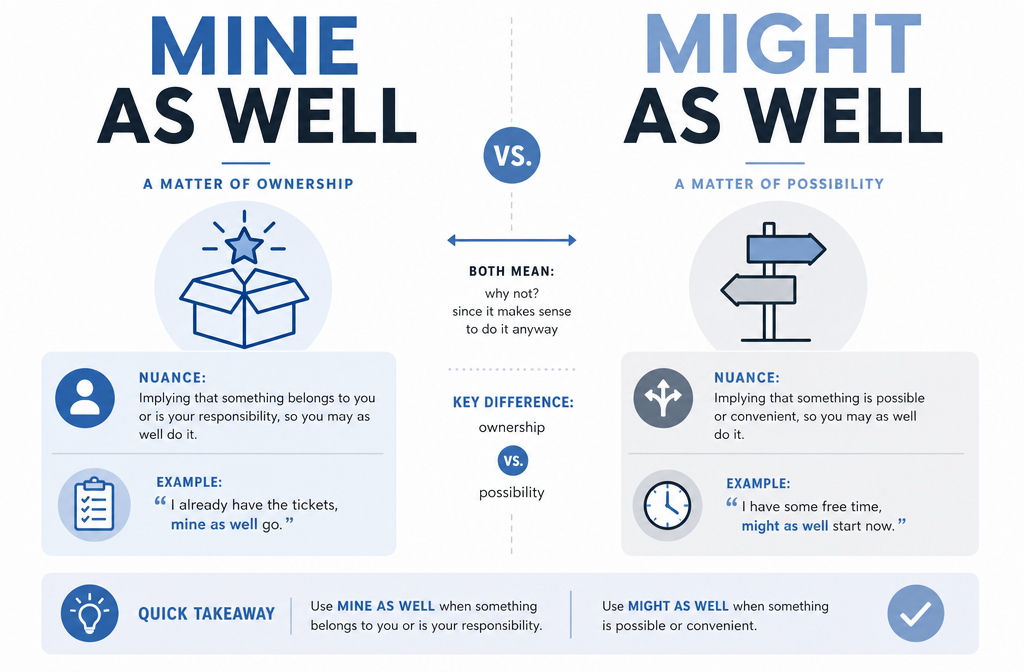
What Does “Mine As Well” or “Might As Well” Actually Mean?
“Might as well” means that doing something is a reasonable or sensible choice, usually because the alternatives are no better or because there is nothing stopping you. It signals acceptance, practicality, or mild resignation.
For example: “We’re already here, so we might as well stay for dinner.” This means: since we are here anyway, staying makes sense.
“Mine as well” has no standard meaning in English grammar. It is simply a phonetic mistake — people write what they hear in fast, casual speech. The phrase “might as well” gets blurred into something that sounds like “mine as well” when spoken quickly.
Key point: If you see “mine as well” in writing, it is almost always a spelling error for “might as well.”
Difference Between “Mine As Well” and “Might As Well”
The difference is simple: one is correct, and one is not.
| Phrase | Grammatically Correct? | Meaning |
|---|---|---|
| Might as well | Yes | It makes sense to do this |
| Mine as well | No | No standard meaning |
| May as well | Yes | Same as “might as well” (slightly more formal) |
“Might” is a modal verb that expresses possibility or suggestion. “Mine” is a possessive pronoun (as in “that book is mine”). Using “mine” in place of “might” creates a sentence that simply does not work grammatically.
Example of the error:
- Wrong: “We mine as well go now.”
- Right: “We might as well go now.”
The confusion happens entirely because of how the phrases sound in spoken English, especially in American and British accents where the “t” in “might” is often soft or dropped.
Is “Mine As Well” Grammatically Correct?
No. “Mine as well” is not grammatically correct in standard English. There is no sentence structure in English where “mine as well” functions as a meaningful phrase the way “might as well” does.
“Might as well” works because “might” is a modal auxiliary verb that pairs with the base form of another verb. The structure is: subject + might as well + base verb.
- “I might as well try.”
- “She might as well call him.”
- “They might as well leave early.”
If you swap in “mine,” the sentence breaks down immediately. “I mine as well try” is not a sentence that follows any English grammar rule.
Bottom line: Always use “might as well” in writing. “Mine as well” will mark you as someone who learned the phrase by ear and never checked the spelling.
Why Do People Say “Mine As Well” Instead of “Might As Well”?
People say “mine as well” because that is what “might as well” sounds like in fast, connected speech. This is called an “eggcorn” in linguistics — a word or phrase that is misheard and then reinterpreted as something that sounds similar but has a different spelling.
In natural conversation, the phrase “might as well” is often pronounced as a single flowing sound: “mighd-as-well” or even “mine-as-well” depending on regional accent and speaking speed. The final “t” in “might” often disappears, and the vowel shifts slightly, making it easy to mishear.
This is especially common among:
- Children learning to write what they hear
- Non-native English speakers
- People who learned English primarily through listening rather than reading
The error sticks because people use the phrase constantly in speech without ever seeing it written down. Once they write it, they write what they heard.
Origin of the Phrase “Might As Well”
“Might as well” has roots in Middle English, where “might” was used as the past tense and subjunctive form of “may.” The phrase expresses a kind of logical reasoning: if the alternatives are no better, then this option is just as good.
The full logic behind the phrase is: “I might do this just as well as anything else, so I will.” Over time, it shortened to “might as well” and became a fixed expression.
The phrase appears in English literature going back several centuries. It is one of many modal verb phrases in English that express degrees of possibility, permission, and suggestion.
Related forms that also exist:
- “May as well” — slightly more formal, same meaning
- “Could just as well” — emphasizes that alternatives are equal
- “Just as soon” — informal, similar meaning in some dialects
How Do People Use “Might As Well” in Conversation?
“Might as well” shows up in everyday speech constantly. It is used to suggest an action when there is no strong reason to avoid it, or when all other options seem equal or worse.
Here are real-world examples across different situations:
Practical decision-making:
“The meeting got canceled. I might as well use the time to finish that report.”
Mild resignation:
“The traffic is terrible. We might as well stop for coffee and wait it out.”
Encouragement:
“You’ve already started the course — you might as well finish it.”
Humor or sarcasm:
“If I’m going to be up this late, I might as well watch the whole season.”
The tone shifts based on context. It can sound positive (a good idea), neutral (logical), or slightly reluctant (not ideal, but acceptable). That flexibility is why it appears so often in both casual and formal speech.

Is “Might As Well” Positive or Negative?
“Might as well” is neither strictly positive nor negative — it is context-dependent. The phrase signals practicality or acceptance, and the emotional tone depends on the situation around it.
- Positive use: “You’re already good at this — you might as well turn it into a business.” (encouraging)
- Neutral use: “The store is on the way home, so I might as well stop.” (logical)
- Negative/resigned use: “Nothing else is working. I might as well try this.” (reluctant acceptance)
A good way to think about it: the phrase means “there is no good reason not to.” Whether that feels good or bad depends on whether the speaker wants to do the thing or not.
When Should You Use “Might As Well” in Writing?
Use “might as well” when you want to suggest that an action is logical, reasonable, or worth doing because the alternatives are no better. It works in both formal and informal writing, though it leans more casual.
Use it when:
- Suggesting a practical course of action
- Expressing that two options are roughly equal
- Showing mild acceptance of a situation
- Writing dialogue that sounds natural and conversational
Avoid it when:
- Writing highly formal documents like legal contracts or academic papers (use “it would be advisable to” instead)
- The tone needs to be strictly professional and neutral
In blog posts, emails, social media, and everyday writing, “might as well” is perfectly appropriate and sounds natural.
Common Mistakes When Saying “Mine As Well”
The biggest mistake is simply writing “mine as well” when you mean “might as well.” But there are a few related errors worth knowing.
Mistake 1: Writing “mine as well”
This is the most common error. Always check your spelling before publishing or sending.
Mistake 2: Confusing “might as well” with “as well”
“As well” means “also” or “too.” It is a different phrase entirely.
- “I’ll come as well.” (I’ll come too.)
- “I might as well come.” (There’s no reason not to come.)
Mistake 3: Using “might as well” when you mean “may as well”
These two are interchangeable in most contexts, but “may as well” sounds slightly more formal. Either is correct.
Mistake 4: Leaving out the verb after “might as well”
The phrase needs a base verb to complete the thought.
- Wrong: “We might as well.”
- Right: “We might as well go.”
Alternatives to Saying “Might As Well”
If you want to vary your language or avoid repeating the phrase, here are solid alternatives that carry the same meaning:
- May as well — nearly identical, slightly more formal
- No reason not to — direct and clear
- Just as soon — informal, regional
- It makes sense to — more formal
- There’s nothing stopping us from — conversational
- We could just as easily — emphasizes equal options
- Why not — casual and brief
Choose based on your tone. For casual writing, “may as well” or “why not” works well. For professional writing, “it makes sense to” or “there is no reason not to” fits better.
How to Explain “Might As Well” to Non-Native English Speakers
For non-native English speakers, “might as well” can be tricky because it uses a modal verb in an idiomatic way that does not translate directly into many other languages.
The clearest explanation: “might as well” = “there is no good reason not to do this, so let’s do it.”
A step-by-step way to teach it:
- Start with a simple scenario: “The movie starts in 5 minutes. We are already at the theater. Should we go in?”
- The answer: “We might as well go in.” (No reason not to.)
- Show the structure: subject + might as well + base verb
- Practice with common examples from daily life
- Contrast it with “mine as well” and explain that “mine” is a possessive pronoun, not a verb
Common confusion for non-native speakers: Many languages have a direct equivalent for “may” or “might” but not for the idiomatic phrase “might as well.” The key is to teach it as a fixed expression, not try to translate it word by word.
Cultural Variations of the “Might As Well” Expression
“Might as well” is used across all major English-speaking countries, but the phrasing and tone can vary slightly.
- American English: “Might as well” is extremely common in everyday speech. The shortened pronunciation often sounds like “mine as well” in fast speech.
- British English: “May as well” is slightly more common in formal British usage, though “might as well” is also widely used.
- Australian English: Both forms are used, often with a casual, laid-back tone.
- Canadian English: Follows American patterns closely.
In all these regions, “mine as well” is considered an error. No regional dialect of standard English accepts “mine as well” as correct.

Examples of “Might As Well” in Different Contexts
Here is a quick reference showing how the phrase works across different situations:
Work:
“The deadline got pushed back a week. I might as well use the extra time to polish the presentation.”
School:
“I’ve already read half the book. I might as well finish it tonight.”
Travel:
“Our flight is delayed by three hours. We might as well grab something to eat.”
Health:
“I’m already at the gym. I might as well do a full workout.”
Shopping:
“I need one item from the store, but since I’m here, I might as well grab everything on the list.”
Social:
“Everyone else is going to the party. I might as well come along.”
Each example shows the same core logic: the situation makes the action a reasonable choice.
FAQ
Is “mine as well” ever correct in English?
No. “Mine as well” is not a correct phrase in standard English. It is a misspelling of “might as well.” There is no grammatical context where “mine as well” functions as a meaningful expression.
What is the difference between “might as well” and “may as well”?
Both phrases mean the same thing: it makes sense to do something because there is no good reason not to. “May as well” is slightly more formal. In everyday speech and writing, they are interchangeable.
Can I use “might as well” in formal writing?
It is acceptable in semi-formal writing, emails, and blog content. For highly formal documents like academic papers or legal writing, replace it with “it would be advisable to” or “there is no reason not to.”
Why does “might as well” sound like “mine as well” when spoken?
In fast, connected speech, the “t” in “might” often softens or disappears, and the vowel can shift. This makes “might as well” sound similar to “mine as well” to people who are listening rather than reading.
What type of error is “mine as well”?
It is called an eggcorn — a word or phrase that is misheard and then written as something that sounds similar but has a different spelling and meaning.
Is “might as well” positive or negative?
Neither, on its own. The tone depends on context. It can be encouraging, neutral, or slightly resigned. The phrase simply means there is no strong reason to avoid the action.
What does “might as well” literally mean?
Literally, it means “I might do this just as well as any other option.” Over time, it became a fixed phrase meaning: this action is reasonable or logical given the circumstances.
Are there other common phrases that get confused like “mine as well”?
Yes. Similar eggcorns include “for all intensive purposes” (should be “for all intents and purposes”) and “should of” (should be “should have”). These all come from mishearing spoken English.
How do I remember which one is correct?
Remember that “might” is a verb and “mine” is a pronoun. You need a verb to make the phrase work. “I might as well go” makes sense. “I mine as well go” does not.
Can “might as well” start a sentence?
Yes, but it needs a subject. “You might as well try” is correct. Starting with just “Might as well try!” is informal but common in casual speech and writing.
Conclusion
The answer to “mine as well or might as well” is clear: always use “might as well.” It is the grammatically correct phrase, and “mine as well” is simply a mishearing that has no place in written English.
Here are your actionable next steps:
- Audit your writing. Search for “mine as well” in any documents, blog posts, or emails you have written. Replace every instance with “might as well.”
- Learn the structure. Remember: subject + might as well + base verb. This pattern will keep you on track every time.
- Teach it to others. If you work with non-native speakers or students, use the step-by-step explanation in this guide to clear up the confusion.
- Use alternatives when needed. “May as well,” “no reason not to,” and “it makes sense to” are all solid replacements for different tones and contexts.
Getting this phrase right is a small thing, but in writing, small things add up. Correct grammar builds trust with your readers, and trust is what keeps them coming back.
References
- Merriam-Webster Dictionary. “Might.” merriam-webster.com. Accessed 2024.
- Oxford English Dictionary. “Might, v.” oed.com. Accessed 2024.
- Garner, Bryan A. Garner’s Modern English Usage. Oxford University Press, 2016.
- Crystal, David. The Cambridge Encyclopedia of the English Language. Cambridge University Press, 2003.
- Language Log, University of Pennsylvania. “Eggcorns: The Database.” Accessed 2024. languagelog.ldc.upenn.edu