
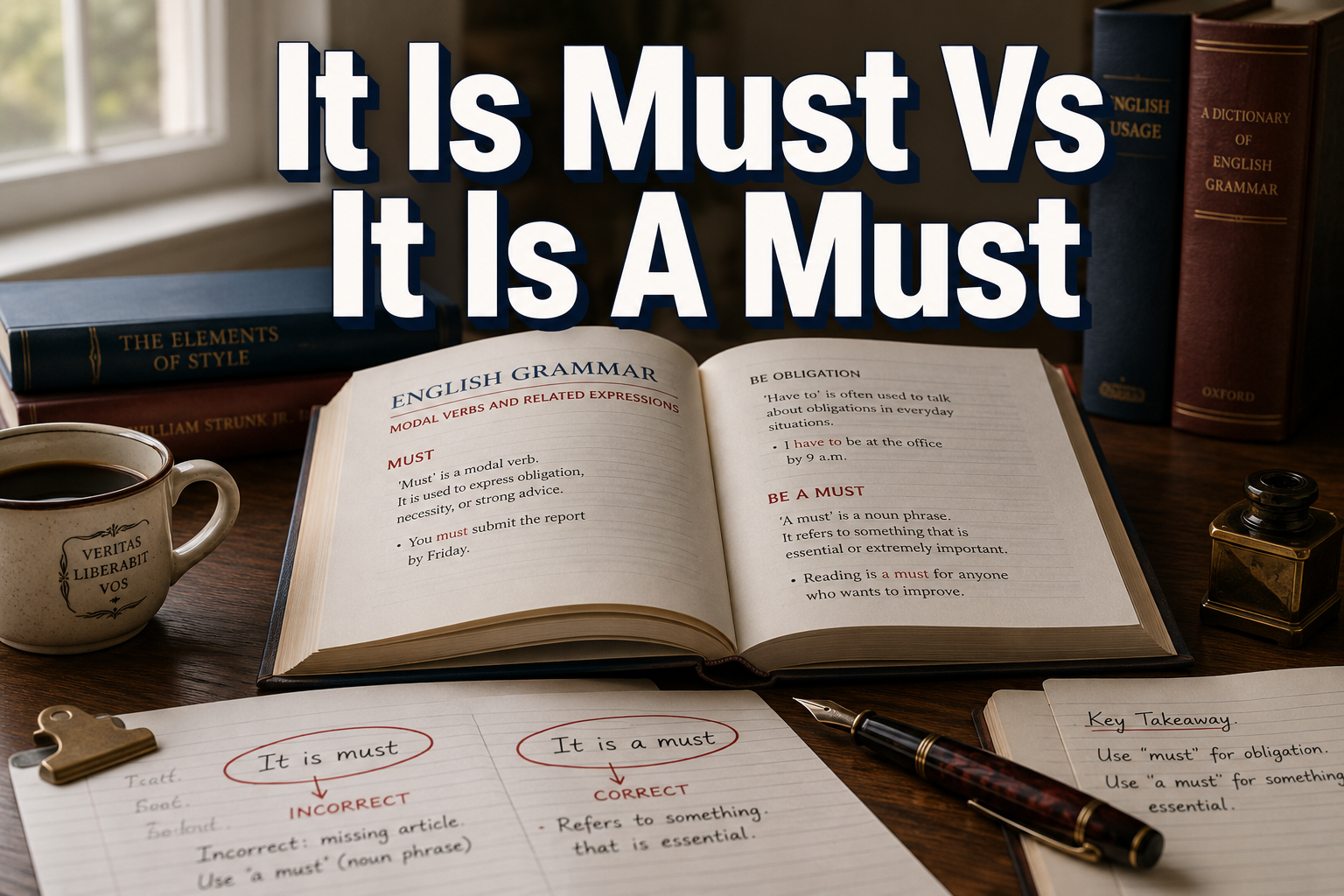
“It is a must” is grammatically correct. “It is must” is incorrect in standard English. The word “must” works as a noun here, meaning something necessary or essential, so it needs the article “a” before it. Native English speakers always say “it is a must” when something is required or highly recommended.
Key Takeaways
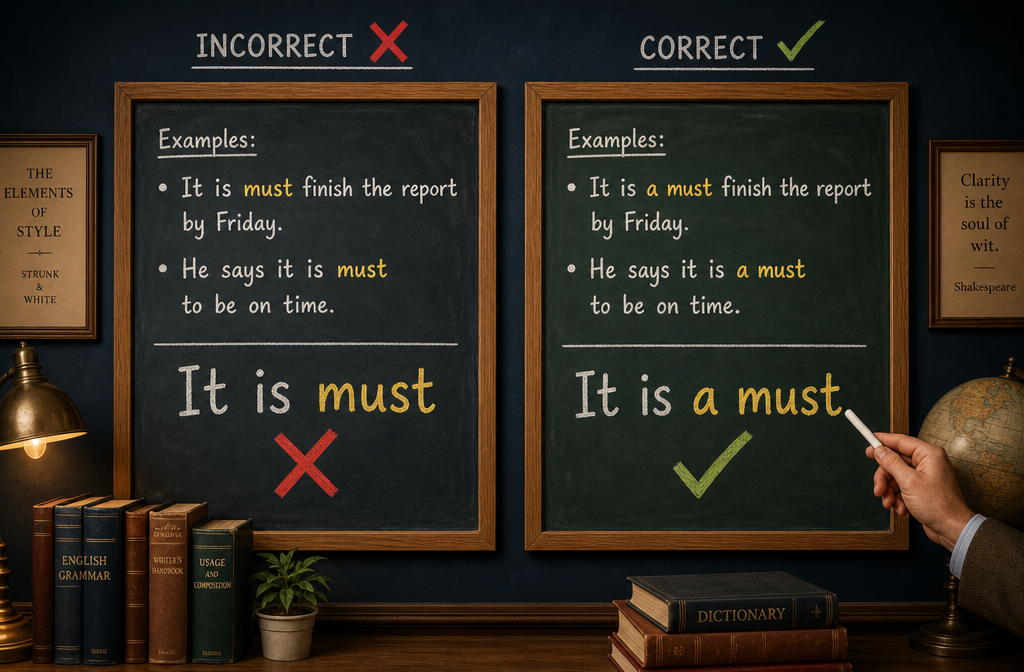
- “It is a must” is correct; “it is must” is grammatically wrong.
- “Must” acts as a countable noun in this phrase, meaning a necessity.
- English requires an article (“a”) before singular countable nouns.
- Native speakers use “it is a must” in casual and formal speech.
- Alternatives include “essential,” “required,” and “a necessity.”
- Dropping the “a” sounds unnatural and confuses meaning.
- The phrase appears in reviews, travel tips, advice, and recommendations.
- Even ESL learners often mix this up, but the fix is simple: always add “a.”
What’s the Difference Between “It Is Must” and “It Is A Must”?
The difference is one tiny but important word: the article “a.” “It is a must” follows standard English grammar rules. “It is must” skips the article and breaks the rule that says singular countable nouns need one.
Here’s the breakdown:
| Phrase | Correct? | Why |
|---|---|---|
| It is a must | Yes | “Must” is a noun; needs article “a” |
| It is must | No | Missing required article before noun |
| It’s a must-have | Yes | Common compound noun form |
| This is must | No | Same article-missing error |
When you say something “is a must,” you’re calling it a necessity. That’s a noun. Nouns like “necessity,” “rule,” or “requirement” all need an article too. You’d say “it is a rule,” not “it is rule.”
Is It Grammatically Correct to Say “It Is Must”?
No. “It is must” is not grammatically correct in standard English. The sentence is missing the indefinite article “a,” which is required before a singular countable noun like “must.”
The word “must” usually works as a modal verb (as in “you must go”). But in the phrase “it is a must,” it switches roles and becomes a noun. Once it’s a noun, English grammar demands an article before it.
Common mistake: ESL learners often drop articles because many languages don’t use them. In English, this small word changes everything.
When Should I Use “It Is A Must”?
Use “it is a must” when you want to stress that something is absolutely necessary, required, or strongly recommended. It works in both casual chats and formal writing.
Good times to use it:
- Travel tips: “Visiting the Eiffel Tower at night is a must.”
- Product reviews: “This skincare serum is a must.”
- Workplace advice: “Clear communication is a must for team success.”
- Cooking: “Fresh basil is a must in this pasta recipe.”
Decision rule: If you can replace the phrase with “is essential” or “is a necessity” and the sentence still makes sense, “it is a must” fits perfectly.
Common Mistakes With “It Is Must” Vs “It Is A Must”
The most common mistake is dropping the “a.” Here’s a quick rundown of errors I see in writing and speech:
- Skipping the article: “Sunscreen is must in summer.” (Wrong) Should be: “Sunscreen is a must in summer.”
- Adding “the” instead: “Exercise is the must.” (Wrong) “The” doesn’t fit here because “a must” refers to one example of a necessity, not a specific one.
- Using it as a verb: “You must a thing.” (Wrong) “Must” as a verb doesn’t take “a.”
- Plural confusion: “These are musts.” (Acceptable in casual use but rare.)
If English isn’t your first language, this trips you up fast. The fix is simple: whenever “must” feels like a thing rather than an action, put “a” before it.
Examples of Correct Usage for “It Is A Must”
Real-world examples make grammar stick. Here are sentences across different contexts:
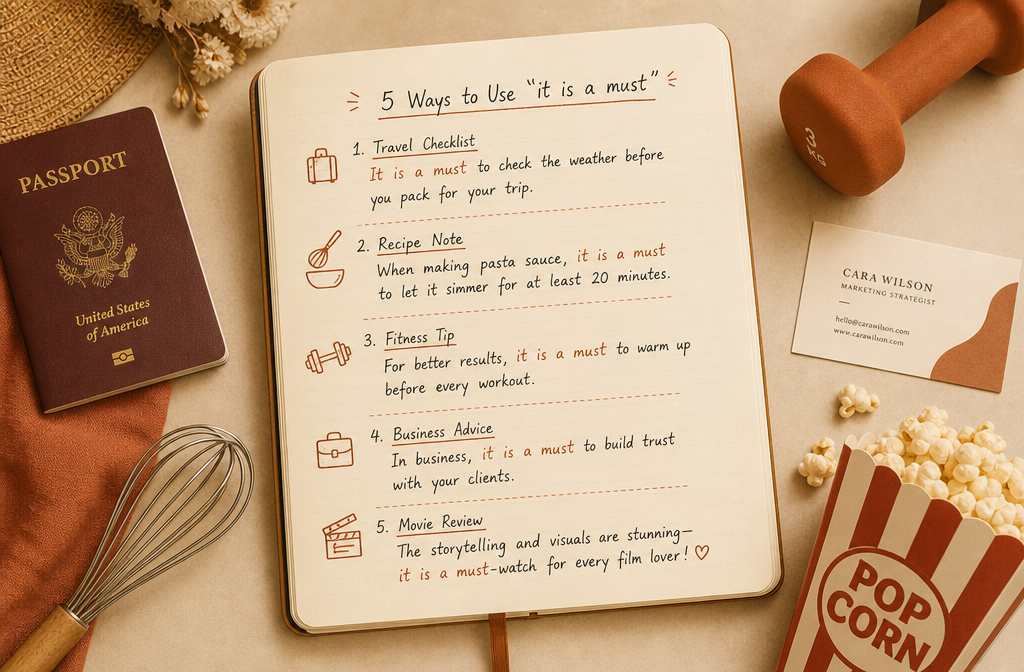
- Travel: “If you’re in Tokyo, trying authentic ramen is a must.”
- Fitness: “Warming up before a workout is a must.”
- Business: “A solid contract is a must before signing any deal.”
- Tech: “Two-factor authentication is a must for online accounts.”
- Food: “Lemon zest is a must in this cake.”
- Reading: “This novel is a must for thriller fans.”
- Parenting: “Patience is a must when raising toddlers.”
Each example treats “must” as a noun, paired with “a” to follow grammar rules.
Why Do People Say “It Is A Must”?
People say “it is a must” because it’s a quick, punchy way to label something as essential. It packs the same meaning as “absolutely necessary” into fewer words. English speakers love compact expressions, and this one delivers.
The phrase also feels warmer than formal alternatives. Saying “exercise is a must” sounds friendly and direct. Saying “exercise is mandatory” sounds stiff or official.
It shows up everywhere because:
- It’s short and easy to say.
- It works in casual and semi-formal contexts.
- It adds light emphasis without sounding pushy.
- It fits naturally in lists, reviews, and tips.
Is “It Is Must” Ever Acceptable in English?
No, “it is must” is not acceptable in standard written or spoken English. You won’t find it in dictionaries, style guides, or professional writing. Some non-native speakers use it because of how their first language handles articles, but it’s still considered an error.
The only exception might be poetic or stylized writing where rules bend on purpose. Even then, it sounds off to native ears. If you’re writing for school, work, or any public audience, stick with “it is a must.”
How Do Native Speakers Use “It Is A Must”?
Native English speakers use “it is a must” casually and often, especially in reviews, recommendations, and advice. It rolls off the tongue and signals strong endorsement without sounding too serious.
You’ll hear it in:
- Conversations: “Oh, that bakery? Their croissants are a must.”
- YouTube reviews: “This camera is a must for beginners.”
- Blog headlines: “10 Apps That Are a Must for Remote Workers.”
- Travel guides: “Booking tickets early is a must.”
The phrase also pairs well with hyphenated forms like “must-have,” “must-see,” and “must-try.” These are compound nouns that follow the same rule. “This movie is a must-see” works because “must-see” is one noun, paired with “a.”
Grammar Rules for “It Is A Must”
Three simple grammar rules explain why “it is a must” works:
- Articles before singular countable nouns: English requires “a” or “an” before singular countable nouns. “Must,” when used as a noun here, is countable.
- “A” vs “an”: Use “a” before words starting with a consonant sound. “Must” starts with the “m” sound, so “a must” is correct.
- Noun forms of modal verbs: Some modal verbs (must, do, don’t) get used as nouns in casual English. When that happens, they follow normal noun rules and need articles.
Quick test: Can you say “a must”? Yes. Can you say “the must”? Rarely, and only in specific contexts. Can you skip the article? No.
Alternatives to Saying “It Is A Must”
If you want variety in your writing, here are solid alternatives that carry the same meaning:

- It’s essential — slightly more formal
- It’s required — strong, used in rules and policies
- It’s a necessity — formal and clear
- It’s non-negotiable — emphatic, no flexibility
- You can’t skip it — casual and direct
- It’s a top priority — emphasizes importance
- It’s a no-brainer — casual, suggests obvious choice
- It’s crucial — strong and clear
Smart recommendation: Mix these into your writing to avoid repeating “it is a must” too often. Variety keeps content fresh and engaging.
Does “It Is Must” Mean Something Different?
No, “it is must” doesn’t carry a different meaning. It’s simply the incorrect version of “it is a must.” There’s no special use case, dialect, or context where dropping the “a” changes meaning. It just sounds wrong.
Some learners think it might be a shortened or informal version, but that’s not how English works. Native speakers wouldn’t say it even in the most casual chats. The article “a” is needed every time.
English Language Usage of “It Is A Must”
In modern English, “it is a must” is widely used in informal, semi-formal, and even some formal writing. It appears in newspapers, blogs, product descriptions, and conversation. Style guides accept it as standard phrasing.
The phrase has been in steady use for over a century. According to general English language references, the noun form of “must” dates back to the 1800s, originally meaning “something that must be done.” It stuck around because it’s useful and concise.
In SEO content and online writing, “it is a must” boosts emphasis without sounding overly dramatic. That’s why bloggers, reviewers, and marketers love it.
Why Is “It Is A Must” Considered Correct?
“It is a must” is correct because it follows the core grammar rule that singular countable nouns need an article. “Must” works as a noun here, so it takes “a.” That’s all the rule says, and the phrase obeys it cleanly.
The phrase has also been validated by decades of native speaker use, dictionary entries, and editorial style guides. When millions of people use a phrase consistently and grammar rules support it, it earns its place in standard English.
FAQ
Is “it is a must” formal or informal?
It works in both. It’s casual enough for chats and acceptable in most professional writing, though formal documents may prefer “essential” or “required.”
Can I say “these are musts”?
Yes, but it’s rare. “These are must-haves” sounds more natural.
Is “must-have” the same as “a must”?
Close, but “must-have” is usually a noun describing a product or item, while “a must” describes any necessity.
Why do some people write “it is must”?
Usually it’s a mistake by ESL learners whose native language doesn’t use articles.
Can “must” be a noun?
Yes. In phrases like “a must” or “must-see,” it acts as a noun meaning a requirement or necessity.
Is “it’s a must” correct?
Yes. “It’s” is just the contraction of “it is.” Both forms are correct.
What’s the opposite of “it is a must”?
Phrases like “it’s optional,” “it’s a nice-to-have,” or “it’s not required.”
Can I start a sentence with “A must”?
Yes, especially in lists or headlines: “A must for every traveler: travel insurance.”
Conclusion
“It is a must” wins every time. The phrase follows clear grammar rules, sounds natural to native speakers, and works in tons of everyday situations. “It is must” simply skips a required article and breaks the rule.
- Always add “a” before “must” when using it as a noun.
- Practice with the examples above in your own writing.
- Use alternatives like “essential” or “non-negotiable” for variety.
- Read your sentences out loud; if it sounds off, check for missing articles.
Small grammar fixes like this one make your English sharper, clearer, and more professional. Master “it is a must,” and you’ll sound like a native speaker in writing and conversation.