
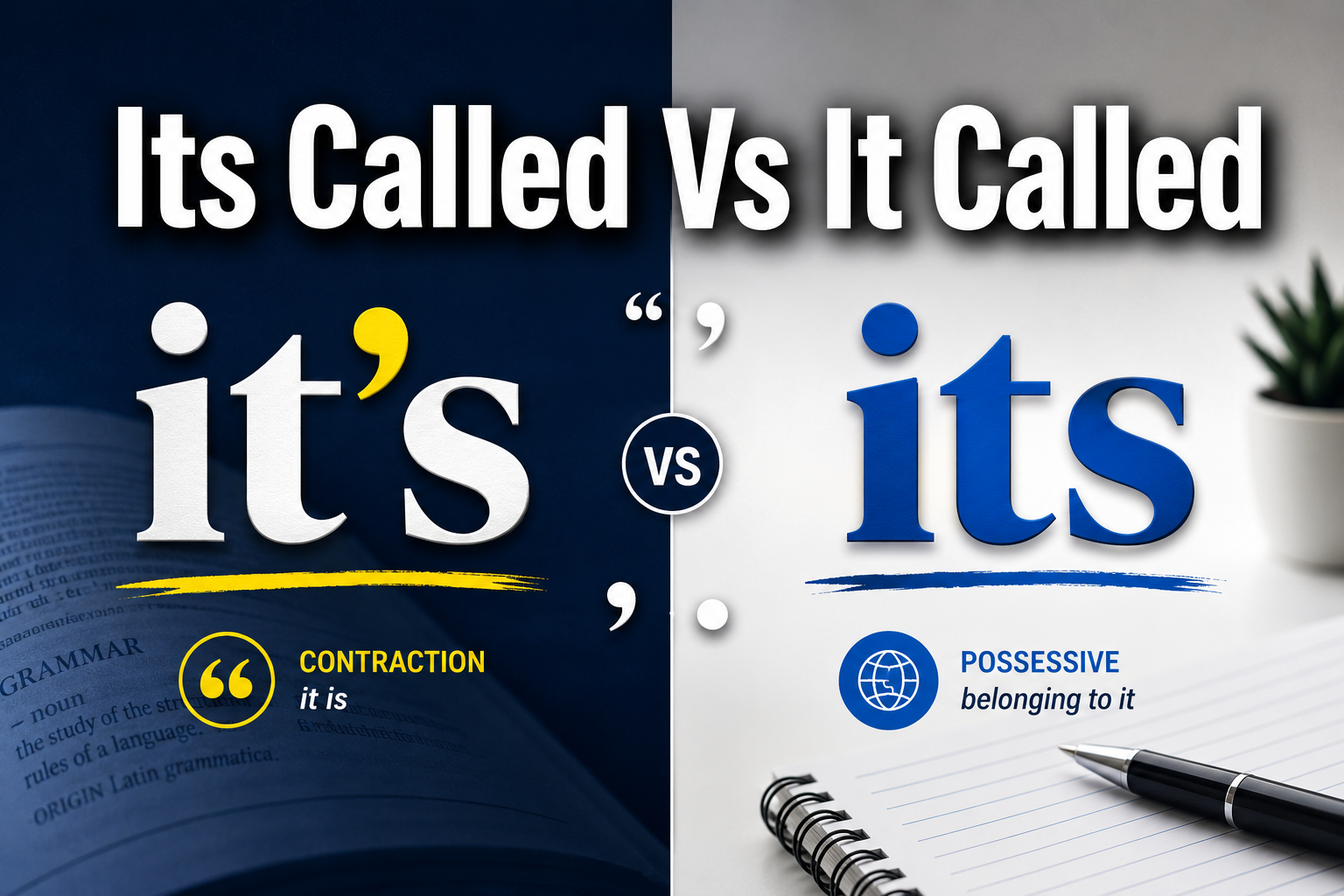
Its Called Vs It Called “It’s called” is the correct phrase when naming or identifying something, because “it’s” is a contraction of “it is.” For example, “It’s called a smartphone” means “It is called a smartphone.” The phrase “it called” is grammatically different it’s the past tense form used when describing an action that “it” performed, like “It called for help.” Understanding the difference between these two phrases comes down to recognizing contractions and verb tenses.
Key Takeaways
- “It’s called” is a contraction of “it is called” and is used to name or identify something
- “It called” is the past tense of “it calls” and describes an action performed in the past
- The apostrophe in “it’s” always indicates a contraction, never possession
- “Its called” (without the apostrophe) is grammatically incorrect and should never be used
- A simple test: replace “it’s” with “it is” if the sentence makes sense, you’re using it correctly
- Most grammar mistakes with its and it’s happen because people confuse contractions with possessives
- Native English speakers struggle with this distinction more than you might think
- Memory tricks and replacement tests make it easier to choose the right form every time
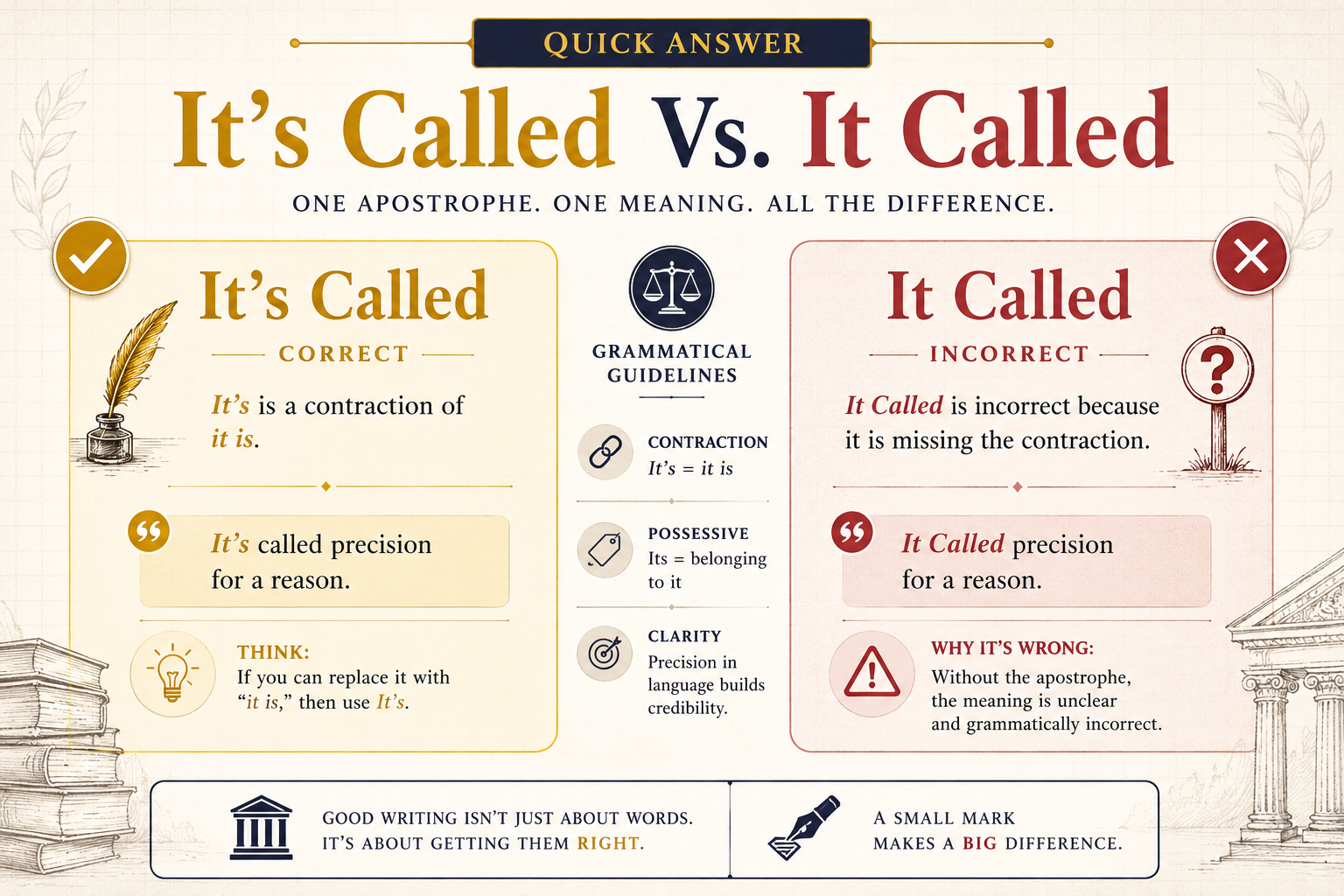
What Does It’s Called Mean Vs Its Called
“It’s called” means “it is called” and is the proper way to introduce or name something. The apostrophe in “it’s” signals that two words have been combined into one. When you say “It’s called minimalism,” you’re literally saying “It is called minimalism.” This phrase appears constantly in everyday conversation when explaining what something is named or how it’s identified.
“Its called” (without an apostrophe) is incorrect because “its” is a possessive pronoun that shows ownership, like “The dog wagged its tail.” Combining the possessive “its” with the verb “called” creates a nonsensical phrase that doesn’t follow English grammar rules.
Here’s the breakdown:
- It’s called = It is called (correct for naming things)
- Its called = Possessive + verb (grammatically incorrect)
- It called = Past tense action (correct but different meaning)
The confusion happens because most possessives in English use an apostrophe (like “the cat’s toy”), but “its” is an exception. Think of it like other possessive pronouns: you don’t write “hi’s” for “his” or “her’s” for “hers,” so you don’t write “it’s” for possession either.
When Do I Use Its Vs It’s in a Sentence
Use “it’s” when you can replace it with “it is” or “it has.” Use “its” when showing that something belongs to or is part of “it.” This simple replacement test works every single time and takes just seconds to apply.
Use “it’s” (with apostrophe) when:
- Saying “it is”: “It’s raining outside” (It is raining outside)
- Saying “it has”: “It’s been a long day” (It has been a long day)
- Introducing or naming something: “It’s called a tablet”
- Making a contraction in casual writing or speech
Use “its” (without apostrophe) when:
- Showing possession: “The bird built its nest”
- Describing a characteristic: “The company changed its policy”
- Referring to something belonging to “it”: “The phone lost its charge”
A common mistake is thinking “its” needs an apostrophe because other possessives do. But “its” follows the same pattern as “his,” “hers,” and “theirs”—none of which use apostrophes. If you’re naming or identifying something, you almost always want “it’s called” with the contraction.
For more guidance on tricky grammar distinctions, check out our complete guide to common grammar confusions.
Common Grammar Mistakes With Its and It’s
The most frequent error is using “its” when you mean “it’s,” especially when naming something. People write “Its called a revolution” when they should write “It’s called a revolution.” This happens because the brain sees “its” and assumes it’s correct without testing whether a contraction is needed.
Top mistakes people make:
- Writing “its” when naming things: “Its called the Northern Lights” (wrong) vs. “It’s called the Northern Lights” (correct)
- Adding an apostrophe to show possession: “The cat licked it’s paw” (wrong) vs. “The cat licked its paw” (correct)
- Mixing up “it called” with “it’s called”: Using past tense when they mean present identification
- Overcorrecting after learning the rule: Some people avoid “it’s” entirely, even when it’s correct
- Using “its” in contractions: Writing “its been a while” instead of “it’s been a while”
These mistakes appear in professional emails, social media posts, and even published content. According to grammar experts, the its/it’s confusion ranks among the top three most common English grammar errors. The mistake persists because both words sound identical when spoken, so spell-check won’t always catch the error.
Choose “it’s called” when you’re naming or identifying. Choose “its” when something owns or possesses something else. When in doubt, say the sentence out loud with “it is” in place of “it’s”—if it sounds wrong, you probably need “its” instead.
How to Remember the Difference Between Its and It’s
The easiest memory trick is the replacement test: substitute “it is” or “it has” for “it’s.” If the sentence still makes sense, use the apostrophe. If it doesn’t make sense, use “its” without the apostrophe.
Proven memory tricks that work:
- The apostrophe shows missing letters: “It’s” = “it i[s]” (the apostrophe replaces the missing letter)
- Possessive pronouns never have apostrophes: Just like his, hers, yours, theirs and its follows the same rule
- If you can say “it is,” write “it’s”: This works 100% of the time for contractions
- Think of “its” like “his”: You wouldn’t write “hi’s book,” so don’t write “it’s tail”
Another helpful approach is to remember that “it’s” always means something temporary or descriptive (“It’s raining,” “It’s called Tuesday”), while “its” describes something that belongs or is attached (“its color,” “its name,” “its purpose”).
For language learners, creating flashcards with example sentences helps build muscle memory. Write “It’s called a bicycle” on one card and “The bicycle lost its wheel” on another. Practice until the distinction becomes automatic.
If you’re interested in how language and meaning work together, explore our article on understanding slang meanings to see how context shapes word usage.
Examples of Correct Usage for Its and It’s
Seeing the difference in action makes it click. Here are real-world examples that show exactly when to use each form.
Correct uses of “it’s called”:
- “It’s called a smartphone because it does more than make calls.”
- “The technique is effective—it’s called positive reinforcement.”
- “Have you tried that new app? It’s called Duolingo.”
- “The condition has a medical name; it’s called tinnitus.”
Correct uses of “it called” (past tense):
- “The bird sat on the branch and it called to its mate.”
- “The phone rang, but by the time I answered, it called off.”
- “The company issued a statement, and it called for immediate action.”
Correct uses of “its” (possessive):
- “The restaurant is known for its amazing desserts.”
- “The dog wagged its tail when I came home.”
- “The organization announced its new policy yesterday.”
- “Every company has its own culture and values.”
Common incorrect examples to avoid:
- Wrong: “Its called a metaphor.” Right: “It’s called a metaphor.”
- Wrong: “The car lost it’s tire.” Right: “The car lost its tire.”
- Wrong: “It’s color is blue.” Right: “Its color is blue.”
- Wrong: “Its been three years.” Right: “It’s been three years.”
Notice how “it’s called” appears when you’re introducing or naming something specific. The phrase works as a bridge between an idea and its label. Meanwhile, “its” always connects directly to a noun, showing what belongs to that thing.
Why Do People Mix Up Its and It’s So Often
People confuse these words because they sound identical when spoken, and the apostrophe rule for “its” contradicts what we learn about possessives. In English, we add apostrophes to show possession (like “Sarah’s book” or “the dog’s collar”), so it feels natural to write “it’s” for possession too. But “its” is a possessive pronoun, which follows different rules—no apostrophe needed.
Main reasons for the confusion:
- Sound identical: When speaking, there’s no difference, so people don’t practice the distinction
- Apostrophe expectations: We’re taught that apostrophes show ownership, creating false instincts
- Autocorrect interference: Phone keyboards often “fix” the correct form to the wrong one
- Reading without attention: We recognize words by shape, not by checking every apostrophe
- Inconsistent exposure: Not everyone receives clear grammar instruction on this specific rule
The mistake also happens because “it’s” appears more frequently in casual writing, so people default to the apostrophe version. When typing quickly, the brain doesn’t always pause to run the replacement test. This is why even professional writers sometimes slip up—it’s not about intelligence, it’s about automatic processing.
Research on language errors shows that native speakers make this mistake more often than advanced English learners because natives rely on instinct rather than conscious rule-checking. Learners who study grammar explicitly often perform better on its/it’s distinctions because they’ve practiced the replacement test repeatedly.
Is It’s Called Grammatically Correct
Yes, “it’s called” is completely grammatically correct. It’s the standard way to introduce or name something in English. The phrase combines the contraction “it’s” (meaning “it is”) with the past participle “called” to create a passive construction that identifies what something is named.
The structure breaks down like this: Subject (it) + verb (is) + past participle (called) + complement (the name). For example, “It’s called a revolution” means “It is called a revolution”—the thing in question has been given the name “revolution.”
When “it’s called” is appropriate:
- Introducing terminology: “It’s called machine learning.”
- Explaining names: “The building? It’s called the Chrysler Building.”
- Defining concepts: “It’s called cognitive dissonance.”
- Casual identification: “It’s called being prepared.”
Formal alternatives:
In formal or academic writing, you might avoid contractions and write “it is called” instead. Both are grammatically correct, but “it is called” sounds more formal and authoritative. For example, a research paper might say, “This phenomenon is called the placebo effect” rather than “It’s called the placebo effect.”
The phrase appears across all types of English writing—from text messages to business communications to published articles. It’s one of the most natural ways to label or identify something in conversation. The only time it’s wrong is when you forget the apostrophe and write “its called,” which creates a grammatical error.
For more examples of how meaning and usage intersect, see our guide on common phrase meanings.
What Are the Most Common Errors With Possessive Its
The biggest error with possessive “its” is adding an apostrophe when none is needed. People write “it’s tail” or “it’s color” when they mean “its tail” and “its color.” This happens because the possessive apostrophe rule (like “the cat’s toy”) is so ingrained that people apply it everywhere—even where it doesn’t belong.
Most frequent possessive “its” mistakes:
- Adding an apostrophe: “The company changed it’s policy” (wrong) should be “its policy”
- Using “it is” by accident: “The dog wagged it is tail” happens when someone expands “it’s” incorrectly
- Avoiding “its” entirely: Some people write awkward sentences to dodge the decision
- Confusing “its” with “their”: Mixing up singular and plural possessives
- Hypercorrection: Changing correct “its” to “it’s” after being told about the rule
Another common error is using “its” when you actually need “it’s called.” For example, writing “Its called a mistake” instead of “It’s called a mistake.” This happens when people remember that possessives don’t use apostrophes but forget to check whether they’re actually showing possession.
Quick decision tree:
- Can you replace it with “it is” or “it has”? Use it’s
- Does something belong to “it”? Use its
- Are you naming or identifying something? Use it’s called
- Are you describing past action? Use it called
The possessive “its” never takes an apostrophe. Period. If you remember nothing else, remember that rule. When you see “it’s,” you should be able to say “it is” or “it has” in its place.
Do Native English Speakers Struggle With Its and It’s
Yes, native English speakers struggle with this distinction constantly. It’s one of the most common errors in English writing, appearing in everything from social media posts to professional emails to published articles. The mistake persists because native speakers learn language by ear first, and “its” and “it’s” sound identical.
Studies on written English errors consistently rank the its/it’s confusion among the top grammar mistakes made by native speakers. Unlike non-native learners who study grammar rules explicitly, native speakers often rely on instinct—and that instinct fails when two words sound the same but are spelled differently.
Why native speakers make this mistake:
- Learned by sound: Native speakers acquire language through listening, not through rules
- Autocorrect dependency: Spell-check doesn’t always catch the error because both words are valid
- Speed over accuracy: When typing quickly, people don’t pause to verify apostrophes
- Rule confusion: The possessive apostrophe rule conflicts with the “its” exception
- Low stakes: In casual writing, people don’t carefully proofread
Interestingly, educated native speakers often make this error more frequently in informal contexts (texts, emails, social media) than in formal writing (reports, essays, publications). This suggests the mistake comes from speed and casualness rather than lack of knowledge. When people slow down and proofread, they usually catch and fix the error.
Non-native speakers who learn English through formal study often outperform native speakers on this particular rule because they’ve practiced the replacement test and learned the exception explicitly. For native speakers, fixing the habit requires conscious attention and repeated practice.
How Do Language Learning Apps Teach Its Vs It’s
Language learning apps teach the its/it’s distinction through pattern recognition, replacement tests, and repeated practice with immediate feedback. Most apps use a combination of explanation, examples, and exercises to build understanding.
Common teaching methods in apps:
- Replacement test drills: Users practice substituting “it is” to check if “it’s” is correct
- Fill-in-the-blank exercises: Sentences with missing words force active decision-making
- Error correction: Users identify and fix mistakes in sample sentences
- Contextual examples: Real-world sentences show proper usage in context
- Spaced repetition: The rule appears multiple times over weeks to build retention
- Visual cues: Color coding or highlighting shows the difference between forms
Apps like Duolingo, Grammarly, and Babbel emphasize the apostrophe-as-contraction rule and teach “its” as a possessive pronoun exception. They typically introduce the concept early in grammar instruction because it’s so fundamental to clear writing.
The most effective apps provide instant feedback when users make mistakes. If you choose “its” when you should choose “it’s,” the app immediately shows why you’re wrong and offers the replacement test as a tool. This real-time correction helps build the right habits faster than traditional classroom instruction.
Many apps also include audio examples so learners hear that both words sound identical. This reinforces that the distinction exists only in writing, which helps explain why the error is so common even among native speakers.
For those learning English or improving their grammar, these apps offer a low-pressure way to practice until the distinction becomes automatic. The key is consistent practice—checking your work, running the replacement test, and paying attention to feedback.
Learn more about how language evolves and changes in our article on Gen Z slang.
Are There Any Tricks to Remember Its Vs It’s
Yes, several memory tricks make the its/it’s choice easier. The most reliable is the replacement test, but other mnemonic devices help too.
Best memory tricks:
- The replacement test: Swap in “it is” or “it has”—if it works, use “it’s”
- Apostrophe = missing letters: The apostrophe in “it’s” shows where letters were removed
- Possessive pronouns have no apostrophes: His, hers, yours, theirs, its—none use apostrophes
- If you can say “it is called,” write “it’s called”: This specifically helps with naming phrases
- “Its” rhymes with “his”: Both are possessive, neither has an apostrophe
Another helpful trick is to remember that contractions always have apostrophes (can’t, won’t, it’s), while possessive pronouns never do (my, your, his, her, its, our, their). This creates two clear categories with no overlap.
Physical reminder method:
Some people use a physical gesture—touching their thumb and index finger together when they say “it is”—to create a muscle memory connection. When writing, they repeat the gesture to trigger the replacement test.
Sentence templates:
Create template sentences you can reference:
- “It’s called [name]” for naming things
- “The [thing] lost its [part]” for possession
The trick that works best varies by person. Try several methods and stick with whichever one clicks for you. The goal is to make the decision automatic so you don’t have to consciously think through the rule every single time.
For more insights into language patterns and meanings, explore our article on understanding surname meanings.
What Do English Teachers Say About Its and It’s
English teachers consistently emphasize that the its/it’s distinction is one of the most important grammar rules to master because the error is so visible and common. Teachers stress the replacement test as the most reliable method and encourage students to proofread specifically for this mistake.
What teachers recommend:
- Always run the replacement test: Before submitting any writing, check every instance
- Slow down when typing: The mistake usually happens during fast, unthinking writing
- Read your work aloud: Hearing “it is” in place of “it’s” helps catch errors
- Create personal reminders: Sticky notes, phone alerts, or margin notes in notebooks
- Practice with intention: Don’t just read the rule—actively practice applying it
Teachers also point out that this error undermines credibility. In professional and academic contexts, confusing “its” and “it’s” signals carelessness or lack of attention to detail. While everyone makes occasional typos, repeated its/it’s errors create a negative impression.
Many teachers assign specific exercises focused solely on this distinction—worksheets with dozens of sentences requiring the correct choice. Repetition builds the habit until checking becomes automatic. Some teachers require students to highlight every “its” and “it’s” in their drafts and verify each one before final submission.
The consensus among English educators is that this rule is simple in theory but requires conscious practice to apply consistently. It’s not about intelligence—it’s about building a habit of checking. Teachers encourage students to be patient with themselves while developing that habit.
For additional grammar guidance, check out our article comparing It Is Must Vs It Is A Must.
Frequently Asked Questions
Is “its called” ever correct?
No, “its called” is never correct. The phrase should always be “it’s called” (with an apostrophe) because you’re saying “it is called.” The possessive “its” doesn’t make sense with the verb “called.”
Can I use “it called” instead of “it’s called”?
No, these mean different things. “It called” is past tense (describing an action), while “it’s called” is present tense (naming something). Use “it’s called” when identifying or naming.
How do I know if I need an apostrophe?
Replace the word with “it is” or “it has.” If the sentence still makes sense, use the apostrophe (it’s). If not, use “its” without an apostrophe.
Why doesn’t “its” have an apostrophe for possession?
Because “its” is a possessive pronoun, like “his,” “hers,” and “theirs.” Possessive pronouns never use apostrophes in English.
Is “it’s called” too casual for formal writing?
The contraction “it’s” is slightly casual. In very formal writing, use “it is called” instead. Both are grammatically correct.
What’s the most common mistake with these words?
The most common mistake is writing “its” when you mean “it’s,” especially in phrases like “its called” (wrong) instead of “it’s called” (correct).
Do grammar checkers catch its/it’s errors?
Sometimes, but not always. Both words are spelled correctly, so spell-check won’t flag them. Grammar checkers like Grammarly are better at catching context errors.
How long does it take to master this rule?
With conscious practice and the replacement test, most people can master the distinction in a few weeks. The key is checking your work consistently until it becomes automatic.
Are there regional differences in how people use its and it’s?
No, the rule is the same across all English-speaking regions. The confusion happens equally in American, British, Australian, and other English variants.
Can “it’s” mean “it has”?
Yes, “it’s” can be a contraction of “it has,” as in “It’s been a long day” (It has been a long day). The replacement test still works.
What should I do if I’m still confused?
Use the replacement test every single time. Say “it is” or “it has” in place of “it’s” if it sounds right, use the apostrophe. If not, use “its.”
Is this mistake really that important?
Yes, in professional and academic writing, this error is highly visible and can hurt your credibility. It’s worth taking the time to get it right.
Conclusion
The difference between “its called” and “it’s called” comes down to one simple rule: use “it’s called” when naming or identifying something because “it’s” means “it is.” The phrase “its called” is grammatically incorrect because “its” is a possessive pronoun that doesn’t work with the verb “called.” Meanwhile, “it called” is a separate phrase entirely, used for past-tense actions.
The replacement test is your best tool—substitute “it is” for “it’s,” and if the sentence makes sense, you’ve got it right. Remember that possessive pronouns (his, hers, its) never use apostrophes, while contractions (it’s, can’t, won’t) always do.
This distinction matters because the error is common and visible. In professional writing, academic work, and public communication, confusing “its” and “it’s” signals carelessness. But with conscious practice and the replacement test, you can eliminate this mistake from your writing completely.
Start checking your work today. Every time you write “its” or “it’s,” pause for two seconds and run the test. Say “it is” in your head—does it work? If yes, add the apostrophe. If no, leave it off. With consistent practice, the choice will become automatic, and you’ll never have to think twice about whether to write “it’s called” or “its called” again.
For more grammar guidance and language insights, explore our complete grammar resource section.