
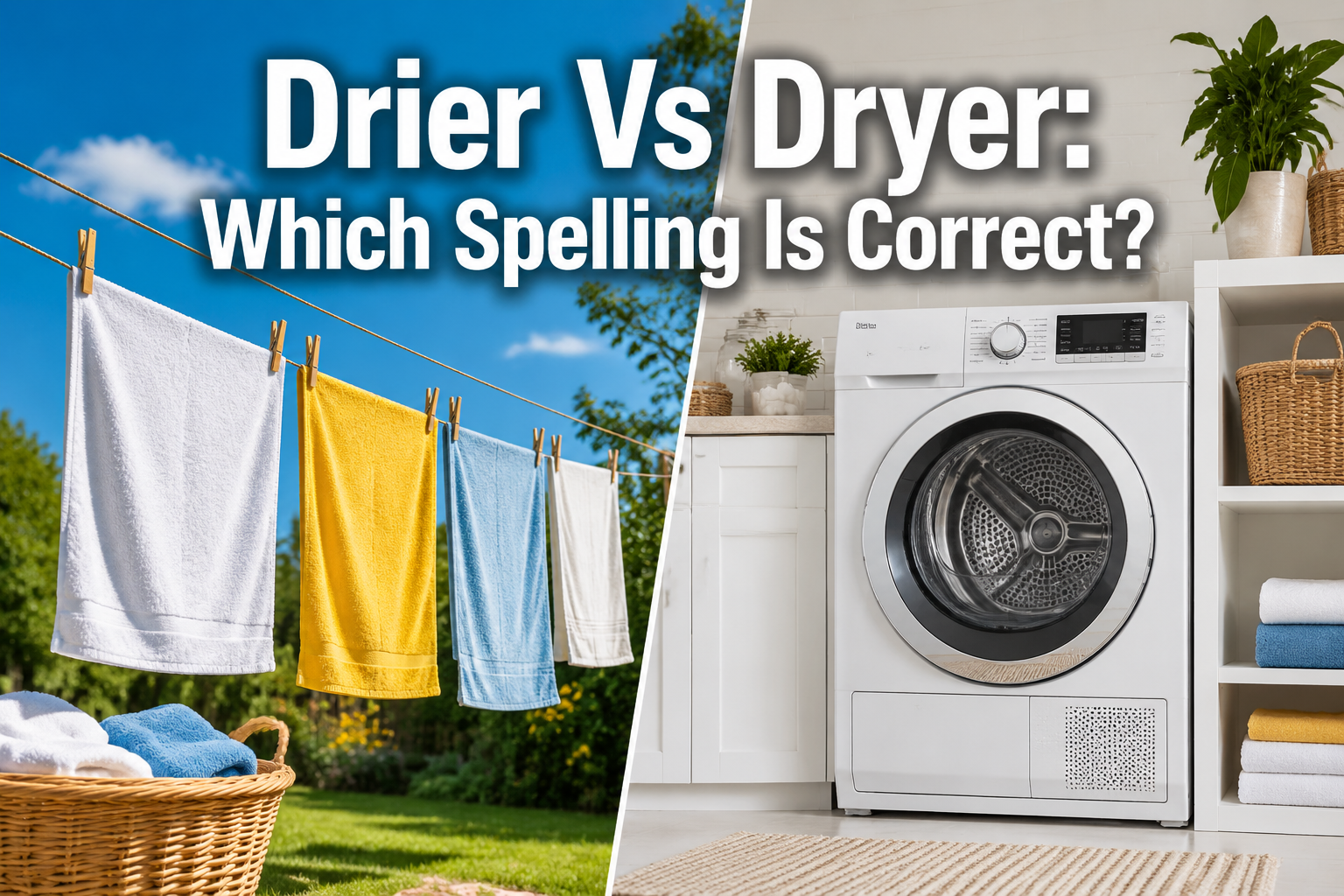
Drier and dryer are two different words with different jobs. “Dryer” is the noun for a machine that dries clothes. “Drier” is the comparative adjective meaning “more dry.” Knowing the difference between drier vs dryer keeps your writing clear and correct.
Key Takeaways
- “Dryer” always refers to an appliance, like a clothes dryer or hair dryer.
- “Drier” means more dry, as in “the air is drier today than yesterday.”
- The two words are not interchangeable, even though they sound the same.
- Most spelling errors happen when people write “drier” instead of “dryer” for the machine.
- In scientific writing, “drier” describes conditions with less moisture.
- Standard electric dryers cost between $400 and $1,000 on average (as of 2026).
- Energy-efficient dryers with the ENERGY STAR label can cut energy use by up to 20% compared to standard models (U.S. Department of Energy).
- Air drying is a free alternative to machine drying and works well for many fabric types.
What Is the Difference Between Drier and Dryer?
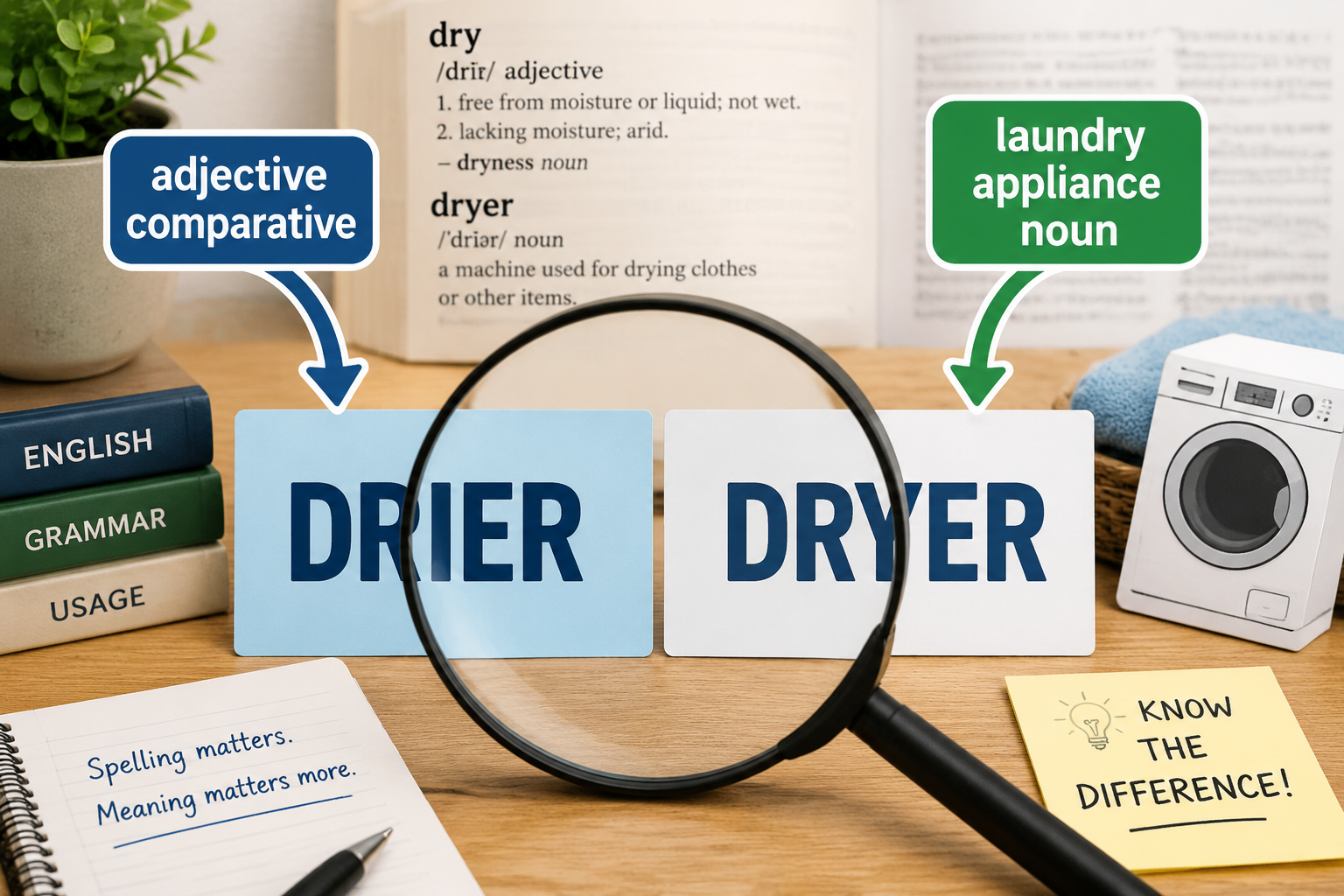
“Drier” and “dryer” sound exactly the same but mean completely different things. “Dryer” is a noun — it names a machine. “Drier” is an adjective — it compares levels of dryness.
Here is a simple breakdown:
| Word | Part of Speech | Example Sentence |
|---|---|---|
| Dryer | Noun (appliance) | “Put the clothes in the dryer.” |
| Drier | Comparative adjective | “The desert is drier than the coast.” |
| Drier | Also used as a noun in chemistry | “Add a drier to speed up paint curing.” |
The confusion happens because both words come from the word “dry.” But English gave them separate roles, and mixing them up is a common grammar mistake.
For more help with tricky grammar comparisons like this one, check out this guide on correct grammar usage and also Mine As Well or Might As Well for similar word-choice questions.
How Do You Spell Drier or Dryer Correctly?
The correct spelling depends on what you mean. If you are talking about a machine, spell it “dryer.” If you are comparing how dry something is, spell it “drier.”
A quick trick: if you can replace the word with “more dry,” use “drier.” If you are talking about a physical object, use “dryer.”
- “The towel feels drier after an hour in the sun.” (more dry = drier)
- “The dryer stopped working this morning.” (machine = dryer)
Some older style guides accepted “drier” as an alternate spelling for the appliance, but modern usage strongly favors “dryer” for the machine. Major dictionaries including Merriam-Webster list “dryer” as the standard noun form.
Are Drier and Dryer the Same Word?
No, they are not the same word, even though they are pronounced identically. They are homophones — words that sound alike but have different meanings and spellings.
Think of them like “their,” “there,” and “they’re.” Same sound, very different meaning. Using the wrong one does not change how your sentence sounds out loud, but it does affect how it reads on the page.
Which Is the Right Term for a Laundry Machine?
“Dryer” is always the correct spelling for a laundry machine. This applies to all types: electric dryers, gas dryers, condenser dryers, and heat pump dryers.
You will see “dryer” on product labels, appliance store websites, and manufacturer manuals. Writing “drier” when you mean the laundry machine is a spelling error, even though some older texts used it that way.
Can Drier Be Used as an Adjective?
Yes, “drier” is the correct comparative adjective form of “dry.” Use it when comparing two things where one has less moisture than the other.
Examples:
- “This summer is drier than last year.”
- “The eastern region has a drier climate.”
- “After the treatment, her skin felt drier.”
You can also use “more dry” instead of “drier,” and both are grammatically correct. “Drier” is just more compact.
What Does Drier Mean in Scientific Contexts?
In science and industry, “drier” has a specific technical meaning beyond just the adjective. A drier (sometimes spelled “dryer” in industrial settings) is a chemical substance added to paints, inks, or varnishes to speed up the drying process.
- In paint chemistry, a drier is a metallic compound (like cobalt or manganese) that acts as a catalyst.
- In meteorology, “drier” describes air masses or weather patterns with below-average humidity.
- In agriculture, “drier conditions” signal drought risk or reduced soil moisture.
So if you see “drier” in a scientific paper, it is likely functioning as either a comparative adjective or a technical noun for a drying agent.
How Much Does a Standard Dryer Cost?
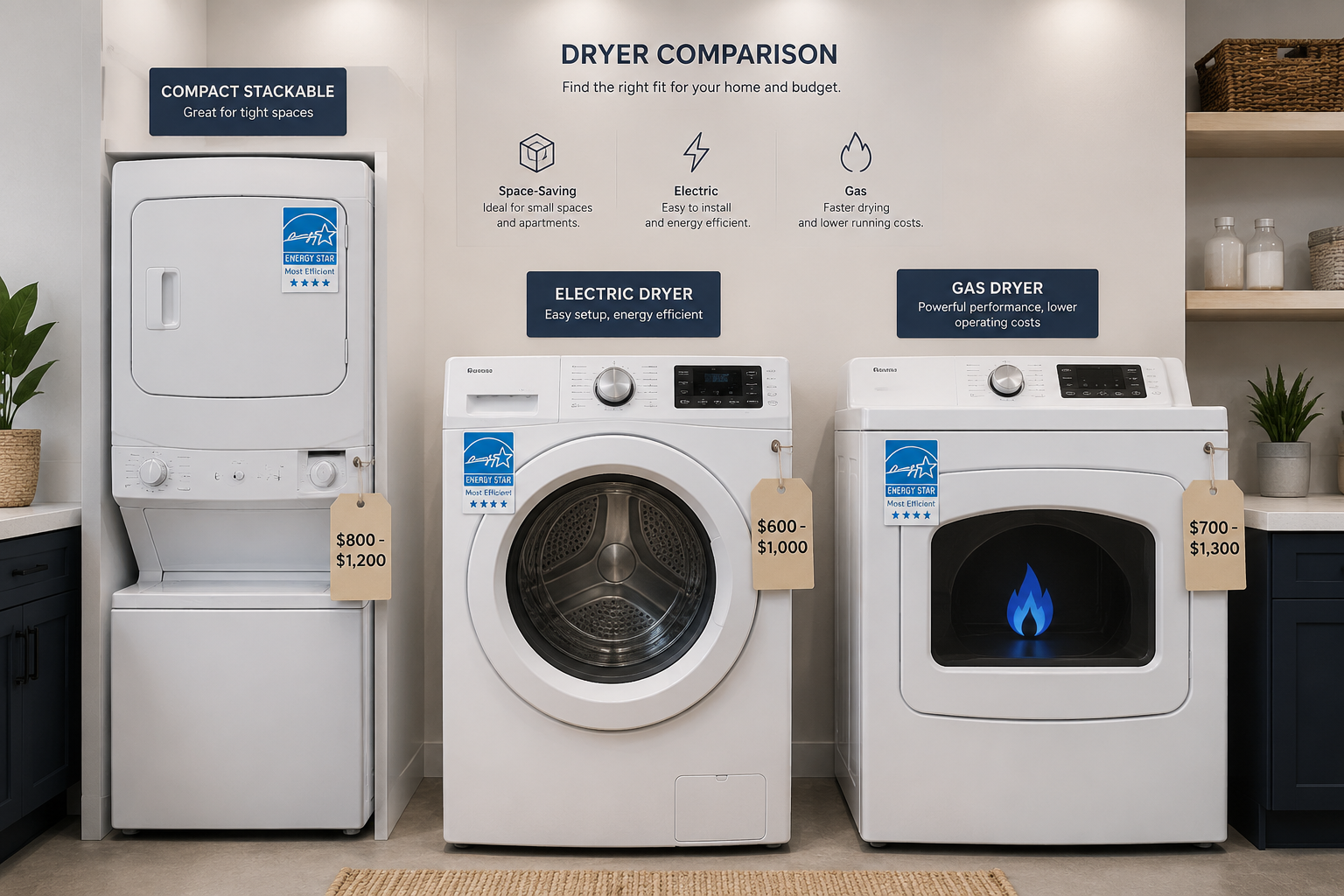
A standard clothes dryer in the U.S. costs between $400 and $1,000 for most households, based on current retail pricing in 2026. Higher-end models with smart features or large capacity can run $1,200 or more.
Cost factors include:
- Fuel type: Gas dryers often cost more upfront but can have lower operating costs depending on local utility rates.
- Capacity: Larger drum sizes cost more.
- Features: Steam cycles, sensor drying, and Wi-Fi connectivity add to the price.
- Brand: Premium brands like LG, Samsung, and Miele sit at the higher end.
Which Dryer Brands Are Best for Small Apartments?
For small apartments, compact and stackable dryers work best. These are the top categories to look at in 2026:
- Ventless condenser dryers: No external vent needed. Brands like Bosch and Miele make reliable compact models.
- Heat pump dryers: More energy-efficient and gentler on clothes. LG and Samsung offer apartment-friendly sizes.
- Combo washer-dryer units: One machine does both jobs, saving floor space. Good for studios or tight laundry closets.
When choosing, check the cubic foot capacity (2.5 to 4.0 cu ft is typical for compact models) and whether your space has a 120V or 240V outlet available.
How to Choose Between Electric and Gas Dryers
The right choice depends on what hookups your home already has and your local utility costs.
Choose an electric dryer if:
- Your laundry space only has a 240V electrical outlet.
- You do not have a gas line in your home.
- You want a wider range of models and price points.
Choose a gas dryer if:
- You already have a gas hookup in the laundry area.
- Your local natural gas rates are lower than electricity rates.
- You want faster drying cycles (gas tends to heat up quicker).
Both types dry clothes equally well. The decision comes down to your home’s setup and long-term energy costs.
What Are the Most Energy-Efficient Dryers?
ENERGY STAR-certified dryers are the most energy-efficient option. According to the U.S. Department of Energy, ENERGY STAR dryers use about 20% less energy than standard models.
Heat pump dryers are the most efficient type overall. They recycle hot air instead of venting it outside, which cuts energy use significantly. Brands offering heat pump models include:
- LG
- Samsung
- Bosch
- Miele
- Whirlpool
Look for the ENERGY STAR label when shopping. Over the life of the appliance, the energy savings can offset a higher upfront cost.
Who Needs a Dryer vs Air Drying Clothes?
A dryer is worth it if you do large loads of laundry regularly, live in a humid climate, or have limited outdoor space. Air drying is a solid option if you have the time, live in a dry or warm climate, or want to extend the life of delicate fabrics.
Dryer is better for:
- Households with kids or athletes producing high laundry volumes
- Rainy or cold climates where air drying takes too long
- Thick items like towels and jeans that dry slowly on a line
Air drying is better for:
- Delicate fabrics like silk, lace, or wool
- Reducing energy bills
- Extending the life of elastic waistbands and printed graphics
Many people use both: machine dry sturdy items, air dry delicates.
Are There Any Alternative Words for Clothes Dryer?
Yes. Depending on the region and context, a clothes dryer may also be called:
- Tumble dryer (common in the UK and Australia)
- Clothes dryer (standard U.S. term)
- Laundry dryer
- Spin dryer (though this technically refers to a centrifuge-style machine, not a heat dryer)
In professional laundry services and commercial settings, large-capacity units are often called industrial dryers or commercial tumble dryers.
What Are Common Mistakes People Make With Drier Vs Dryer?
The most common mistake is using “drier” when writing about a laundry appliance. This happens because both words come from “dry,” so the spelling feels interchangeable.
Other mistakes include:
- Writing “dryer” when describing weather or climate (should be “drier”)
- Using “more dryer” instead of “drier” (double comparative — grammatically wrong)
- Assuming “drier” is always the older or more formal spelling (it is not)
A good rule: if you are writing about an object you plug in or connect to a gas line, it is always “dryer.” If you are comparing moisture levels, it is always “drier.”
How Do Professional Laundry Services Handle Dryers?
Commercial laundry services use industrial-grade dryers that are much larger and more powerful than home units. These machines typically run on natural gas for faster heat-up times and lower operating costs at scale.
Key differences from home dryers:
- Drum capacity of 30 to 100+ pounds per load (vs. 7 to 9 lbs for home models)
- Built for continuous use across multiple shifts
- Programmable moisture sensors to prevent over-drying
- Regular maintenance schedules to meet commercial safety standards
For home users, the takeaway is that professional services prioritize efficiency and throughput. If you are choosing a home dryer, look for similar features in miniature: moisture sensors, efficient heating, and durable drum construction.
FAQ
Is “drier” or “dryer” correct for a clothes-drying machine?
“Dryer” is the correct spelling for a clothes-drying machine. “Drier” is a comparative adjective meaning more dry.
Can I use “drier” and “dryer” interchangeably?
No. They have different meanings. Using them interchangeably is a spelling error, even though they sound the same.
What is the plural of dryer?
The plural is “dryers,” as in “both dryers are running.”
Is “drier” a real word?
Yes. “Drier” is a real word. It means more dry, or it can refer to a chemical drying agent in paint and ink.
Which is correct: “more dry” or “drier”?
Both are grammatically correct. “Drier” is the standard comparative form, but “more dry” is also acceptable.
How do I remember the difference between drier and dryer?
Think: “dryer” has a Y like the letter in “appliance” — it is the machine. “Drier” compares dryness levels.
What does drier mean in weather forecasts?
In weather forecasts, “drier” means less rainfall or lower humidity compared to a previous period or a reference point.
Are heat pump dryers worth the extra cost?
For most households, yes. They use significantly less energy over time, and the savings can offset the higher purchase price within a few years depending on usage.
What is the difference between a condenser dryer and a vented dryer?
A vented dryer pushes moist air outside through a duct. A condenser dryer collects moisture in a tank inside the machine, so no vent is needed.
Can I use “drier” as a noun?
Yes, in chemistry and paint manufacturing, a “drier” is a substance added to speed up drying. Outside of that technical context, the noun form is almost always “dryer.”
Conclusion
The drier vs dryer question has a clear answer: use “dryer” for the machine and “drier” for comparisons of moisture. These two words look almost identical, but they do different jobs in a sentence.
Here are your actionable next steps:
- When writing about a laundry appliance, always spell it “dryer.”
- When comparing how dry something is, use “drier.”
- If you are shopping for an appliance, look for ENERGY STAR-certified models to save on energy costs.
- For small spaces, consider a ventless condenser or heat pump dryer.
- Bookmark a reliable grammar resource so you can check word-choice questions quickly.
Getting this right is a small detail, but it matters in professional writing, product descriptions, and content creation. For more word-meaning breakdowns like this, the Meaning About homepage has a wide range of language and definition guides worth exploring. You might also find the grammar category useful for similar questions.