

The correct phrase is “say your piece” not “say your peace.” The word “piece” here means a prepared statement or opinion you want to share. “Say your peace” is a common misspelling that sounds right when spoken but changes the meaning entirely.
Key Takeaways
- “Say your piece” is the grammatically correct version of this idiom
- “Piece” in this context means a portion of speech or a prepared statement
- “Peace” refers to calmness or the absence of conflict — a different meaning
- The confusion happens because both words sound identical when spoken aloud
- The phrase means to speak your mind or express your opinion fully
- Using “say your peace” is not a grammar crime, but it is technically incorrect
- The idiom dates back centuries and relates to speaking one’s prepared remarks
- You can use a simple memory trick to always get it right
- Similar phrases include “speak your mind,” “have your say,” and “air your grievances”
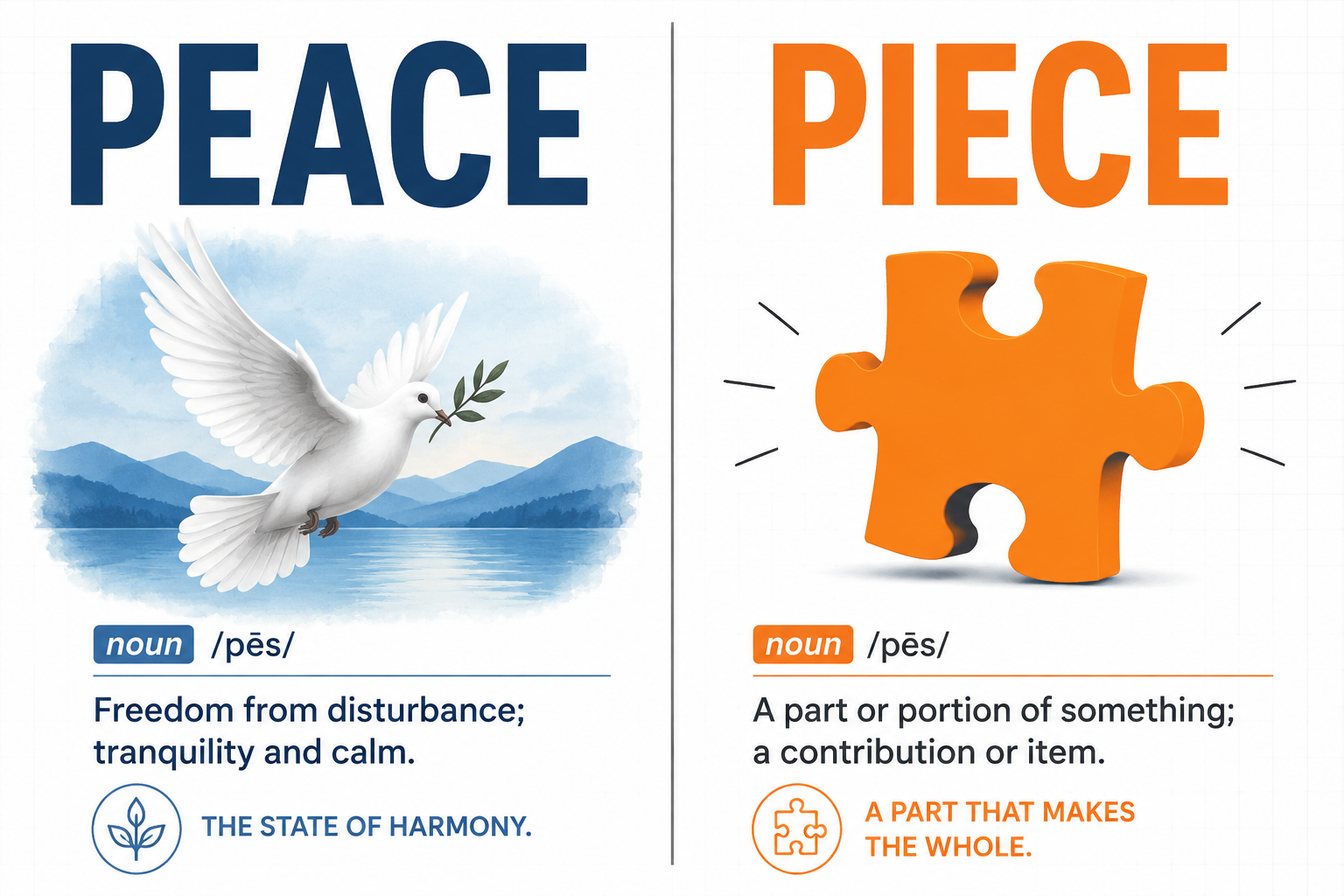
Is It Say Your Peace or Say Your Piece?
The correct version is “say your piece.” This is a well-established English idiom that means to express your opinion, share your thoughts, or deliver what you have to say on a matter. The word “piece” here refers to your contribution to a conversation — like your piece of the discussion.
“Say your peace” is the incorrect version, even though it sounds identical in speech. Because English has many homophones (words that sound the same but have different meanings), this mix-up is extremely common.
Bottom line: If you are writing this phrase, always use “piece.”
What Does “Say Your Piece” Actually Mean?
“Say your piece” means to fully express your thoughts, opinions, or feelings on a topic without being cut off or silenced. It implies that the speaker has something prepared or important to share.
The word “piece” in this idiom functions similarly to how we use it in phrases like “a piece of advice” or “a piece of your mind.” It signals a defined portion of speech — something you have ready to deliver.
Examples of the meaning in action:
- A lawyer saying their piece before the judge makes a ruling
- An employee saying their piece during a performance review
- A family member saying their piece at a difficult dinner conversation
The phrase carries a sense of completeness. Once you have said your piece, you have fully communicated what you needed to say.
What Does “Say Your Peace” Actually Mean?
“Say your peace” is not a standard idiom, but some people use it intentionally to mean something slightly different. In this version, “peace” refers to calmness — so the phrase could loosely mean “say what will bring you peace” or “express yourself so you can find peace.”
This interpretation is not widely accepted in formal grammar or standard usage. It reads more like a creative variation than a recognized phrase.
The key difference:
- “Say your piece” = deliver your prepared statement or opinion
- “Say your peace” = (informal/incorrect) express yourself for emotional relief
Unless you are deliberately playing on the double meaning, stick with “say your piece.”
The Difference Between Peace and Piece in This Phrase
These two words are homophones — they sound exactly the same but have completely different meanings and spellings.
| Word | Meaning | Used Correctly In |
|---|---|---|
| Piece | A portion, part, or contribution | “Say your piece,” “a piece of cake,” “chess piece” |
| Peace | Calmness, harmony, absence of conflict | “World peace,” “peace of mind,” “rest in peace” |
The confusion is purely visual. In speech, no one can tell the difference. In writing, the wrong choice changes the meaning of your sentence.
Quick rule: If you mean “speak your mind,” use “piece.” If you mean “find calm,” use “peace.”
Where Did This Saying Come From?
The phrase “say your piece” has roots in older English usage where “piece” commonly referred to a prepared speech or formal statement. Think of theatrical pieces, musical pieces, or literary pieces — all of which are defined, complete works.
The Oxford English Dictionary traces uses of “piece” as a portion of speech or writing back to at least the 16th century. Over time, the idiom settled into everyday conversation as a way to invite someone to speak freely before a decision is made.
The phrase gained widespread use in legal and political settings, where speakers were formally given the floor to deliver their prepared remarks before a ruling or vote.
Which Version Is Grammatically Correct?
“Say your piece” is the grammatically correct version. This is confirmed by major style guides, dictionaries, and grammar authorities including Merriam-Webster and the Oxford English Dictionary.
“Say your peace” does not appear as a recognized idiom in standard references. It is widely classified as an eggcorn — a word or phrase that sounds like the correct one but substitutes a different word that also makes some sense to the speaker.
An eggcorn is different from a typo. It happens when someone genuinely believes the substituted word is correct because it sounds logical. “Say your peace” feels right because speaking up can bring emotional peace. But that does not make it grammatically standard.
Why Do People Mix Up Peace and Piece?
The mix-up happens for three main reasons.
1. They sound identical. English has hundreds of homophones, and without seeing the word written, there is no way to tell them apart by sound alone.
2. “Peace” feels emotionally connected. Saying what you need to say can bring peace of mind. So “say your peace” feels logical even though it is not the standard phrase.
3. The eggcorn effect. When a substituted word makes partial sense, the brain accepts it as correct. This is how eggcorns spread through everyday language.
This is one of the most common idiom mistakes in written English, alongside mix-ups like “for all intensive purposes” (should be “for all intents and purposes”) and “on accident” (should be “by accident”).
How to Remember the Right Way to Say This Phrase
Use this simple memory trick: “piece” and “speech” both contain the letter combination “ece.”
When you say your piece, you are giving a speech. Both words share that same pattern — and both relate to spoken communication.
Another way to remember it: think of “a piece of your mind.” That phrase is well-known and uses “piece” in exactly the same way. Saying your piece is like giving someone a piece of your mind — you are sharing your thoughts.
Memory shortcut: Piece = speech = something you say. Peace = calm = something you feel.
Common Mistakes With This English Idiom
Beyond the peace/piece confusion, people also misuse this phrase in other ways.
- Using it to mean “stay quiet”: The phrase means to speak up, not to hold back. Saying “just say your peace and move on” can be misread if the writer means “piece.”
- Mixing it with “hold your peace”: “Hold your peace” (as in a wedding ceremony) means to stay silent. It uses “peace” correctly. Do not confuse the two.
- Treating it as permission to ramble: “Say your piece” implies a focused, prepared statement — not an open-ended rant.
Hold your peace vs. say your piece:
- “Hold your peace” = stay silent (uses “peace” correctly)
- “Say your piece” = speak up (uses “piece” correctly)
Both are correct in their own context. The words are different because the meanings are different.
Examples of Using “Say Your Piece” Correctly
Here are real-world examples showing the phrase used in the right context.
- “Everyone will get a chance to say their piece before we vote.”
- “She said her piece at the meeting and then let the others respond.”
- “He finally said his piece after months of staying quiet.”
- “The judge allowed both sides to say their piece before delivering the verdict.”
- “I just want to say my piece and then I’ll drop it.”
In each case, “piece” refers to a prepared or intentional statement. The speaker has something specific to communicate and is being given the floor to do so.
Similar English Sayings About Speaking Up
If “say your piece” does not fit the tone of your writing, here are strong alternatives that carry similar meaning.
- Speak your mind — direct and widely understood
- Have your say — common in group or democratic settings
- Make your voice heard — often used in civic or social contexts
- Air your grievances — used when the statement involves a complaint
- Get it off your chest — more emotional, implies relief after speaking
- Put your cards on the table — implies honesty and full disclosure
Each phrase has a slightly different tone. “Say your piece” is the most neutral and formal of the group, making it a solid choice for professional writing.

When Should You Use This Phrase in Conversation?
“Say your piece” works best in situations where someone has been waiting to express a specific opinion or concern. It fits both formal and informal settings.
Good contexts to use it:
- Before a group decision is made
- During a conflict resolution conversation
- In legal or professional settings where each party speaks in turn
- When inviting someone to share feedback they have been holding back
Contexts where it might feel off:
- Casual small talk (too formal for everyday chit-chat)
- Written academic papers (too idiomatic for formal essays)
The phrase carries a tone of finality — once you have said your piece, the expectation is that the conversation moves forward. Use it when you want to signal that someone has the floor and then the matter will be settled.
FAQ
Is “say your peace” ever correct?
No, “say your peace” is not a recognized standard idiom. It is a common eggcorn. The correct phrase is “say your piece,” where “piece” means a prepared statement or opinion.
What is the origin of “say your piece”?
The phrase comes from older English usage where “piece” referred to a prepared speech or formal statement. It has been in use since at least the 16th century and became common in legal and political settings.
What is an eggcorn?
An eggcorn is a word substitution where the wrong word sounds like the right one and also makes partial logical sense. “Say your peace” is a classic eggcorn because peace relates emotionally to the act of speaking up.
What is the difference between “say your piece” and “hold your peace”?
“Say your piece” means to speak up and share your opinion. “Hold your peace” means to stay silent. Both use homophones correctly — “piece” for speaking, “peace” for silence.
Can I use “say your piece” in formal writing?
Yes, but it is an idiom, so it fits better in conversational or semi-formal writing. In strictly academic or legal writing, prefer direct language like “deliver your statement” or “express your position.”
What are some synonyms for “say your piece”?
Strong alternatives include: speak your mind, have your say, make your voice heard, air your grievances, and get it off your chest.
Why do so many people write “say your peace”?
Because “peace” and “piece” are homophones — they sound identical. When people hear the phrase spoken, they often default to the more familiar spelling of “peace,” which is used more frequently in everyday writing.
Is this one of the most common idiom mistakes in English?
Yes. Grammar and language experts consistently list the peace/piece confusion among the most frequent idiom errors in written English, alongside similar mix-ups involving homophones.
Conclusion
The answer is clear: “say your piece” is correct. The word “piece” refers to your prepared statement or opinion — the part of the conversation that belongs to you. “Say your peace” is a widespread mistake driven by the fact that both words sound identical when spoken.
Here are your actionable next steps:
- Use the memory trick: piece = speech, both contain “ece”
- When in doubt, replace the phrase with “speak your mind” — if it fits, “piece” is right
- Remember that “hold your peace” (silence) and “say your piece” (speaking) use different words for different reasons
- Proofread any formal writing where this phrase appears — autocorrect will not catch it
Getting this right is a small thing, but it signals careful, credible writing. In content creation, emails, articles, and professional communication, the details matter. Now you know exactly which word to use — so go ahead and say your piece.
References
- Merriam-Webster Dictionary. “Piece.” merriam-webster.com
- Oxford English Dictionary. “Piece, n.” oed.com
- Garner, Bryan A. Garner’s Modern English Usage. Oxford University Press, 2016.
- Language Log, University of Pennsylvania. “Eggcorns: The Database.” languagelog.ldc.upenn.edu
All also check out