

“Take effect” is almost always the correct phrase. It means something begins to work, becomes active, or produces results. “Take affect” is not a standard English phrase and is considered a grammar error in most contexts. If you’re writing about a law, medication, or policy becoming active, always use “take effect.”
Key Takeaways
- “Take effect” is the correct phrase in standard English
- “Effect” is most often a noun meaning a result or outcome
- “Affect” is most often a verb meaning to influence something
- “Take affect” is not grammatically correct in everyday writing
- The confusion comes from how similar “affect” and “effect” sound
- “Go into effect” and “take effect” mean the same thing and are both correct
- In psychology, “affect” can be a noun (describing emotion), but it still doesn’t combine with “take” in standard usage
- When a law, drug, or rule becomes active, it “takes effect”
What Is the Difference Between Take Affect and Take Effect?
The core difference is simple: “take effect” is correct, and “take affect” is not. “Effect” in this phrase is a noun meaning a result, outcome, or change that becomes active. “Affect” is almost always a verb, so it doesn’t pair with “take” the way “effect” does.
Think of it this way: when a new rule “takes effect,” it starts producing results. The word “effect” fits because it refers to that result. “Affect” means to influence something, so saying something “takes affect” creates a phrase that doesn’t have a clear meaning in English.
This is one of the most common grammar mix-ups in writing, similar to other tricky word pairs. For a related breakdown, check out this guide on Better Than Or Better Then: Which Is Correct?
Is It “Take Affect” or “Take Effect”? The Direct Answer
“Take effect” is correct. “Take affect” is not a real phrase in standard English grammar.
Here’s the short version:
- Correct: The new policy will take effect on Monday.
- Incorrect: The new policy will take affect on Monday.
Every major style guide, including the Chicago Manual of Style and Merriam-Webster, confirms that “take effect” is the proper construction. There is no context in standard writing where “take affect” is acceptable.
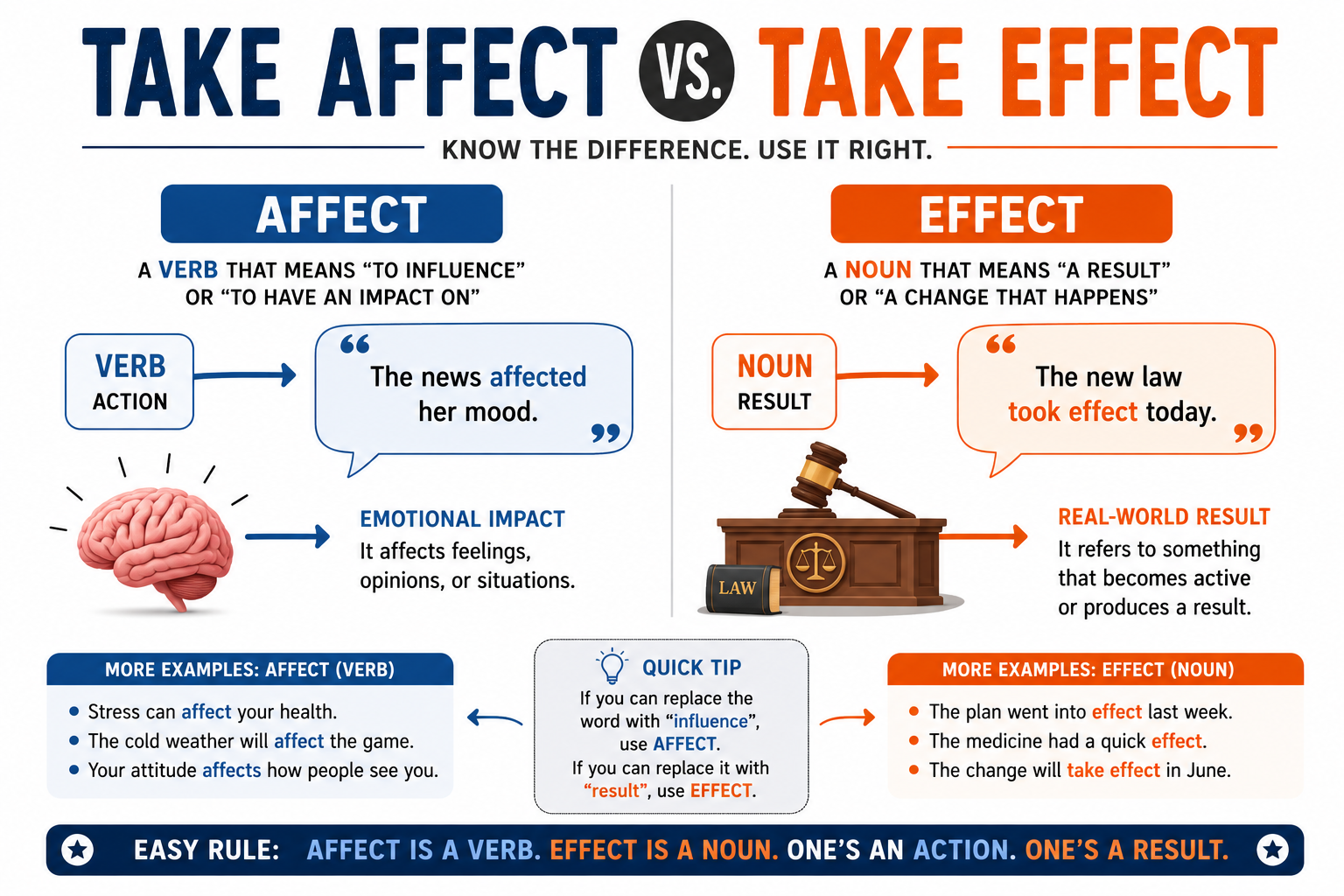
Affect vs Effect: A Simple Explanation
Before going deeper into “take affect vs take effect,” it helps to understand the basic difference between affect and effect.
Affect is usually a verb. It means to have an influence on something.
- Example: “The rain affected the game.”
Effect is usually a noun. It means a result or outcome.
- Example: “The rain had a negative effect on the game.”
A simple memory trick: RAVEN
- Remember
- Affect is a
- Verb,
- Effect is a
- Noun
This rule covers about 90% of everyday usage. The exceptions are rare and mostly appear in specialized fields like psychology.
Why Do People Confuse Take Affect and Take Effect?
People mix up “take affect” and “take effect” mainly because the two words sound nearly identical when spoken. In casual conversation, the difference between “affect” and “effect” is almost impossible to hear.
Other reasons the confusion spreads:
- Both words relate to change and results, so they feel interchangeable
- Autocorrect tools sometimes fail to catch the error
- Writers see “affect” used so often that it starts to look right in all contexts
- The phrase “take effect” is common in formal writing (legal, medical, business), which some people don’t read as often
This kind of sound-alike confusion happens with other phrases too. For example, people often struggle with Say Your Peace or Say Your Piece: Which Is Correct? for the same reason.
What Does “Take Effect” Mean? Definition and Examples
“Take effect” means to become active, to start working, or to begin producing results. It is used when something (a law, drug, policy, or decision) moves from being planned or inactive to being fully operational.
Real-world examples of “take effect” in a sentence:
- “The new minimum wage law will take effect on January 1.”
- “The medication usually takes effect within 30 minutes.”
- “The company’s new refund policy took effect last week.”
- “The ceasefire agreement is expected to take effect by midnight.”
- “Changes to the tax code take effect at the start of the fiscal year.”
In every case, “take effect” signals the moment something becomes real and active. It’s a phrase you’ll see constantly in news articles, legal documents, and medical instructions.
Can You Ever Say “Take Affect”? Is There Any Correct Usage?
No, “take affect” is not correct in standard English writing. There is no widely accepted context where this phrase is grammatically sound.
Some people point to the psychological use of “affect” as a noun (referring to emotional expression or mood), but even in that context, the phrase “take affect” is not used. A psychologist would say a patient “displays flat affect,” not that something “takes affect.”
Bottom line: If you’re ever tempted to write “take affect,” replace it with “take effect.” You’ll be right every time.
This is similar to other grammar traps, like the confusion around Mine As Well or Might As Well: Which Is Correct? where one version sounds right but isn’t.
Does “Affect” Ever Mean to Implement or Activate?
No, “affect” does not mean to implement or activate something. That job belongs to “effect” when it’s used as a verb (which is rare but real).
Here’s the part that surprises most people: “effect” can actually be a verb in formal writing. When used as a verb, “effect” means to bring something about or to cause something to happen.
- Effect as a verb: “The new CEO effected major changes in the company.”
(This means she caused those changes to happen.) - Affect as a verb: “The changes affected every department.”
(This means the changes influenced every department.)
So when it comes to “take affect vs take effect,” the word doing the heavy lifting is “effect” as a noun, meaning a result that becomes active. “Affect” never fills this role.
Take Effect vs Go Into Effect: Is There a Difference?
“Take effect” and “go into effect” mean the same thing. Both phrases describe the moment something becomes active or operational. You can use either one, and both are grammatically correct.
Examples side by side:
| Phrase | Example Sentence |
|---|---|
| Take effect | The law will take effect in March. |
| Go into effect | The law will go into effect in March. |
| Come into effect | The law will come into effect in March. |
All three are interchangeable in most writing. “Take effect” is slightly more common in American English. “Come into effect” appears more often in British English. “Go into effect” is common in legal and news writing.
Choose whichever sounds natural for your sentence. None of them are wrong.
Take Effect: Common Usage in Legal, Medical, and Business Writing
“Take effect” is one of the most frequently used phrases in formal writing. Understanding where it shows up helps writers use it with confidence.
Legal writing:
Laws, regulations, and court orders “take effect” on a specific date. This is standard language in legislation and contracts.
Medical writing:
Medications, treatments, and vaccines “take effect” after a certain period. Doctors and pharmacists use this phrase constantly.
Business writing:
New policies, pricing changes, and employee agreements “take effect” on a set date. HR documents and company announcements rely on this phrase.
News writing:
Journalists use “take effect” to report when decisions become real. It’s a clear, neutral phrase that communicates timing precisely.
If you’re writing in any of these fields, “take effect” is the phrase you need. It signals professionalism and precision. For more grammar guidance on similar word choices, see our guide on It Is Must Vs It Is A Must: Correct Grammar Guide.
Which One Is Correct: Take Affect or Take Effect? Final Ruling
“Take effect” is correct. “Take affect” is a grammar error.
Here’s the complete picture in one place:
- “Effect” is a noun meaning a result or outcome
- “Take effect” means to become active or start working
- “Affect” is a verb meaning to influence
- “Take affect” has no standard meaning in English
- Even in rare cases where “effect” acts as a verb or “affect” acts as a noun, “take affect” still doesn’t form a correct phrase
- Use “take effect,” “go into effect,” or “come into effect” interchangeably
When in doubt, read the sentence aloud and substitute “become active.” If it makes sense, you want “take effect.” It will always make sense. “Take affect” never will.
For more word-choice guides like this one, explore the grammar section at Meaning About.
FAQ
Is “take affect” ever correct?
No. “Take affect” is not a standard English phrase and is considered a grammar error. Always use “take effect” when describing something becoming active or producing results.
What does “take effect” mean?
“Take effect” means to become active, to start working, or to begin producing results. It’s used for laws, medications, policies, and agreements.
What is the difference between affect and effect?
“Affect” is usually a verb meaning to influence something. “Effect” is usually a noun meaning a result or outcome. In the phrase “take effect,” “effect” is used as a noun.
Can “effect” be a verb?
Yes, in formal writing, “effect” can be a verb meaning to bring about or cause something. Example: “She effected real change.” This is rare but correct.
Can “affect” be a noun?
Yes, in psychology, “affect” is a noun referring to emotional expression or mood. But it still doesn’t combine with “take” to form “take affect” in any standard usage.
What’s the difference between “take effect” and “go into effect”?
They mean the same thing. Both describe the moment something becomes active. “Take effect” is more common in American English; “go into effect” is frequent in legal and news writing.
How do I remember when to use affect vs effect?
Use the RAVEN trick: Remember Affect is a Verb, Effect is a Noun. This covers most everyday usage.
When does a law “take effect”?
A law takes effect on the date it becomes legally enforceable. This date is usually written into the legislation itself.
Is “take affect” a common mistake?
Yes, it’s one of the more common grammar errors in English writing, largely because “affect” and “effect” sound nearly identical when spoken.
What should I write instead of “take affect”?
Write “take effect,” “go into effect,” or “come into effect.” All three are correct and interchangeable in most contexts.
Conclusion
The answer to “take affect vs take effect” is clear: always use “take effect.” It’s the grammatically correct phrase, backed by every major style guide and used consistently in legal, medical, and business writing.
Here are your actionable next steps:
- Do a quick search in your documents for “take affect” and replace every instance with “take effect.”
- Bookmark the RAVEN trick (Affect is a Verb, Effect is a Noun) so it sticks.
- When writing about laws, medications, or policies becoming active, default to “take effect” without hesitation.
- If you’re unsure, substitute “become active” in the sentence. If it works, you need “take effect.”
Getting this right takes about 30 seconds once you know the rule. And knowing it makes your writing sharper, more credible, and easier to read.
References
- Merriam-Webster. (n.d.). Effect. Retrieved from https://www.merriam-webster.com/dictionary/effect
- Garner, B. A. (2016). Garner’s Modern English Usage (4th ed.). Oxford University Press.
- The Chicago Manual of Style Online. (2017). Affect, Effect. University of Chicago Press.
- Strunk, W., & White, E. B. (2000). The Elements of Style (4th ed.). Longman.