
“Stay tuned” means “keep watching, listening, or paying attention because more information is coming soon.” It started as a literal instruction for radio and TV audiences but now works in everyday conversation, social media, texting, and professional communication. When someone says “stay tuned,” they are telling you not to go anywhere because something important is on the way.
Key Takeaways
- “Stay tuned” originally told radio listeners to keep their dial on the same station
- Today it means “wait for more information” or “something is coming soon”
- It works in casual texts, social media posts, marketing campaigns, and even some professional emails
- “Stay tuned” is semi-formal, not strictly formal, so context matters
- Common synonyms include “stay posted,” “watch this space,” and “more to come”
- In texting and social media, it signals a teaser or upcoming announcement
- Marketers use it to build excitement and keep audiences engaged
- It is still widely used in 2026 and is not considered outdated
What Does Stay Tuned Mean, Exactly?
“Stay tuned” means to keep your attention on something because more details are coming. It is a phrase that tells the listener or reader to wait and not miss what comes next.
You will hear it on TV news (“Stay tuned for more on this story”), read it in a brand’s Instagram caption, or get it in a text from a friend who has big news but is not ready to share it yet. The core meaning is always the same: something is coming, so do not walk away.
The phrase works because it creates a small amount of suspense. It does not reveal everything at once. Instead, it keeps people curious and engaged.
Stay Tuned Meaning and Origin: Where Did This Phrase Come From?
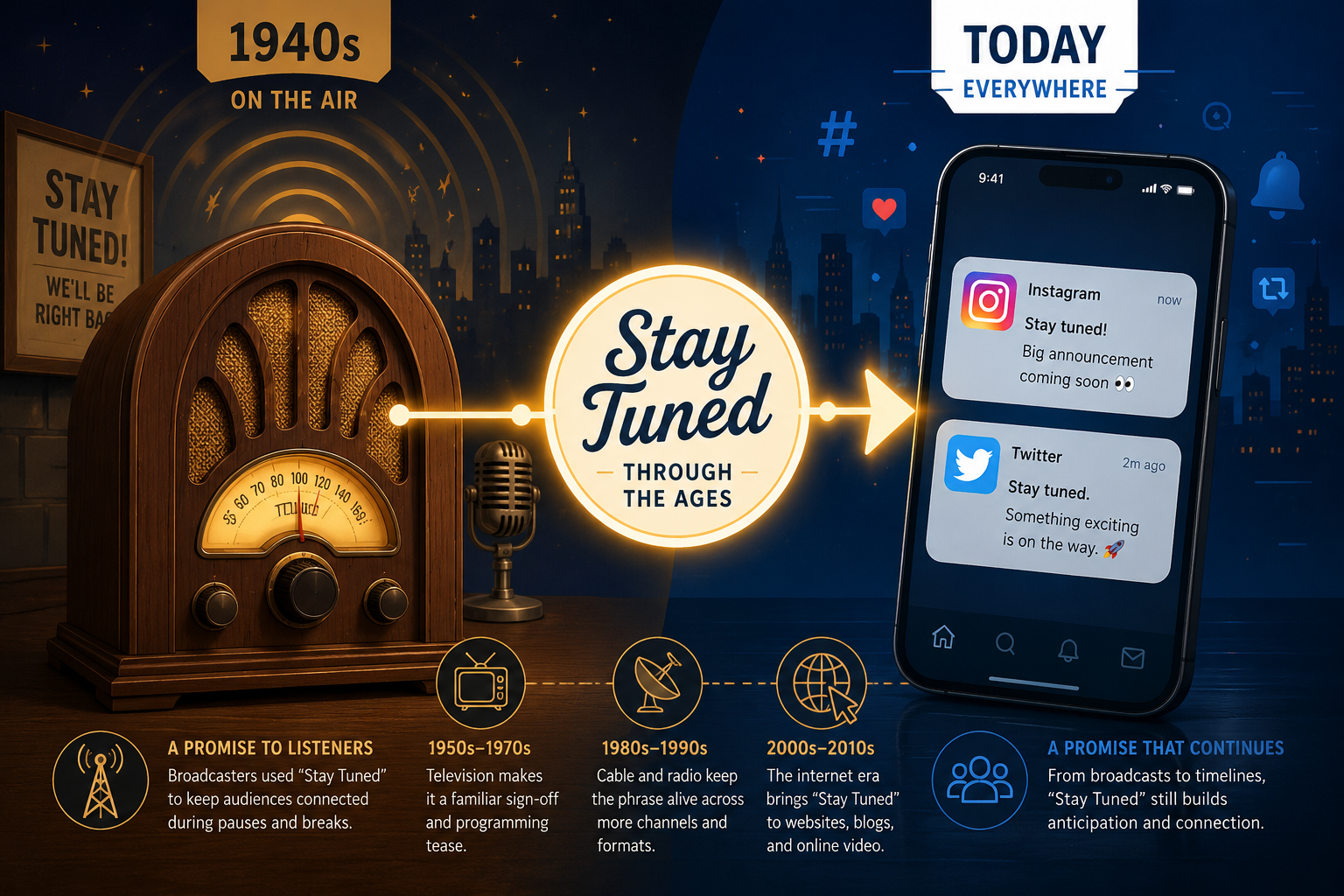
The phrase “stay tuned” comes directly from early radio broadcasting in the 1920s and 1930s. Back then, radio hosts would literally tell audiences to keep their dial tuned to the same frequency so they would not miss the next segment.
When television became popular in the 1940s and 1950s, TV broadcasters borrowed the phrase. Announcers would say “stay tuned to this channel” before commercial breaks to stop viewers from switching to a competitor.
Over time, the phrase moved beyond broadcasting entirely. By the late 20th century, people used it in everyday speech to mean “more is coming, so pay attention.” Today in 2026, it appears in everything from corporate press releases to casual group chats.
The short version of its history:
- 1920s-1930s: Radio hosts used it to keep listeners on the same station
- 1940s-1950s: TV broadcasters adopted it for the same reason
- Late 1900s: It moved into general conversation
- 2000s-present: Social media and texting gave it a whole new life
How Do You Use Stay Tuned in a Sentence?
“Stay tuned” fits naturally at the end of a statement or announcement. It signals that more information will follow soon.
Here are real-world examples across different contexts:
Casual conversation:
- “I have some big news to share. Stay tuned!”
- “We are working on something exciting. Stay tuned for the reveal.”
Social media:
- “New product dropping this Friday. Stay tuned.”
- “Big announcement coming tomorrow. Stay tuned to our page.”
Professional setting:
- “We are finalizing the details and will share an update shortly. Stay tuned for more information.”
- “The report is almost ready. Stay tuned for the full release next week.”
Texting:
- “Can’t say much yet but stay tuned lol”
- “Stay tuned, you’re gonna love this”
The phrase can stand alone at the end of a sentence or be followed by a specific detail like “stay tuned for updates” or “stay tuned to our channel.”
Stay Tuned vs Stay Posted: What Is the Difference?
Both phrases mean roughly the same thing, but there are small differences in tone and usage.
| Phrase | Tone | Best Used When |
|---|---|---|
| Stay tuned | Slightly broadcast-style, energetic | Announcements, reveals, teasers |
| Stay posted | Casual, conversational | Ongoing updates, informal chats |
| Watch this space | Modern, social-media friendly | Brand announcements, launches |
| More to come | Neutral, professional | Emails, reports, presentations |
“Stay tuned” carries a bit more energy and excitement. “Stay posted” feels more like a casual reminder to check back. If you are building hype for a product launch, “stay tuned” works better. If you are just keeping a friend updated on a situation, “stay posted” feels more natural.
For more on how everyday phrases carry different meanings in different contexts, check out this guide on what NFS means in text for a good example of how context shapes meaning.
Is Stay Tuned Formal or Informal?
“Stay tuned” sits in the middle ground between formal and informal. It is not slang, but it is not strictly professional language either.
In most cases, it reads as semi-formal or casual-professional. Here is how to think about it:
- Too casual for: Legal documents, formal reports, academic writing
- Fine for: Marketing emails, social media, team announcements, press releases
- Natural in: Casual emails, texts, blog posts, video content
If you are writing to a senior executive or a client you have never met, a phrase like “further details will follow” or “we will share updates shortly” is safer. But in most modern workplaces, “stay tuned” in an internal email or a company newsletter is completely acceptable.
Can You Say Stay Tuned in Professional Emails?
Yes, but with some care. “Stay tuned” is acceptable in professional emails when the tone is already conversational or when you are writing to colleagues you know well.
Use it when:
- You are sending a team update about an upcoming project
- The company culture is relaxed and informal
- You are writing a newsletter or marketing email
Avoid it when:
- You are writing a formal proposal or legal communication
- The recipient is a new client or senior stakeholder who expects formal language
- The email is about a sensitive topic like HR or compliance
A safe alternative in formal emails: “We will share more details as they become available.”
Stay Tuned in Texting: What Does It Mean?
In texting, “stay tuned” is a casual way to tell someone that more information is coming. It often signals that the sender has news, a surprise, or an update they are not ready to share yet.
For example:
- “I just got some crazy news. Stay tuned.”
- “Something big is happening tonight, stay tuned lol”
It can also be used playfully or sarcastically. If a friend says “stay tuned” after hinting at drama, they are building suspense on purpose. The phrase keeps the other person curious without giving anything away.
If you enjoy breaking down what phrases mean in text conversations, you might also find it useful to read about what PMO means in text or explore what JSP means on Snapchat.
Stay Tuned Meaning in Social Media and Marketing
In social media and marketing, “stay tuned” is a strategic phrase used to tease upcoming content, products, or announcements. It builds anticipation and encourages followers to keep checking back.
Brands use it to:
- Tease a product launch before the official reveal
- Hint at a collaboration or partnership
- Signal that a big announcement is coming without giving details
- Keep engagement high between content drops
For example, a brand might post: “Something big is coming this Thursday. Stay tuned.” This creates curiosity without giving away the surprise.
In marketing, the phrase works because it triggers a psychological response. People do not like missing out. Telling them to “stay tuned” activates that feeling and keeps them paying attention. This is a core part of value-first content strategy, where you give the audience a reason to come back.
For a deeper look at how slang and phrases evolve on social platforms, the glazing meaning on social networks article is a good read.
When Should You Say Stay Tuned?
Use “stay tuned” when you have information coming but are not ready to share it yet. It works best when you want to build excitement or keep someone’s attention.
Good times to use it:
- Before a product launch or announcement
- When you have news but need more time to confirm details
- At the end of a social media post to encourage followers to come back
- In a team email when a project update is almost ready
Times to skip it:
- When you have no follow-up planned (do not tease what you cannot deliver)
- In formal or legal communication
- When the audience expects immediate information
The biggest mistake people make with “stay tuned” is using it without following through. If you tell your audience to stay tuned and then go silent, you lose trust. Always deliver on the promise the phrase makes.
Stay Tuned Synonyms: What Else Can You Say?
If “stay tuned” does not fit your tone or context, here are solid alternatives:
- Stay posted – casual, good for ongoing updates
- Watch this space – modern, popular on social media
- More to come – neutral and professional
- Keep an eye out – friendly and conversational
- Check back soon – direct and clear
- Updates to follow – formal, good for professional emails
- Coming soon – simple and widely understood
- Don’t miss it – energetic, good for marketing
Choose based on your audience and tone. For formal writing, “further details will follow” or “updates to follow” are the cleanest options. For social media or texting, any of the casual alternatives work well.
You can also explore related language patterns in our guide on Gen Z slang and what it means for more context on how informal phrases shift over time.
Is Stay Tuned Still Used or Is It Outdated?
“Stay tuned” is still widely used in 2026 and is not outdated. The phrase has adapted well to modern communication channels.
While it started with radio and TV, it has found a strong second life on social media, in marketing copy, and in everyday texting. Brands, creators, and individuals all use it regularly.
Some people argue it sounds a bit old-fashioned because of its broadcasting roots, but that retro quality can actually feel charming or intentional. When a brand uses “stay tuned,” it can signal confidence and a sense of occasion.
The phrase is not going anywhere. It is one of those expressions that has proven flexible enough to survive major shifts in how people communicate. For more on how phrases carry meaning across different contexts, see our breakdown of what WDYLL means as another example of language that shifts with context.
Stay Tuned Meaning in Different Contexts: A Quick Summary
The phrase means something slightly different depending on where you see it:
- Broadcasting (TV/radio): Keep watching or listening, more content is coming
- Social media: Follow along, a reveal or announcement is coming soon
- Texting: I have news or something exciting to share, wait for it
- Marketing: Build anticipation for a product, launch, or campaign
- Professional emails: More details are coming, please wait for the update
- Casual conversation: I am not ready to share everything yet, but something is happening
The core meaning never changes: more is coming, so pay attention. The tone and level of formality adjust based on the setting.
FAQ: What Does Stay Tuned Mean
Q: What does “stay tuned” mean in simple terms?
It means “keep paying attention because more information is coming soon.” It is a way of telling someone not to leave or stop watching.
Q: Is “stay tuned” a formal phrase?
No, it is semi-formal at best. It works in casual and marketing contexts but is not appropriate for formal or legal writing.
Q: Where did “stay tuned” come from?
It came from early radio broadcasting in the 1920s, when hosts told listeners to keep their dial on the same station frequency.
Q: Can I use “stay tuned” in a text message?
Yes. In texting, it is a casual and friendly way to hint that you have news or something interesting coming.
Q: What is the difference between “stay tuned” and “stay posted”?
“Stay tuned” has more energy and excitement, often used for announcements. “Stay posted” is more casual and works for ongoing updates.
Q: Is “stay tuned” used in marketing?
Yes, frequently. Brands use it to tease product launches, collaborations, and announcements to build anticipation.
Q: What are some alternatives to “stay tuned”?
“Watch this space,” “more to come,” “stay posted,” “check back soon,” and “updates to follow” are all solid alternatives.
Q: Is “stay tuned” still relevant in 2026?
Yes. The phrase is still widely used across social media, marketing, texting, and everyday conversation.
Q: Can “stay tuned” be used sarcastically?
Yes. In texting or casual conversation, someone might use it sarcastically to hint at drama or to be playful about a minor update.
Q: What happens if I say “stay tuned” but never follow up?
You lose credibility with your audience. Always deliver on the promise the phrase creates.
Conclusion
“Stay tuned” is a simple but powerful phrase. It started on radio dials in the 1920s and has traveled all the way to Instagram captions and group chats in 2026. The meaning has stayed consistent: more is coming, so keep paying attention.
Here are your actionable next steps:
- Use “stay tuned” when you have a real follow-up planned, not just to fill space
- Match the phrase to your tone, skip it in formal or legal writing
- In marketing, pair it with a specific timeframe (“stay tuned this Friday”) for better results
- If the phrase feels overused in your content, swap it for “watch this space” or “more to come”
- In texting, use it freely as a casual way to build a little suspense
Language is always evolving, and phrases like “stay tuned” show how words can move from one medium to another without losing their purpose. If you want to keep building your knowledge of how words and phrases work in modern communication, explore our full slang meaning guides for more authority-driven insights and user-focused breakdowns.
References
- Merriam-Webster Dictionary. (n.d.). Stay tuned. Retrieved from https://www.merriam-webster.com
- Oxford English Dictionary. (n.d.). Tuned. Oxford University Press.
- Crystal, D. (2006). Language and the Internet (2nd ed.). Cambridge University Press.
- McQuail, D. (2010). McQuail’s Mass Communication Theory (6th ed.). SAGE Publications.