
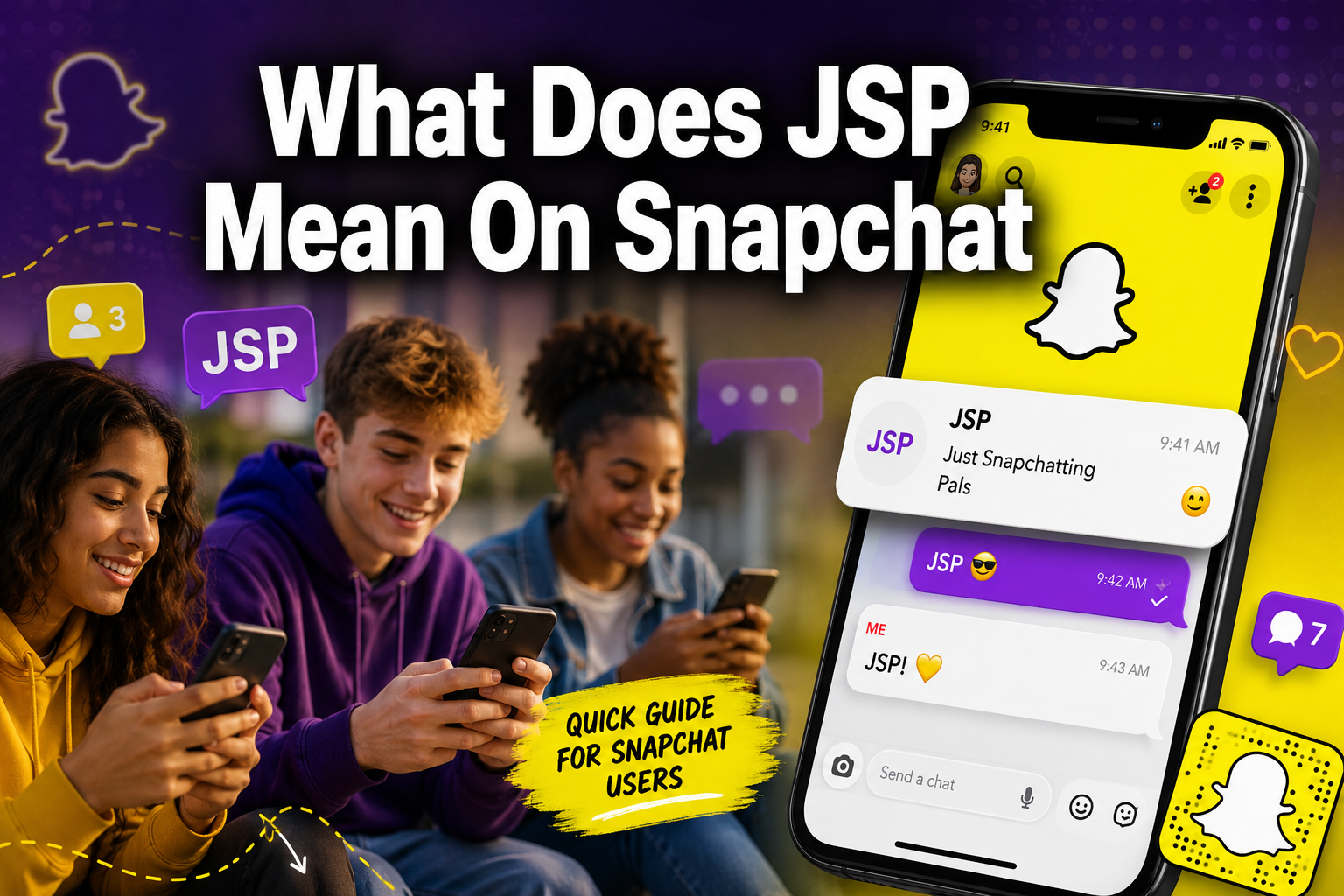
JSP on Snapchat most commonly means “Just Playing” or “Just Saying,” depending on the context of your conversation. When someone sends you “JSP” after a message, they’re usually signaling that their previous comment was a joke (Just Playing) or adding a casual opinion without being pushy (Just Saying). In French-speaking Snapchat communities, JSP typically means “Je sais pas” (I don’t know). The exact meaning depends on your conversation’s tone, language, and relationship with the person messaging you.
Key Takeaways
- JSP primarily stands for “Just Playing” on Snapchat, used to show someone is joking or teasing
- “Just Saying” is the second most common meaning, used for casual opinions or observations
- In French conversations, JSP means “Je sais pas” (I don’t know)
- Context matters: the same abbreviation shifts meaning based on tone and conversation flow
- JSP remains popular among teenagers and young adults in 2026, especially ages 13-24
- The term is casual slang, not an official Snapchat feature or platform term
- Using JSP wrong in formal contexts or with people who don’t know slang can create confusion
- Similar Snapchat abbreviations include WTV (whatever), NFS, and WDYLL
What Does JSP Actually Stand For On Snapchat?
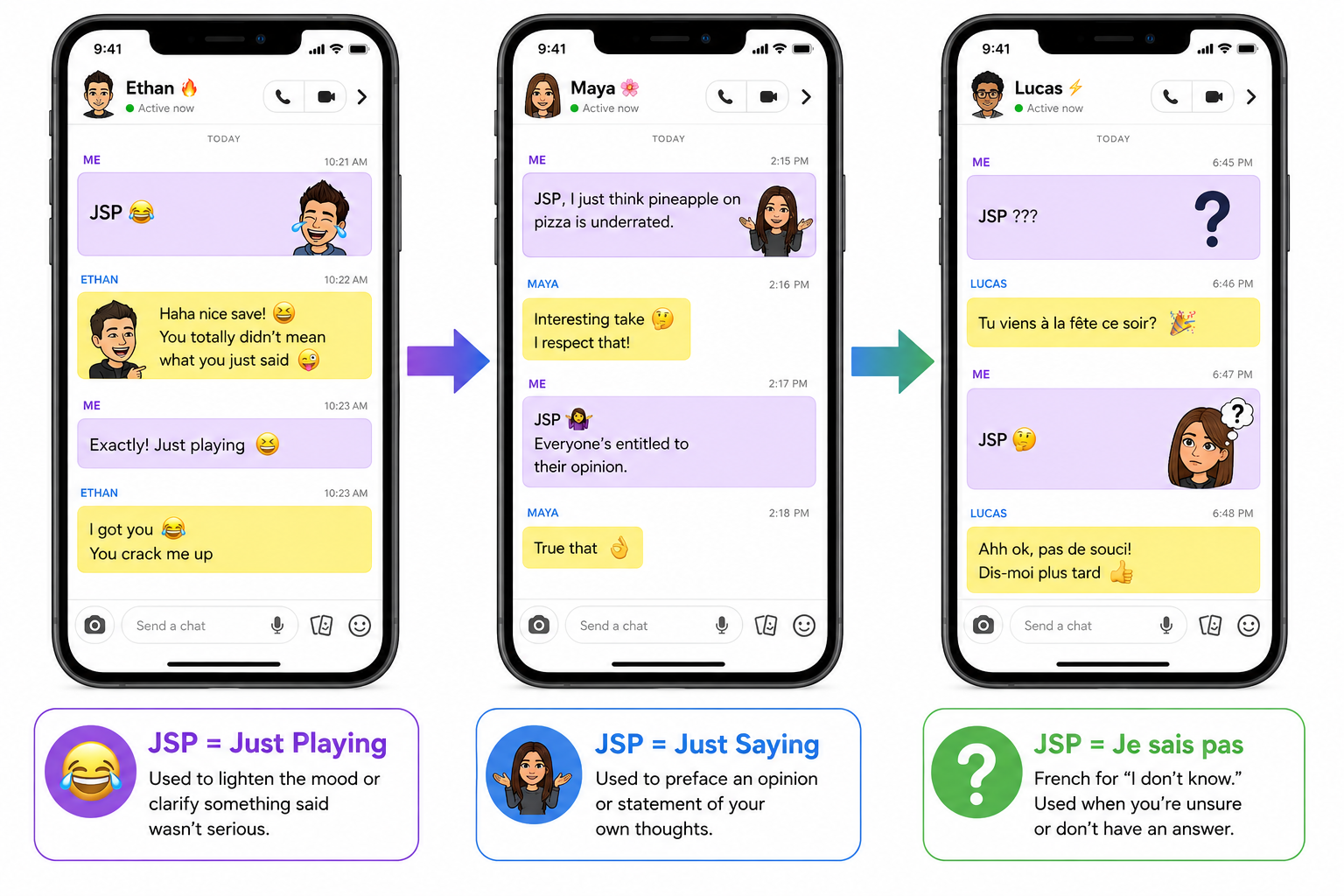
JSP on Snapchat stands for “Just Playing” in most English-language conversations. This is the most widely recognized meaning among American and British teenagers who use the app daily.[1][8] When someone types “JSP” after sending a potentially edgy or teasing message, they’re letting you know they were joking and you shouldn’t take offense.
The second common expansion is “Just Saying,” which serves a different purpose. People use this version when they want to share an opinion or observation without sounding preachy or demanding. It’s a way to soften a statement and keep things casual.[4][9]
In French-speaking communities, JSP takes on a completely different meaning: “Je sais pas” or “Je ne sais pas,” which translates to “I don’t know.”[3][6][7] If you’re chatting with friends who speak French or live in French-speaking regions, this is likely the default interpretation.
Why multiple meanings exist: Snapchat is a global platform, and slang evolves differently across languages and regions. JSP emerged organically from users shortening common phrases they type repeatedly. Because “Just Playing,” “Just Saying,” and “Je sais pas” all share the same initials, the abbreviation stuck in multiple communities simultaneously.[10]
Important context clue: Look at the message before JSP appears. If someone just made a joke or playful insult, they probably mean “Just Playing.” If they shared an opinion or fact, they likely mean “Just Saying.” If they’re answering a question in French, it’s “I don’t know.”
Why Do People Use JSP In Snapchat Messages?
People use JSP in Snapchat messages because it saves time and adds a casual, friendly tone to conversations. Typing three letters is faster than spelling out full phrases, which matters when you’re firing off quick snaps and chats throughout the day.[8][9]
JSP also serves as social insurance. When you’re teasing a friend or making a sarcastic comment, adding “JSP” at the end prevents misunderstandings. Text messages lack facial expressions and vocal tone, so these abbreviations act as emotional context markers. They tell the reader how to interpret your words.
Three main reasons people choose JSP:
- Speed: Three letters beat typing “just playing” or “just saying” every time
- Tone control: It signals playfulness or casualness without extra explanation
- Group identity: Using current slang shows you’re part of the in-group and understand teen communication norms
Teenagers especially value efficiency in digital communication. Studies of Gen Z slang patterns show that this generation prefers brevity and invented shorthand over formal language when chatting with friends. JSP fits perfectly into that communication style.
When JSP works best: Quick back-and-forth chats, group conversations with friends who know your humor, and casual relationships where formality isn’t expected. It’s less appropriate in conversations with adults who aren’t familiar with slang, professional contacts, or situations where clarity matters more than speed.
Is JSP A Slang Term Or Abbreviation?
JSP is both a slang term and an abbreviation. Technically, it’s an initialism (you say each letter separately: “J-S-P”) rather than an acronym (which you’d pronounce as a single word). But in everyday usage, people call it slang because it’s informal, evolves through peer groups, and isn’t found in standard dictionaries.[4][9]
The term belongs to the category of text-speak or internet slang. It emerged from the same digital communication patterns that gave us “LOL,” “BRB,” and “TTYL.” These shortened forms spread through social media platforms, texting apps, and online gaming communities.
What makes JSP slang rather than formal language:
- It’s not recognized by official dictionaries or grammar authorities
- Meaning changes based on social context and regional usage
- Primarily used by younger demographics (teens and young adults)
- Considered too casual for professional or academic writing
- Evolves quickly as new generations adopt or abandon it
Unlike official Snapchat features (like “Snap Streaks” or “Snap Map”), JSP isn’t created or endorsed by Snap Inc. The company’s help documentation doesn’t define JSP because it’s user-generated slang, not a platform function.[1][10]
Similar slang abbreviations: If you’re learning JSP, you’ll probably encounter related terms like CTFU (cracking the f*** up), DWS (dealing with stress), and other casual shorthand that follows the same pattern.
How Do Teenagers Use JSP In Their Conversations?
Teenagers use JSP primarily as a safety net after making jokes or potentially risky comments. When you’re testing boundaries with humor or playful roasting, JSP signals “don’t take this seriously” and prevents your friend from getting genuinely hurt or angry.[1][8]
Real-world usage examples:
- After teasing: “Your new haircut looks like you lost a fight with a lawnmower… JSP, it actually looks good!”
- Sharing opinions: “I think that movie was overrated, JSP”
- Softening criticism: “You might want to study more for the next test, JSP”
- Playful sarcasm: “Oh wow, you’re SUCH a great driver… JSP”
The placement matters. JSP almost always comes at the end of a message, acting as a modifier for everything that came before it. Putting it at the beginning or middle would feel awkward and confusing to most users.
Tone variations by meaning:
- “Just Playing” JSP: Usually follows jokes, sarcasm, or mock insults. The message before it has a teasing or edgy quality.
- “Just Saying” JSP: Follows opinions, observations, or gentle suggestions. The message before it states a viewpoint without demanding agreement.
- “Je sais pas” JSP: Responds to a direct question when the person genuinely doesn’t know the answer.
Teenagers value authenticity and casualness in their peer relationships. Using JSP shows you’re comfortable enough with someone to joke around, but also considerate enough to clarify your intent. It’s a small linguistic tool that maintains social bonds in digital spaces.
What Are Other Similar Snapchat Slang Terms?
Snapchat users employ dozens of abbreviations similar to JSP, each serving specific social functions. Understanding these related terms helps you decode conversations and communicate more naturally on the platform.[10]
Popular Snapchat slang in 2026:
- WTV: “Whatever” – shows indifference or casual agreement
- NFS: “Not for sale” or “No funny stuff” – depends on context
- WDYLL: “What do you look like” – common in new conversations
- CTFU: “Cracking the f*** up” – stronger than LOL
- DWS: “Dealing with stress” – explains why someone’s distant
- TSTS: “That’s the stuff” – shows approval
- SMH: “Shaking my head” – expresses disappointment or disbelief
- FR: “For real” – emphasizes truth or agreement
- BET: “Okay” or “sounds good” – confirms plans
- ISTG: “I swear to God” – adds emphasis to a statement
These terms share common traits with JSP: they’re short, context-dependent, and primarily used by younger demographics. Learning them as a group makes more sense than memorizing each one individually, because they follow similar patterns of creation and usage.
How slang spreads on Snapchat: New terms often start with a small friend group, spread through schools or local communities, then go viral through TikTok or Instagram. Snapchat’s private messaging nature means slang sometimes stays regional longer than on public platforms. What’s popular in California might not reach New York teens for months, and international variations (like French “JSP”) can coexist without conflict.[8][9]
Slang evolution warning: Terms that feel current in 2026 might sound outdated by 2027. Part of slang’s function is signaling in-group membership, so each generation slightly modifies or replaces the previous generation’s terms. If adults start using a phrase frequently, teenagers often abandon it to maintain their distinct communication style.
When Did JSP Start Being Used On Social Media?
JSP emerged gradually across text messaging and early social media platforms between 2015 and 2018, with usage accelerating on Snapchat specifically around 2018-2019. The term wasn’t invented by a single person or viral moment; instead, it evolved organically as users independently shortened common phrases they typed frequently.[8][10]
The French version “Je sais pas” abbreviated as JSP predates the English meanings by several years. French texters were using JSP as early as the mid-2010s, following the same pattern that gave French digital communication shortcuts like “MDR” (mort de rire, equivalent to LOL) and “TKT” (t’inquiète, don’t worry).
Timeline of JSP adoption:
- 2015-2017: Early text message usage, primarily in French-speaking communities
- 2018-2019: English “Just Playing” and “Just Saying” versions gain traction on Snapchat and Instagram
- 2020-2021: COVID-19 pandemic increases digital communication, spreading slang terms faster
- 2022-2024: JSP becomes established in teen vocabulary across multiple English-speaking countries
- 2025-2026: Current widespread usage with multiple recognized meanings depending on context[9][13]
Unlike some viral slang that explodes overnight (like mewing or glazing), JSP spread through gradual peer-to-peer adoption. This slower growth pattern often indicates staying power, because the term fills a genuine communication need rather than serving as a temporary meme.
Why Snapchat specifically: The platform’s focus on quick, casual photo and video messages with text overlays created perfect conditions for abbreviation-heavy communication. Users wanted to add context to snaps without typing long explanations, so three-letter shortcuts became standard practice.
Does JSP Mean Different Things On Other Platforms?
JSP carries the same core meanings across most social platforms, but usage frequency and interpretation preferences vary by platform culture. On Snapchat, Instagram DMs, and text messaging, “Just Playing” and “Just Saying” dominate English conversations, while Twitter/X and Reddit users might encounter the term less frequently.[4][9][10]
Platform-by-platform breakdown:
Snapchat: Primary platform for JSP usage. “Just Playing” is most common, followed by “Just Saying.” The casual, friend-focused nature of Snapchat makes these interpretations natural fits.[1][8]
Instagram DMs: Similar usage to Snapchat. Teenagers use JSP the same way in private messages, though public comments rarely include it because slang in public spaces can look try-hard or confusing to broader audiences.
Text messaging (SMS/iMessage): Identical meanings and usage patterns. JSP works the same way in phone texts as it does in Snapchat chats.[9]
TikTok comments: Less common because TikTok communication favors video responses and longer-form comments. When JSP appears, it usually means “Just Saying” in opinion-based comments.
Twitter/X: Rare usage. The platform’s public nature and older user base mean slang terms spread differently. When present, “Just Saying” is the typical interpretation.
Discord/gaming platforms: Occasionally used in casual friend servers, but gaming communities develop their own distinct slang ecosystems that may not overlap with Snapchat terms.
Professional platforms (LinkedIn, work Slack): Never appropriate. JSP and similar slang should stay in personal communication spaces.
The French “Je sais pas” meaning remains consistent across all platforms when conversations happen in French, regardless of the app. Language context overrides platform context in these cases.[3][6][7]
Cross-platform communication tip: If you’re not sure whether someone will understand JSP, spell out the full phrase or use a more universal term. Clarity beats coolness when actual understanding is at stake.
Am I Using JSP Correctly When Messaging Friends?
You’re using JSP correctly if you add it after jokes or casual opinions to clarify your tone, and if your friends understand what you mean. The key test is whether your message becomes clearer or more confusing when you include it.[8][9]
Signs you’re using JSP right:
- Your friends respond appropriately (laughing at jokes, engaging with opinions)
- You place it at the end of messages, not the beginning or middle
- You use it in casual conversations with peers, not formal situations
- The message before JSP actually needs tone clarification
- You’re consistent with meaning (not switching between “Just Playing” and “Just Saying” randomly)
Signs you might be misusing JSP:
- Friends ask “what does that mean?” or seem confused
- You’re using it in professional contexts or with adults unfamiliar with slang
- You add it to every message as a nervous habit, even when tone is already clear
- You’re using it to excuse genuinely mean comments (JSP shouldn’t be a shield for actual bullying)
- You mix it into formal writing like school essays or job applications
Context-appropriate usage examples:
Good: “That test destroyed me… JSP, I think I did okay” (softens complaint)
Good: “Your playlist has some questionable choices, JSP” (clarifies teasing)
Bad: “Dear Professor, I couldn’t finish the assignment, JSP” (too casual for formal email)
Bad: “You’re actually stupid… JSP” (using slang to excuse mean behavior)
The relationship test: JSP works best with friends who share your communication style and understand current slang. With new acquaintances, older relatives, or professional contacts, spelling out “just kidding” or “just my opinion” prevents confusion and shows consideration.
Remember that digital communication lacks vocal tone and facial expressions. JSP serves as a substitute for the smile or playful voice you’d use in person. If you wouldn’t need to clarify tone in a face-to-face conversation, you probably don’t need JSP in the text version either.
Are There Any Embarrassing Ways I Might Misuse JSP?
Yes, several common mistakes can make JSP usage awkward or create genuine misunderstandings. The most embarrassing errors happen when people use slang in inappropriate contexts or assume everyone shares the same interpretation.[8][9]
Top embarrassing JSP mistakes:
1. Using it with authority figures: Sending “I’ll try to come to work tomorrow, JSP” to your boss makes you look unprofessional and unclear. Authority figures often don’t know current slang, and using it suggests you can’t code-switch between casual and formal communication.
2. Wrong language context: Using English “Just Playing” in a French conversation (or vice versa) shows you don’t understand the audience. If someone writes in French and you respond with English slang, it creates confusion and can seem culturally tone-deaf.
3. Excuse for actual rudeness: Writing “You’re ugly and nobody likes you, JSP” doesn’t make the insult okay. JSP should clarify playful teasing between friends, not provide cover for genuine meanness. Friends can tell the difference.
4. Overuse that kills meaning: Adding JSP to every single message makes it lose impact. When everything is “just playing” or “just saying,” nothing is, and friends stop taking your clarifications seriously.
5. Formal writing inclusion: Putting JSP in school essays, college applications, or work emails is a fast way to look immature. These contexts require standard English, not text-speak.
6. Assuming universal understanding: Not everyone knows slang terms, especially people from different age groups, regions, or cultural backgrounds. Using JSP with someone who’s never seen it forces them to either ask (awkward) or guess wrong (creates misunderstanding).
Recovery strategies when you mess up:
- If someone looks confused, immediately clarify: “Sorry, I meant ‘just kidding'”
- In professional contexts, send a follow-up with proper language
- Learn from context clues: if your audience doesn’t use slang, don’t force it
- When in doubt, spell it out
The general rule: JSP is for casual peer communication only. If you’re unsure whether it’s appropriate, it probably isn’t. Choosing clarity over coolness prevents most embarrassing situations.
What Age Groups Typically Use JSP On Snapchat?
JSP usage concentrates heavily in the 13-24 age range, with peak usage among high school and college students (roughly 15-22 years old). This demographic drives most Snapchat slang evolution and adoption.[8][9]
Age breakdown by usage frequency:
Ages 13-17 (Gen Z teenagers): Highest usage group. These users are native to Snapchat culture and use JSP fluently in daily conversations. They understand multiple meanings and switch between them naturally based on context.
Ages 18-24 (Young adults/college age): High usage, though slightly less frequent than younger teens. This group uses JSP comfortably but may also code-switch to more formal language in professional contexts like internships or first jobs.
Ages 25-34 (Millennials): Moderate to low usage. Some young millennials who are very online understand JSP, but many in this age group prefer spelling out phrases or use older slang terms from their own teenage years.
Ages 35+ (Gen X and older): Rare usage. Most people in this age range either don’t use Snapchat regularly or stick to standard language when they do. They’re more likely to ask “what does that mean?” than use JSP themselves.
Why age matters for slang adoption:
Teenagers and young adults have stronger peer influence and spend more time on social platforms where slang spreads. They’re also in a life stage where establishing identity and in-group membership matters intensely, making slang adoption socially valuable.
Older users typically have established communication styles and less need to signal belonging through teen-specific language. They may understand slang passively (from kids or younger coworkers) without actively using it.
Generational communication gap: If you’re texting someone more than 10 years older or younger than you, assume they might not know current slang. This doesn’t make either group wrong; it just reflects different communication ecosystems. Successful digital communication means adapting your language to your audience, not expecting everyone to know your preferred shortcuts.
Is JSP Considered Cool Or Outdated Slang?
As of 2026, JSP remains current and actively used among teenagers and young adults, but it’s not particularly “trendy” or attention-grabbing. It occupies the middle ground: functional slang that serves a purpose without being flashy or meme-worthy.[8][9][13]
Current status assessment:
Not outdated: JSP still appears regularly in Snapchat conversations and text messages. Unlike dead slang terms that make you sound like you’re trying too hard (think “on fleek” or “YOLO” in 2026), JSP continues to fill a genuine communication need.
Not cutting-edge: JSP isn’t the newest or coolest slang. It won’t make you look especially trendy, but it won’t make you look out of touch either. It’s simply functional shorthand that people understand.
Staying power indicators: Slang terms that solve specific communication problems tend to last longer than meme-based phrases. JSP’s utility (clarifying tone in text) gives it longevity that purely humorous terms lack.
Comparison to other slang longevity:
- Still current: JSP, FR (for real), BET
- Fading: YOLO, on fleek, bae
- Rising: Gyatt, Sigma (though these may be temporary)
Regional and demographic variation: What feels current in one community might seem outdated in another. Urban teenagers in major cities often adopt and abandon slang faster than suburban or rural peers. Online communities develop their own slang ecosystems that may not match mainstream patterns.
How to stay current without trying too hard:
- Use slang you genuinely understand and that fits your natural communication style
- Pay attention to what your actual friend group uses, not what internet lists say is popular
- Don’t force terms that feel awkward or unnatural to you
- Accept that some slang has age limits; using teen terms in your 30s often looks like trying too hard
- Prioritize being understood over being trendy
The safest approach: if your peers use JSP and understand it, go ahead. If you’re not sure or your audience is mixed, spell it out. Communication effectiveness beats coolness every time.
How Can I Tell What JSP Means In Different Contexts?
You can determine JSP’s meaning by examining the message it follows, the conversation’s language, and your relationship with the sender. Context clues almost always make the intended meaning clear.[4][8][9]
Step-by-step context analysis:
1. Check the language: If the conversation is in French or includes French words, JSP almost certainly means “Je sais pas” (I don’t know).[3][6][7] If it’s English, move to step 2.
2. Look at the previous message tone:
- Playful, teasing, or sarcastic? Probably “Just Playing”
- Opinion, observation, or suggestion? Probably “Just Saying”
- Answering a question? Could be either, but lean toward “Just Saying”
3. Consider the relationship:
- Close friends who joke around? More likely “Just Playing”
- Casual acquaintances? More likely “Just Saying”
- New conversation? Probably “Just Saying” (people are more careful with humor early on)
4. Check for other context clues:
- Emojis: laughing faces suggest “Just Playing,” thinking faces suggest “Just Saying”
- Previous conversation pattern: if they’ve been joking all day, continue that assumption
- Direct questions: “Wait, are you serious?” means they’re not sure either—ask for clarification
Example context analysis:
Message: “Your taste in music is terrible… JSP”
Analysis: Teasing comment + ellipsis + JSP = “Just Playing” (softening a playful insult)
Message: “I think pineapple belongs on pizza, JSP”
Analysis: Opinion statement + controversial topic + JSP = “Just Saying” (casual opinion, not demanding agreement)
Message: “Tu sais où est Marie? / JSP”
Analysis: French question + French response = “Je sais pas” (I don’t know where Marie is)
When you’re still not sure: Just ask. “Wait, are you kidding or serious?” is perfectly fine. Clarifying prevents misunderstandings, and most people appreciate that you care enough to check rather than guessing wrong.
Pro tip: The more you observe JSP in actual conversations, the faster you’ll recognize patterns. Like learning any language element, context recognition improves with exposure and practice.
Frequently Asked Questions
What does JSP mean when a girl sends it on Snapchat?
When a girl sends JSP on Snapchat, it means the same thing as when anyone else sends it: usually “Just Playing” or “Just Saying” depending on context. Gender doesn’t change the meaning. Look at the message before JSP to determine if she’s joking around or sharing a casual opinion.
Can JSP mean something inappropriate or offensive?
No, JSP itself is not inappropriate or offensive. It’s a neutral abbreviation for “Just Playing,” “Just Saying,” or “Je sais pas.” However, people sometimes misuse it to excuse rude comments, which doesn’t make the rudeness okay. The abbreviation is fine; the message before it might not be.
Should I use JSP in professional Snapchat messages?
No, avoid using JSP or any text slang in professional Snapchat messages. Even if you’re messaging coworkers or business contacts on the platform, stick to clear, standard language. Slang makes you appear unprofessional and can create confusion with people unfamiliar with current terms.
Is JSP only used on Snapchat or other apps too?
JSP appears across multiple platforms including Snapchat, Instagram DMs, text messaging, and occasionally TikTok or Twitter. The meanings stay consistent across platforms, though usage frequency varies. Snapchat and text messaging see the highest JSP usage in 2026.
How do I respond when someone sends me JSP?
Respond based on the context. If they used “Just Playing” after a joke, laugh or send a playful reply back. If they used “Just Saying” after an opinion, acknowledge it or share your own view. If they used French “Je sais pas,” continue the conversation by suggesting alternatives or sharing what you know.
Will people think I’m old if I use JSP?
No, JSP remains current slang in 2026 and won’t make you seem outdated. It’s functional shorthand rather than trendy meme language. However, if you’re significantly older than teenagers and force slang into every message, that might seem like trying too hard. Use it naturally or not at all.
What’s the difference between JSP and JK?
JSP (“Just Playing”) and JK (“Just Kidding”) are nearly identical in meaning and usage. Both clarify that a previous message was a joke. JK is slightly older and more universally understood across age groups, while JSP is more current among teenagers. Either works fine in casual conversations.
Can JSP have different meanings in the same conversation?
Yes, JSP can shift between “Just Playing” and “Just Saying” within one conversation depending on context. Each instance should be interpreted based on the specific message it follows. This flexibility is normal for context-dependent slang and usually doesn’t cause confusion when you pay attention to tone.
Is it rude not to use JSP after a joke?
No, it’s not rude to skip JSP if your joke is obviously playful. Many people successfully joke in text without any clarifying abbreviation. Use JSP when there’s genuine risk of misunderstanding, but don’t feel obligated to add it to every humorous message. Over-explanation can actually make jokes less funny.
Do people outside the US understand JSP?
English-speaking teenagers in the UK, Canada, Australia, and other countries generally understand JSP, though adoption rates vary by region. The French “Je sais pas” meaning is standard in France, Belgium, Quebec, and other French-speaking areas. Always consider your specific audience’s background when using slang.
How long will JSP stay popular?
JSP will likely remain in use as long as people need quick ways to clarify tone in text messages. Unlike meme-based slang that fades quickly, functional abbreviations tend to have longer lifespans. That said, all slang eventually evolves or gets replaced, so JSP may look outdated in 5-10 years even if it’s fine now.
Should I teach my parents what JSP means?
Only if they ask or if you frequently use it in family group chats. Most parents don’t need to know every piece of teen slang, and explaining can sometimes make conversations feel forced. If they’re confused by JSP in a message, briefly explain “it means I’m joking” or “it means just my opinion” and move on.
Conclusion
JSP on Snapchat serves as quick, useful shorthand for “Just Playing” or “Just Saying” in English conversations, and “Je sais pas” (I don’t know) in French contexts. Understanding which meaning applies comes down to reading the message before JSP, recognizing the conversation’s language, and knowing your relationship with the sender. This three-letter abbreviation helps clarify tone in text-based communication where facial expressions and vocal cues are missing.
As of 2026, JSP remains current among teenagers and young adults, particularly ages 13-24, though it’s functional slang rather than cutting-edge trendy language. Use it confidently in casual conversations with peers who understand current slang, but avoid it in professional contexts, formal writing, or messages to people unfamiliar with text-speak. When in doubt about whether your audience will understand, spelling out the full phrase prevents confusion and shows consideration.
The key to using JSP correctly is matching your communication style to your audience and context. Pay attention to how your friends use slang, recognize that meanings shift between languages and regions, and remember that clarity always beats coolness. Whether you’re joking with close friends, sharing casual opinions, or navigating multilingual conversations, JSP can make your messages clearer when used thoughtfully. For more insights into social media slang, check out our guides on other popular text abbreviations and Gen Z communication trends.
References
[1] What Does Jsp Mean On Snapchat 2634856 – https://www.dexerto.com/entertainment/what-does-jsp-mean-on-snapchat-2634856/
[3] %ec%8a%a4%eb%83%85%ec%b1%97%ec%97%90%ec%84%9c Jsp%eb%8a%94 %eb%ac%b4%ec%97%87%ec%9d%84 %ec%9d%98%eb%af%b8%ed%95%98%eb%82%98%ec%9a%94 – https://snapchatplanets.org/ko/%EC%8A%A4%EB%83%85%EC%B1%97%EC%97%90%EC%84%9C-jsp%EB%8A%94-%EB%AC%B4%EC%97%87%EC%9D%84-%EC%9D%98%EB%AF%B8%ED%95%98%EB%82%98%EC%9A%94/
[4] What Does Jsp Mean On Snapchat – https://grammarorbit.com/what-does-jsp-mean-on-snapchat/
[6] Que Signifie Jsp Sur Snapchat – https://snapchatplanets.org/fr/que-signifie-jsp-sur-snapchat/
[7] Que Significa Jsp En Snapchat – https://snapchatplanets.org/es/que-significa-jsp-en-snapchat/
[8] What Does Jsp Mean On Snapchat – https://cloud-science.com/what-does-jsp-mean-on-snapchat/
[9] Jsp Meaning In Text – https://journalsnova.com/jsp-meaning-in-text/
[10] What Does Jsp Mean On Snapchat – https://snapchatplanets.org/what-does-jsp-mean-on-snapchat/
SEO Meta Title: What Does JSP Mean On Snapchat? Complete 2026 Guide
SEO Meta Description: JSP on Snapchat means “Just Playing” or “Just Saying” in English, and “Je sais pas” in French. Learn how to use this popular slang correctly in 2026.