
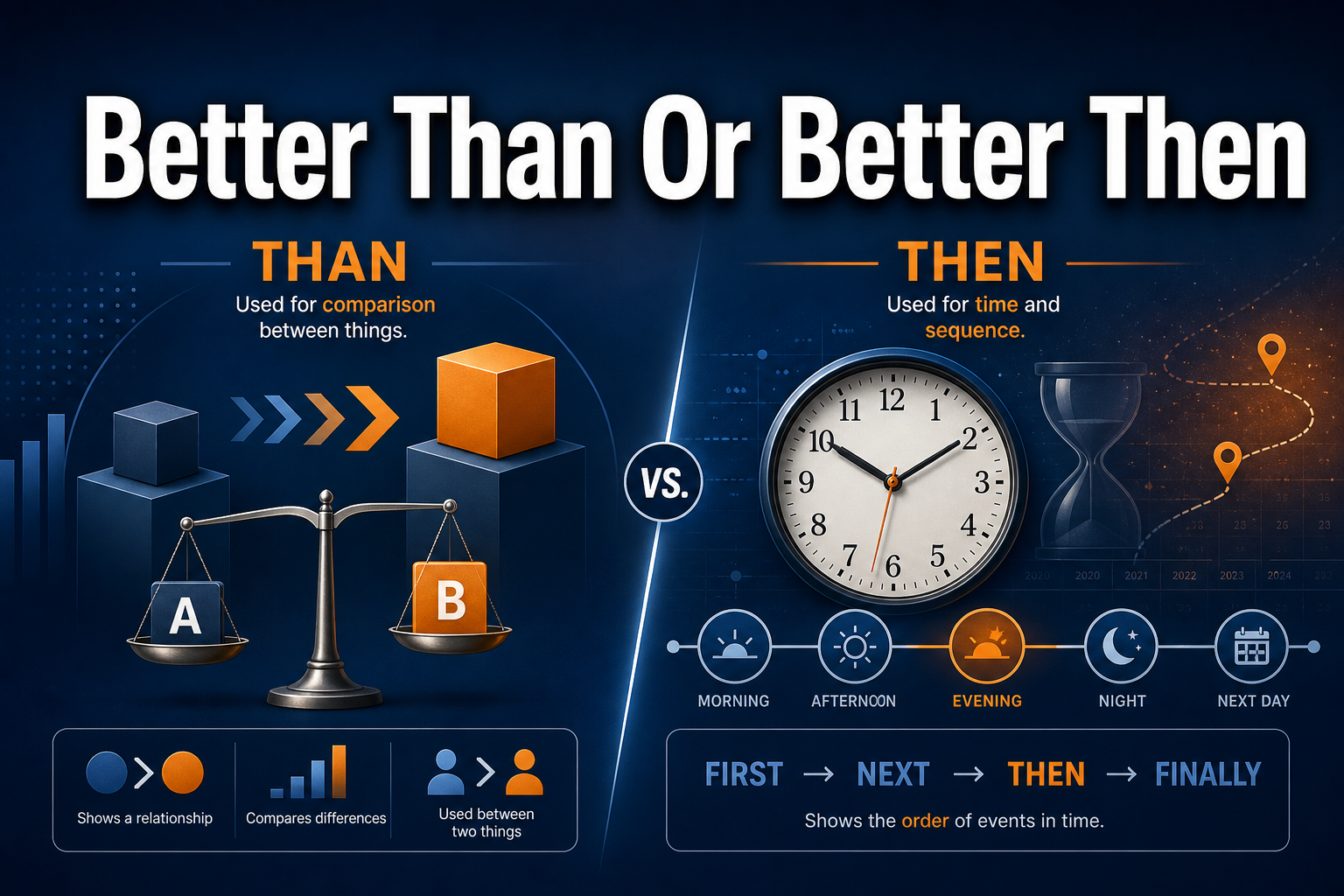
Better Than Or Better Then “Better than” is the correct phrase for making comparisons in standard English. “Better then” is almost always wrong when you’re comparing two things. The word “than” is used for comparisons (like “bigger than” or “faster than”), while “then” refers to time or sequence (like “back then” or “first this, then that”).
Key Takeaways
- “Better than” is the only correct form when comparing two things or people
- “Than” is the comparison word used after adjectives like better, worse, faster, and stronger
- “Then” relates to time, sequence, or consequence, not comparisons
- “Better then” is considered a grammar error in nearly all contexts
- Native English speakers sometimes confuse these words because they sound similar
- Grammar checking software can catch this common mistake automatically
- The rule has remained consistent for centuries and hasn’t changed in 2026
- Learning the “comparison = than” pattern helps you remember the correct usage
- Style guides and dictionaries all agree on this distinction
- Even professional writers occasionally make this error when typing quickly
What’s the Difference Between Better Than and Better Then?
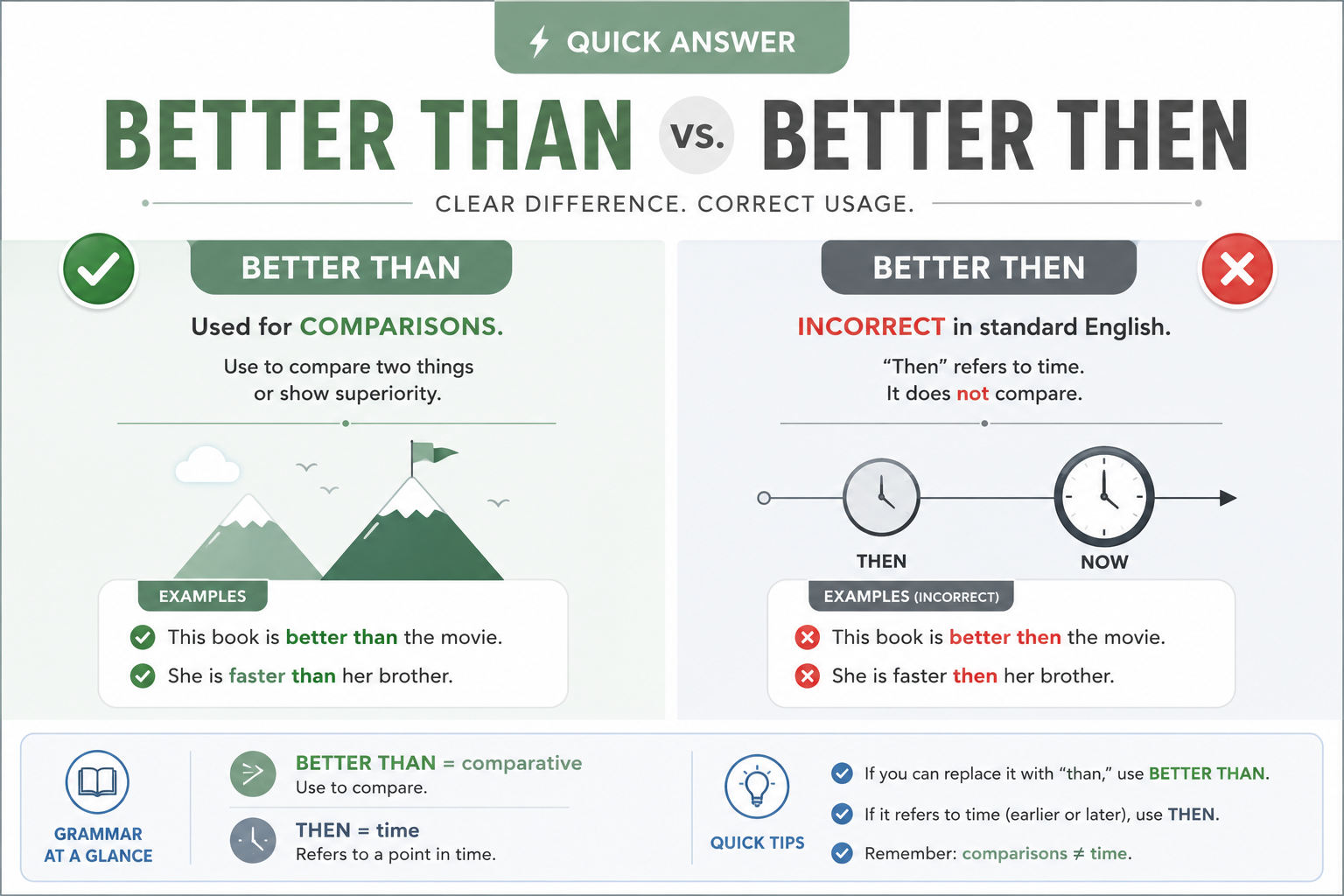
The difference between “better than” and “better then” comes down to two completely different words: “than” and “then.” These words serve distinct purposes in English grammar.
“Than” is a conjunction or preposition used exclusively for comparisons. When you’re showing that one thing is superior to, inferior to, or different from another thing, you use “than.” It appears after comparative adjectives (words ending in -er or preceded by “more” or “less”).[5]
“Then” is an adverb that deals with time, sequence, or logical consequence. It answers questions like “when?” or “what happened next?” You’ll see it in phrases about the past (“back then”), future (“see you then”), or order of events (“first this, then that”).[5]
The phrase “better than” follows the standard comparison pattern because “better” is the comparative form of “good.” Just as you’d say “taller than,” “smarter than,” or “more expensive than,” you say “better than” when ranking or comparing quality.[2]
“Better then” only makes grammatical sense when “then” refers to a specific time period, not a comparison. For example: “The weather was better then” (meaning at that past time). But this construction doesn’t compare two things—it describes a condition at a particular moment.[4]
How Do I Know Which One to Use in a Sentence?
Knowing whether to use “better than” or “better then” requires a simple test: ask yourself what you’re trying to express.
If you’re comparing two things, use “than.” Look for these signals in your sentence:
- You’re saying one thing is superior to another
- You can identify two items being compared
- You could rephrase using “compared to” or “in comparison with”
- The sentence structure is “X is better than Y”
If you’re talking about time or sequence, use “then.” Watch for these indicators:
- You’re referring to a specific time period (“at that time”)
- You’re describing what happens next in a series of events
- You’re explaining a consequence (“if X, then Y”)
- You could replace “then” with “at that time” or “next”
Here’s a practical decision rule: Choose “than” if you can point to two things being weighed against each other. If there’s no second item in the comparison, you probably need “then” instead (or you’re writing about time).
For instance, “Coffee is better than tea” clearly compares two beverages. But “Coffee tastes better then” is incomplete unless you add context like “Coffee tastes better then than it does now,” where “then” refers to a past time.[10]
Common Grammar Mistakes with Better Than or Better Then
The most frequent error is substituting “then” for “than” in comparative sentences. This happens so often that grammar sites list it as one of the top English usage mistakes.[3]
Typical wrong usage patterns:
- “She’s better then me at math” (should be “better than me”)
- “This option is better then that one” (should be “better than that one”)
- “I’d rather stay home then go out” (should be “rather than go out”)
- “Nothing tastes better then homemade food” (should be “better than homemade”)
Why these are errors: In each case, the sentence compares two things (she vs. me, this option vs. that one, staying home vs. going out, homemade vs. other food). Comparisons always require “than,” not “then.”[4]
Another common mistake is overthinking the rule and incorrectly “correcting” proper uses of “then.” Some writers become so focused on avoiding “better then” that they change legitimate time references to “than.”
For example, “Life was better then” is actually correct when “then” means “at that time in the past.” Changing it to “Life was better than” creates an incomplete sentence that needs a second comparison item.[2]
Edge case to watch: The phrase “better than ever” is always spelled with “than,” never “then,” because you’re comparing current quality to all past quality. Similarly, our guide on correct grammar usage explains other commonly confused phrases.
Why Do People Mix Up Better Than and Better Then?
People confuse “better than” and “better then” for several clear reasons, most of which have nothing to do with understanding grammar rules.
Sound similarity is the primary culprit. In casual speech, “than” and “then” are often pronounced identically or nearly so, especially in fast conversation. Both words reduce to a quick “thən” sound in connected speech, making them audibly indistinguishable.[6]
Typing speed creates errors. When writing quickly, your fingers may type the more familiar or frequent word. Since “then” appears in many common phrases (“and then,” “now and then,” “back then”), it sometimes gets typed automatically even when “than” is needed.[4]
Spell-check doesn’t catch it. Both “than” and “then” are correctly spelled English words, so standard spell-checkers won’t flag “better then” as an error. Only grammar-checking software that analyzes sentence structure can identify the mistake.[14]
The words look similar on the page. With only one letter different (a vs. e), it’s easy to misread or mistype these words, especially when proofreading your own writing where your brain tends to see what you meant rather than what you wrote.[3]
Non-native speakers face extra challenges. English learners whose first language doesn’t distinguish comparison words from time words may struggle to internalize this distinction. The pattern doesn’t always translate directly.[6]
Examples of Correct Usage for Better Than
Understanding “better than” becomes easier when you see it in various real-world contexts. Here are authority-driven examples that show the pattern clearly.
Basic comparisons:
- “This restaurant is better than the one downtown.”
- “Her presentation was better than mine.”
- “Digital marketing often performs better than traditional advertising.”
Comparisons with pronouns:
- “You’re better than you think.” (comparing you to your self-perception)
- “Nobody does it better than her.”
- “I’m better than I was yesterday.”
Comparisons with actions or states:
- “Preventing problems is better than fixing them.”
- “Earning interest is better than paying it.”
- “Working smarter is better than working harder.”
Idiomatic expressions:
- “Better late than never.”
- “Better safe than sorry.”
- “Better than nothing.”
- “Better than expected.”
- “Better than ever.”
Professional and academic writing:
- “The revised strategy performed 23% better than the baseline approach.”
- “Participants rated the new interface better than the legacy system.”
- “This method proves better than previous techniques in three key areas.”
Notice that in every example, you can identify two things being compared: restaurant A vs. restaurant B, her presentation vs. my presentation, digital vs. traditional, etc. This two-element structure is your reliable signal to use “than.”[7]
For more examples of commonly confused phrases, check out our article on might as well versus mine as well.
Are Better Than and Better Then Interchangeable?
No, “better than” and “better then” are not interchangeable in standard English. They serve completely different grammatical functions and cannot be swapped without changing meaning or creating errors.[3]
“Better than” cannot be replaced with “better then” in comparative sentences. Doing so creates a usage error that most educated readers will notice. Grammar authorities, style guides, and dictionaries all agree that “than” is the only correct choice for comparisons.[5][7]
The only scenario where “better then” appears correctly is when “then” functions as a time adverb, and even in those cases, the sentence isn’t making a comparison. For example:
- “The coffee was better then” (at that past time)
- “Things will be better then” (at that future time)
- “Make it better, then submit it” (sequence: improve it, next submit it)
In these sentences, “then” isn’t part of a comparison—it’s indicating when something happens or what happens next.[2]
Attempting to use them interchangeably reveals a fundamental grammar misunderstanding. It’s similar to confusing “your” and “you’re” or “their” and “there”—the words may sound alike, but they have distinct meanings and uses that aren’t flexible.[4]
Professional editors, grammar checkers, and writing teachers all treat “better then” (when used for comparison) as an error that needs correction, not as an acceptable variant. The rule is consistent across American English, British English, and other English varieties.[14]
How to Remember the Right Way to Use Better Than
Memory tricks make it easier to choose the correct word every time. Here are proven strategies that work for writers at all levels.
The “A for comparison” trick: Notice that “than” contains the letter A, and so does “comparison.” When you’re making a compArison, use thAN. This simple mnemonic helps thousands of writers remember the distinction.[6]
The “E for time” trick: “Then” contains the letter E, just like “when.” If your sentence is about whEN something happens, use thEN.[5]
The substitution test: Try replacing the word with “compared to.” If “compared to” makes sense, you need “than.” If it doesn’t fit, you probably need “then” or a different word entirely.[10]
The two-item check: Before writing “than” or “then,” ask yourself: “Can I point to two things being compared?” If yes, use “than.” If no, use “then” (or reconsider your sentence structure).[4]
Sound it out differently: Train yourself to pronounce “than” with a short “a” sound (like “can”) and “then” with a short “e” sound (like “when”). Exaggerating the pronunciation difference in your mind helps reinforce the distinction.[6]
Create example sentences: Write and memorize one clear example of each: “Coffee is better than tea” (comparison) and “I’ll do it then” (time). Having these anchors helps you pattern-match when writing.[2]
Similar memory techniques work for other confusing word pairs, as explained in our Gen Z slang guide which covers evolving language patterns.
Typical Errors English Learners Make with These Phrases
English learners face specific challenges with “better than” versus “better then” that differ from native speaker errors. Understanding these patterns helps both learners and teachers address the issue effectively.
Overgeneralization of “then” in all contexts. Some learners memorize “then” as a connector word and use it everywhere, including comparisons. This happens because “then” appears frequently in conditional sentences (“if…then”) and learners extend that pattern incorrectly.[3]
Direct translation interference. Many languages use the same word for comparison and time sequence, or use different grammatical structures altogether. Learners may translate their native pattern directly, producing “better then” when English requires “than.”[6]
Confusion with “that” and “than.” Some English learners mix up “than” with “that” because both can follow adjectives. They might write “better that” or confuse which word goes where, sometimes landing on “then” as a compromise.[4]
Inconsistent usage within the same text. Learners sometimes use “better than” correctly in one paragraph but switch to “better then” in another, showing they haven’t fully internalized the rule. This inconsistency signals partial understanding.[3]
Avoidance strategies that create awkward sentences. To dodge the than/then choice, some learners rewrite sentences in ways that sound unnatural: “This is good. That is not as good” instead of “This is better than that.”[10]
Common learner error patterns:
- “Study is better then play” (should be “than”)
- “This way is more better then that” (double error: “more better” and “then”)
- “Better then to do it now” (confused structure; should be “Better to do it now than later”)
What helps: Explicit instruction on the comparison vs. time distinction, extensive practice with comparative sentences, and exposure to authentic English texts where they can see the pattern used correctly hundreds of times.[14]
When Do Writers Accidentally Use the Wrong Word?
Even experienced writers occasionally mix up “better than” and “better then.” Knowing when these errors typically occur helps you catch them during editing.
During rapid first-draft writing. When ideas flow quickly, your fingers may type the wrong homophone because your brain is focused on content rather than mechanics. This is one of the most common causes of than/then errors in professional writing.[4]
In informal digital communication. Texts, social media posts, and quick emails often contain than/then errors because people prioritize speed over proofreading. The casual nature of these formats makes writers less careful.[3]
When tired or distracted. Mental fatigue reduces your ability to catch small errors. Studies show that writers make more homophone mistakes at the end of long writing sessions or when multitasking.[6]
In sentences with complex structures. Long, complicated sentences with multiple clauses make it harder to track whether you’re making a comparison or indicating sequence, increasing error rates.[10]
After editing and revision. Sometimes writers introduce than/then errors while revising. You might change a sentence structure in a way that requires switching the word, but forget to make that change.[4]
When using voice-to-text software. Speech recognition software often misinterprets “than” and “then” because they sound identical in natural speech. The software makes its best guess, which is frequently wrong.[14]
Prevention strategies:
- Build proofreading time into your writing process
- Use grammar-checking tools that catch contextual errors
- Read your work aloud to catch mistakes your eyes miss
- Search your document for every instance of “then” and verify each one
- Take breaks before final proofreading to approach your text with fresh eyes
Writers who understand their personal error patterns can develop targeted checking strategies. For instance, if you know you type “then” by default, you can specifically search for “better then” during editing.
Can Software Help Me Catch These Grammar Errors?
Yes, modern grammar-checking software can reliably catch “better than” versus “better then” errors, though not all tools are equally effective.
Advanced grammar checkers analyze context. Unlike simple spell-checkers that only verify word spelling, tools like Grammarly, ProWritingAid, and the Microsoft Editor examine sentence structure to determine whether “than” or “then” is appropriate in context.[14]
How these tools work: They use natural language processing to identify comparative constructions. When they detect a comparative adjective like “better” followed by “then,” they flag it as a likely error and suggest “than” instead.[2]
Effectiveness varies by tool:
- Premium grammar checkers (Grammarly Premium, ProWritingAid) catch this error reliably in almost all contexts
- Built-in word processor checkers (Microsoft Word, Google Docs) catch it most of the time but may miss some cases
- Basic spell-checkers (like simple browser extensions) typically don’t catch it at all because both words are spelled correctly
- AI writing assistants (ChatGPT, Claude with editing prompts) can identify and explain these errors when asked to review text
Limitations to be aware of: Software may occasionally flag correct uses of “then” as errors if the sentence structure is unusual. You still need to understand the rule to evaluate whether the software’s suggestion is right.[4]
Best practices for using grammar software:
- Run your text through a grammar checker before publishing
- Don’t blindly accept all suggestions—understand why each change is recommended
- Use these tools as learning aids, not just correction machines
- Combine software checking with manual proofreading for best results
Free options that work well: The free version of Grammarly, the Hemingway Editor (for readability), and the built-in grammar checker in Google Docs all catch than/then errors with reasonable accuracy.[10]
For writers who frequently make this mistake, setting up your grammar checker to be more aggressive about flagging potential errors can help you learn the pattern faster. Similar to how we explain text message abbreviations, understanding the tools available helps you communicate more clearly.
Do Native English Speakers Always Use Better Than Correctly?
No, native English speakers make than/then errors regularly, despite having intuitive knowledge of English grammar. This might surprise English learners who assume native speakers never make such mistakes.
Research and observation show that than/then confusion appears frequently in native speaker writing. Grammar blogs, editing forums, and writing teachers consistently list this among the top errors they see, even in writing by educated native speakers.[3][4]
Why native speakers make this error:
- Homophones sound identical: In most English dialects, “than” and “then” are pronounced the same way in casual speech, removing the auditory cue that might prevent errors.[5]
- Typing speed outpaces conscious thought: Fast typists often produce the wrong word because their fingers follow habit patterns rather than conscious word choice.[4]
- Informal writing gets less attention: Native speakers are more careful in formal contexts (academic papers, business reports) than in texts, social media, or emails.[3]
- Autocorrect doesn’t help: Since both words are valid, autocorrect won’t flag the error, and many native speakers don’t proofread casual writing.[14]
The error appears across education levels. Grammar experts have documented than/then mistakes in published books, professional websites, and even in writing by people with advanced degrees. It’s not limited to less educated writers.[6]
However, native speakers usually recognize the error when it’s pointed out. Unlike some grammar rules that educated speakers genuinely disagree about, most native speakers immediately see that “better then” is wrong once they focus on it. The error is typically one of inattention rather than lack of knowledge.[10]
Context matters: Native speakers make this error far more often in quick, informal digital writing than in carefully edited formal writing. A native speaker might type “better then” in a text message but would likely catch and correct it in a resume or report.[4]
This pattern suggests that for native speakers, the issue is usually about writing mechanics and proofreading rather than fundamental grammar confusion. For learners, this is actually encouraging—it means that even if you occasionally make this error, you’re in good company, and the solution is mainly about developing careful editing habits.
What Do Style Guides Say About Better Than Versus Better Then?
Major style guides and authoritative grammar references uniformly agree on the than/then distinction, providing consistent guidance for writers across all contexts.
Merriam-Webster’s usage guide explicitly addresses this issue, stating that “than” is the word used in comparisons and appears after comparative adjectives, while “then” relates to time and sequence. The guide emphasizes that this rule is not a matter of preference but of standard English grammar.[5]
The Associated Press (AP) Stylebook and The Chicago Manual of Style, two of the most influential style guides in American publishing, both specify “than” for comparisons without exception. Neither guide lists any acceptable use of “then” in comparative constructions.[7]
Dictionary.com defines “better than” as a standard phrase meaning “superior to” or “more than,” noting that this usage dates back to the 9th century. The entry makes no mention of “better then” as a variant, indicating it’s not recognized as standard.[7]
Scribbr and other academic writing guides used by students and researchers worldwide provide clear rules: use “than” after comparatives (better, worse, more, less) and use “then” for time, sequence, and consequence. These guides treat “better then” in comparisons as an error to be corrected.[2][14]
Grammar reference books (such as “Practical English Usage” by Michael Swan and “The Elements of Style” by Strunk and White) consistently present the same rule. There is no disagreement among authoritative sources on this point.[6]
What this means for writers: You can confidently use “better than” for all comparisons, knowing that this choice is supported by every major style authority. If you’re writing for publication, academic submission, or professional contexts, “than” in comparisons is not just preferred—it’s required.[3]
No evolution or change in 2026: Some grammar rules have shifted over time or vary between English dialects, but the than/then distinction has remained stable for centuries and shows no signs of changing. What was correct in 1926 remains correct in 2026.[5][7]
The unanimous agreement among style guides makes this one of the clearer rules in English grammar, even though the similar sound of the words makes it easy to confuse them in practice.
Conclusion
The distinction between “better than” and “better then” is straightforward once you understand the core principle: “than” is for comparisons, and “then” is for time and sequence. This rule has remained consistent throughout English grammar history and continues unchanged in 2026.
Key points to remember:
- Always use “better than” when comparing two things
- “Than” follows comparative adjectives like better, worse, faster, and stronger
- “Then” refers to time (“back then”) or sequence (“first this, then that”)
- The error is common because the words sound identical in speech
- Grammar-checking software can help you catch these mistakes
- Even native speakers make this error in casual writing
- All major style guides agree on this distinction
Actionable next steps:
- Review your recent writing and search for instances of “then” to verify you used it correctly
- Set up a grammar checker that catches contextual errors
- Practice the memory tricks: “compArison = thAN” and “whEN = thEN”
- When editing, specifically look for comparative adjectives and check what word follows them
- Read more examples of correct usage to internalize the pattern
Understanding this grammar rule improves your writing clarity and credibility. While everyone makes occasional mistakes, knowing the difference between “better than” and “better then” helps you communicate more effectively and avoid errors that distract readers from your message.
Frequently Asked Questions
Is “better then” ever correct in English?
Yes, but only when “then” refers to time, not comparison. “The weather was better then” (meaning at that past time) is correct. However, “This is better then that” is always wrong—it should be “better than.”
Why do I keep mixing up than and then?
You mix them up because they sound identical in speech. Your brain hears them the same way, so when writing quickly, you may type the wrong one. Using grammar-checking software and proofreading specifically for this error helps break the habit.
Can I use “better than” with pronouns like “me” or “I”?
Yes. Both “better than me” and “better than I” appear in English, though “better than I am” is more formally complete. In casual writing, “better than me” is widely accepted and natural-sounding.
What’s the difference between “rather than” and “rather then”?
“Rather than” is correct for expressing preference between two options. “Rather then” is incorrect in standard English. The same rule applies: “than” for comparisons and choices, “then” for time.
Do British and American English differ on this rule?
No. Both British and American English use “than” for comparisons and “then” for time. The rule is identical across all major English dialects, including Australian, Canadian, and other varieties.
How can I train myself to stop making this mistake?
Use the “compArison = thAN” memory trick, enable grammar checking in your writing software, proofread specifically for this error, and practice writing comparison sentences correctly. Most people improve within a few weeks of focused attention.
Is “more better than” ever correct?
No. “More better” is incorrect because “better” is already the comparative form of “good.” Use either “better than” or “more good than” (though the latter sounds awkward). Never combine “more” with “better.”
What other words follow the same pattern as “than”?
All comparative adjectives use “than”: taller than, smarter than, more expensive than, less interesting than, worse than, faster than. If you’re comparing, you need “than.”
Can grammar apps make mistakes with than versus then?
Yes, though rarely. Advanced grammar checkers are very accurate with this distinction, but they may occasionally flag unusual sentence structures incorrectly. Understanding the rule yourself helps you evaluate whether the software’s suggestion is right.
Why does my phone’s autocorrect not fix this error?
Autocorrect only fixes misspelled words. Since both “than” and “then” are correctly spelled English words, autocorrect can’t determine which one you meant. You need grammar-checking software, not just spell-checking, to catch this error.
Is this error considered serious in professional writing?
Yes. Using “better then” instead of “better than” in professional or academic writing is considered a basic grammar error that can hurt your credibility. It’s one of the mistakes that educated readers notice immediately.
How long has this grammar rule existed?
The distinction between “than” for comparison and “then” for time has existed for centuries in English. Dictionary.com notes that “better than” has been used since the 9th century, and the rule hasn’t changed since then.