

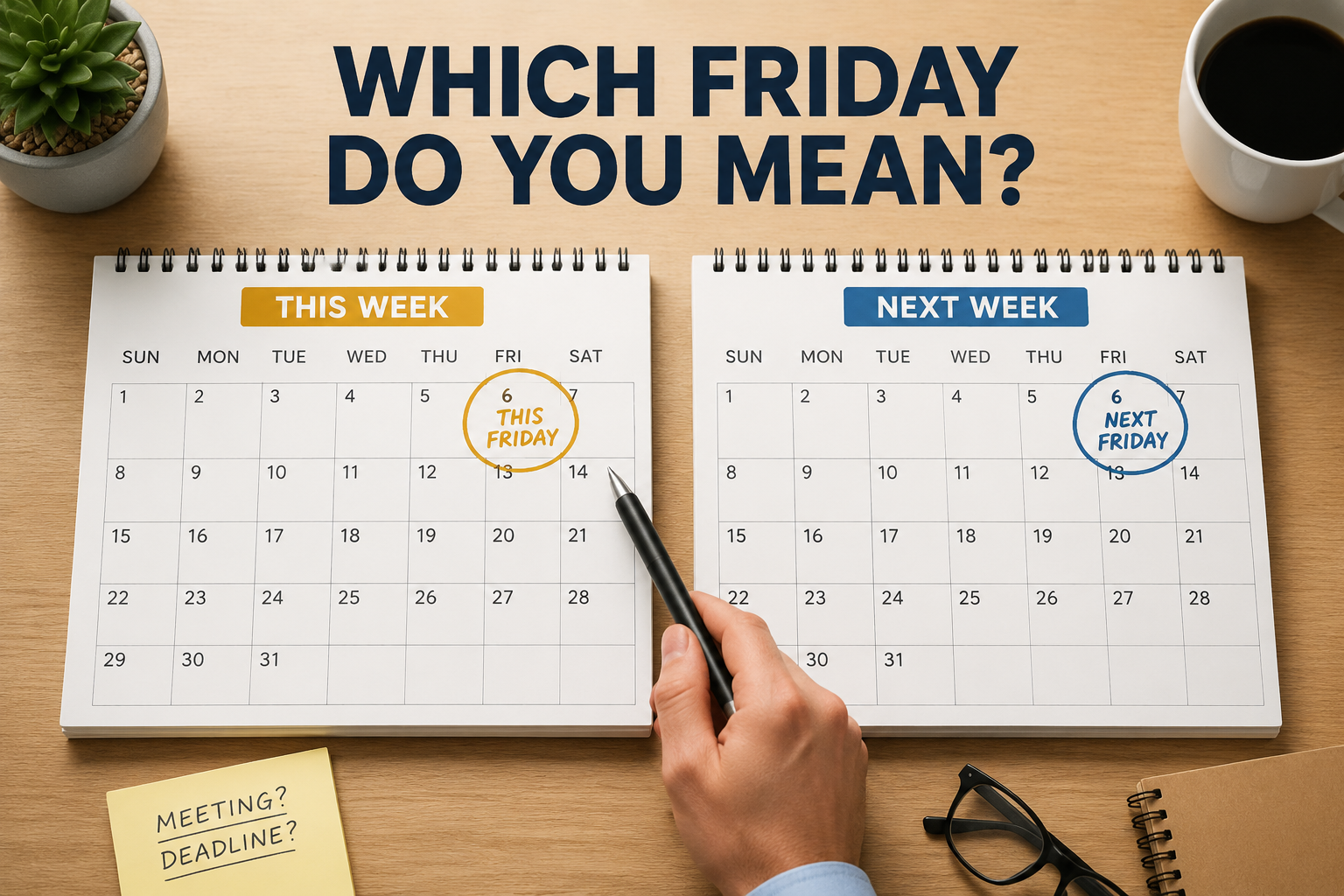
Next Friday or This Friday “This Friday” means the coming Friday in the current week. “Next Friday” means the Friday after that one full week later. The confusion between these two phrases causes real scheduling mix-ups every day, so knowing the difference matters.
Key Takeaways
- “This Friday” refers to the nearest upcoming Friday, within the current week
- “Next Friday” typically means the Friday of the following week, not the closest one
- The confusion is extremely common and well-documented in English grammar discussions [1]
- Context and day of the week both affect how people interpret these phrases
- Regional and generational differences make “next Friday” especially tricky [5]
- When in doubt, always use a specific date (e.g., “Friday, June 27”) to avoid confusion
- Saying “this coming Friday” or “a week from Friday” adds helpful clarity
- Both phrases can mean different things to different people, even native English speakers [8]
What Does “This Friday” Actually Mean?
“This Friday” means the Friday that is coming up soonest in the current week. It is the closer of the two Fridays people often debate.
For example, if today is Tuesday, June 23, then “this Friday” is June 27. Most English speakers agree on this interpretation. The word “this” points to something nearby in time, that means the Friday you will reach first.
One exception: If today is already Friday, saying “this Friday” gets awkward. Some people mean today; others mean next week. In that case, skip the phrase entirely and use the date.
- Use “this Friday” when you mean the Friday coming up in the next few days
- Avoid it if the current day is Thursday or Friday, since it creates confusion
- It works best when said early in the week (Monday through Wednesday)
What Does “Next Friday” Mean and Why Is It Confusing?
“Next Friday” most commonly refers to the Friday of the following week, not the closest one. This is where most scheduling mistakes happen. [2]
If today is Tuesday, June 23, then “next Friday” would be July 4 not June 27. The word “next” implies you are skipping past the nearest Friday and landing on the one after it.
But here is the problem: many people use “next Friday” to mean the very next Friday coming up. Research on English usage forums shows this is one of the most debated phrases in everyday English. [8]
Why the confusion exists:
- “Next” can mean “the one immediately following” in some contexts
- Regional differences play a role — speakers in some areas use “next” to mean the closest upcoming instance [5]
- Generational habits differ; older speakers often treat “next Friday” as one week out, while younger speakers sometimes use it interchangeably with “this Friday” [10]
- The day you say it matters — on a Monday, “next Friday” feels far away; on a Thursday, it feels close
Common mistake: Texting a friend “see you next Friday” when you mean in two days. They show up a week and a half later. This kind of mix-up is exactly why specific dates are always safer.
How the Day of the Week Changes Everything
The meaning of “next Friday or this Friday” shifts depending on what day you say it. This is the part most grammar guides skip.
| Today Is | “This Friday” Means | “Next Friday” Means |
|---|---|---|
| Monday | 5 days away | 12 days away |
| Wednesday | 3 days away | 10 days away |
| Friday | Today (awkward) | 7 days away |
| Saturday | 7 days away | 14 days away |
| Sunday | 6 days away | 13 days away |
On a Saturday or Sunday, “this Friday” jumps to the following week, which makes it feel like “next Friday” anyway. That overlap is where most people get tripped up. [3]
Decision rule: If you are speaking on a weekend, just say the date. Both phrases lose their clarity when the week has already ended.
Next Friday or This Friday: What Do Grammar Experts Say?
Most grammar resources agree that “this Friday” is the closer Friday and “next Friday” is one week beyond that. [4]
Grammar guides consistently recommend treating these phrases as two separate points in time, not interchangeable terms. The phrase “next” in time expressions traditionally signals a full week’s jump forward — similar to how “next month” means the month after the current one, not the rest of this month. [1]
However, real-world usage does not always follow the textbook rule. In casual conversation and text messages, people frequently use “next Friday” to mean the very next Friday coming up. This is especially true in informal digital communication, where brevity often wins over precision.
For content creators, business owners, or anyone scheduling events online, this ambiguity can cost real time and money. A missed meeting or a late delivery because of a misread Friday is a preventable problem.
If you enjoy exploring how language creates confusion in everyday life, you might also find it interesting to read about common grammar mistakes like “mine as well or might as well” or the debate around it is must vs it is a must — both show how small word choices carry big meaning.

How to Avoid Confusion When Scheduling
The straightforward fix is to stop relying on “this Friday” or “next Friday” alone. Use these phrases as a starting point, then add the actual date.
Step-by-step approach for clear scheduling:
- Say the phrase first: “This Friday” or “Next Friday”
- Follow it immediately with the date: “…June 27”
- If speaking verbally, confirm by repeating: “So that’s Friday the 27th, right?”
- In writing, always include the full date in parentheses
Better alternatives to use:
- “This coming Friday” — signals urgency and nearness
- “A week from Friday” — removes all doubt about which Friday
- “Friday the [date]” — the clearest option every time
- “Two Fridays from now” — useful when you are already past one Friday
This approach works in texts, emails, calendar invites, and verbal conversations. It takes two extra seconds and eliminates the back-and-forth of “wait, which Friday did you mean?” [9]
Language evolves fast in digital spaces. If you want to stay sharp on how phrases shift in meaning online, check out this breakdown of Gen Z slang and what these terms mean — it shows how quickly everyday language can change meaning depending on context.
Regional and Cultural Differences That Affect Interpretation
Not everyone speaks English the same way, and “next Friday” is a perfect example of where regional habits create real misunderstandings. [5]
In British English, “next Friday” tends to mean the Friday of the following week — firmly one week beyond the nearest one. In American English, usage is more flexible, and many speakers treat “next Friday” as simply the upcoming Friday. [2]
This matters if you work with international teams, run an online business, or communicate across time zones. A British colleague and an American colleague could read the same message and arrive on different Fridays.
Smart recommendations for cross-cultural communication:
- Always use dates in professional emails, not day references alone
- When scheduling across regions, include the day, date, and time zone
- If you receive a message with “next Friday,” confirm the date before assuming
Language clarity is a professional skill. The same care you put into understanding phrases like what DWS means in a text message or what WTV means in text applies here — context and audience always shape meaning.
Practical Examples of Next Friday or This Friday in Real Life
Here are real-world examples that show how these phrases play out and where they go wrong.
Example 1 — Work email (sent on Monday):
“The report is due this Friday.”
Clear. Everyone knows it is due in five days.
Example 2 — Group chat (sent on Thursday):
“Party at my place next Friday!”
Unclear. Is that tomorrow (Friday) or eight days from now?
Example 3 — Verbal conversation (said on Sunday):
“Let’s meet this Friday.”
Confusing. Is that six days away or does “this” refer to the week just starting?
Example 4 — Calendar invite (any day):
“Team sync — Friday, July 11”
Perfect. No ambiguity at all.
The pattern is clear: the more specific you are, the better. Phrases like “next Friday or this Friday” work as conversation starters, but they should never be the only information you give when a deadline or meeting is on the line.
FAQ
Is “next Friday” the same as “this Friday”?
No. “This Friday” is the closest upcoming Friday. “Next Friday” is the Friday after that — one full week later. They refer to two different dates.
What does “this Friday” mean if today is Thursday?
If today is Thursday, “this Friday” means tomorrow. However, many people find this confusing and prefer to just say “tomorrow” instead.
What does “next Friday” mean if today is Monday?
If today is Monday, “next Friday” means the Friday of the following week — 12 days away, not 5 days away.
Why do people disagree about what “next Friday” means?
Regional habits, generational differences, and informal usage have blurred the line. Native English speakers genuinely interpret the phrase differently depending on where they grew up and how they learned to use it. [8]
What is the safest way to say which Friday I mean?
Always add the specific date. Say “this Friday, June 27” or “next Friday, July 4” so there is zero room for misinterpretation.
Does “next Friday” mean something different in British vs. American English?
Yes, generally. British English tends to treat “next Friday” as the Friday of the following week. American English is less consistent, and many speakers use it to mean the very next Friday. [2]
Can “this Friday” refer to a Friday that already passed?
No. “This Friday” always refers to an upcoming Friday, not one in the past. For a past Friday, say “last Friday.”
What should I say if today is already Friday and I mean next week?
Say “a week from today” or “Friday the [date].” Saying “next Friday” on a Friday is especially confusing and best avoided.
Is it okay to use “next Friday” in a professional email?
Only if you include the date alongside it. In professional settings, always pair day references with the actual calendar date to avoid scheduling errors.
What is the clearest phrase to use instead of “next Friday or this Friday”?
“Friday, [month] [day]” is always the clearest. If you want a phrase, “this coming Friday” (for the nearest one) and “a week from Friday” (for the one after) are both unambiguous.
Conclusion
The debate over “next Friday or this Friday” is not just a grammar question — it is a practical communication issue that affects schedules, deadlines, and plans every day. The standard rule is simple: “this Friday” is the nearest upcoming Friday, and “next Friday” is the one a full week beyond that. But because real-world usage varies by region, generation, and context, the safest move is always to add the actual date.
Actionable next steps:
- Start using specific dates alongside day references in all your messages
- When you receive a message with “next Friday,” reply to confirm the exact date before agreeing
- In professional emails and calendar invites, always write the full date
- If you are scheduling across countries or time zones, include the date and time zone every time
Small language habits like this one save real time and prevent real frustration. Clear communication is a skill worth building — and it starts with knowing exactly which Friday you mean.
References
https://www.reddit.com/r/grammar/comments/62ej93/why_does_the_phrase_next_friday_mean_2_fridays/
[9] Next Friday Vs This Friday – https://grammerpalat.com/next-friday-vs-this-friday/
[10] Question 182835 – https://www.italki.com/en/post/question-182835