Wyrd (pronounced “weird”) is an Old English and Old Norse concept meaning personal fate or destiny — but it is not fixed. It is the ongoing result of your past actions, your ancestry, and the choices you make right now. Think of it as a living thread being woven in real time, not a locked-in outcome you cannot touch.
Key Takeaways
- Wyrd comes from the Old English word “weorthan,” meaning “to become” or “to happen.”
- It is best translated as personal fate, but it is more active and dynamic than the word “fate” usually suggests.
- The Norns three powerful beings in Norse mythology are said to weave wyrd for every living creature.
- Wyrd is shaped by your past actions, your family line, and your present choices.
- It is not the same as karma, though both concepts share some overlap.
- You cannot fully escape your wyrd, but how you meet it is considered deeply important in Norse thought.
- Modern pagans and practitioners of Heathenry actively work with wyrd as a spiritual framework.
- The English word “weird” comes directly from wyrd, originally meaning “having power over fate.”
What Does Wyrd Mean in Norse Mythology?
Wyrd is the Old Norse and Old English concept of personal fate — the idea that every person has a unique thread of destiny that is constantly being shaped by their actions, their ancestors, and the forces around them. In Norse mythology, wyrd is not a punishment or a gift. It is simply the pattern of your existence as it unfolds.
The word appears in Old English texts like Beowulf, where it is used to describe the force that determines when and how a person meets their end. Warriors would say things like “wyrd goes as it must” — accepting that some outcomes are beyond human control, while still choosing to face them with courage.
Wyrd is closely tied to the concept of the web of fate, a vast invisible network connecting every living being. Your thread in that web is your wyrd.
What Is the Origin of the Word Wyrd?
The word wyrd comes from the Proto-Germanic root “wurthi,” which evolved into the Old English verb “weorthan,” meaning “to become” or “to turn out.” So wyrd literally means “that which has become” or “that which is happening.”
Over centuries, the word shifted in meaning. By the Middle English period, it had taken on the sense of something strange or uncanny — because people associated fate with mysterious, supernatural forces. That is how the modern English word “weird” was born. If something seemed “wyrd,” it seemed connected to fate and therefore eerie or unusual.
So the next time someone calls something “weird,” they are unknowingly using a word rooted in ancient Norse ideas about destiny.
How Is Wyrd Different From Fate?
Wyrd and fate are related but not identical. “Fate” in Western tradition often implies a fixed, unchangeable outcome — something written in stone before you were born. Wyrd is more fluid than that.
Here is a straightforward breakdown:
| Concept | Fixed or Flexible? | Shaped By | Who Controls It? |
|---|---|---|---|
| Fate (Western) | Mostly fixed | Divine will | Gods or the universe |
| Wyrd (Norse) | Partially flexible | Past actions, ancestry, present choices | The Norns + the individual |
| Karma (Eastern) | Flexible over lifetimes | Actions across lives | The individual |
Wyrd acknowledges that some things are set — your birth, your family, certain major events — but how you respond to those things also becomes part of your wyrd. Your choices today are literally weaving tomorrow’s thread.
What Is the Connection Between Wyrd and the Norns?
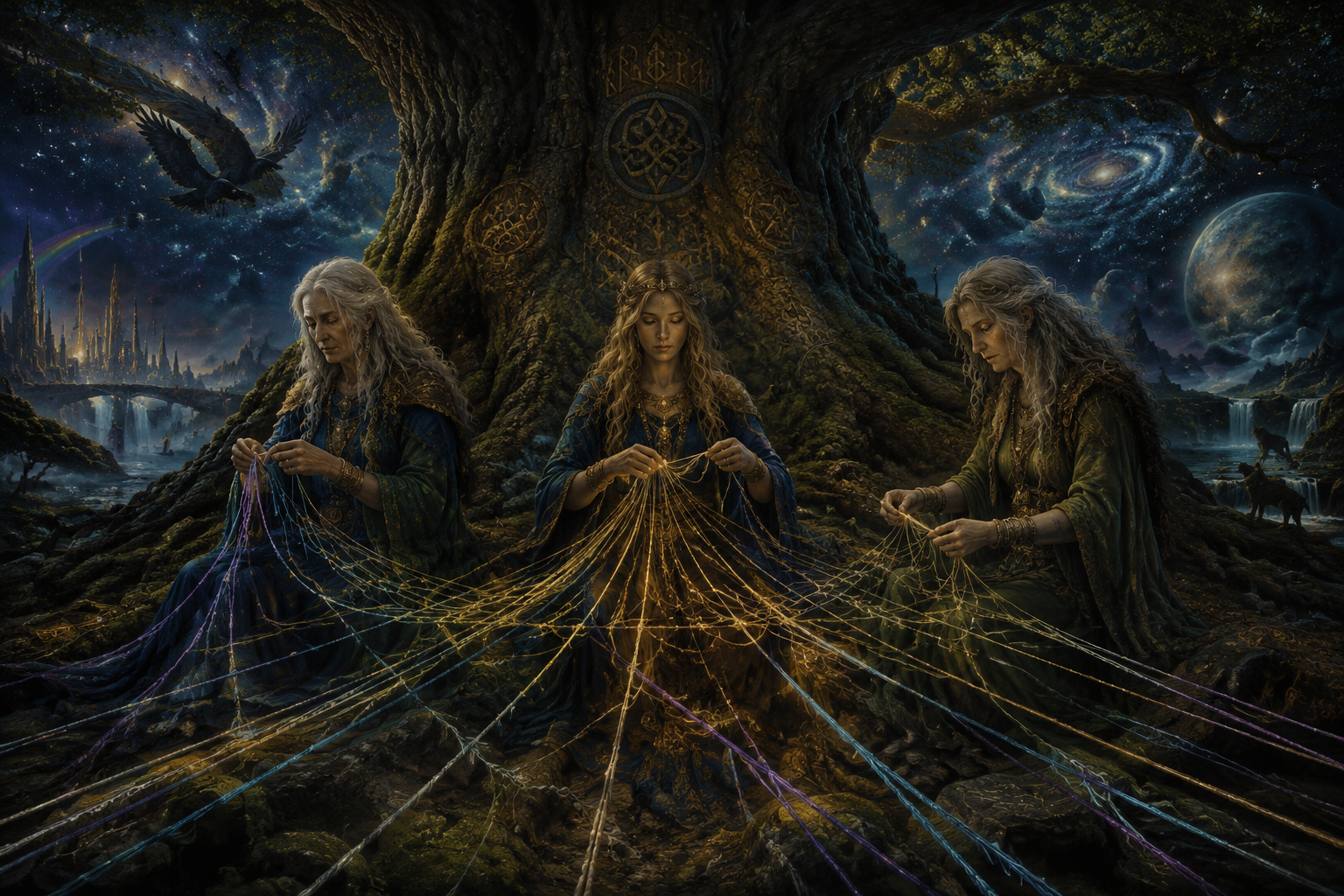
The Norns are the three beings in Norse mythology most directly responsible for wyrd. They are named Urd (what has been), Verdandi (what is becoming), and Skuld (what shall be). They live at the base of Yggdrasil, the great world tree, beside the Well of Urd.
Their job is to weave the wyrd of every god, human, and creature in the nine worlds. They carve runes into the trunk of Yggdrasil and spin threads that represent individual lives. When a thread is cut, that life ends.
The Norns are not evil. They are neutral forces, more like cosmic record-keepers and weavers than judges. They do not punish or reward — they simply weave what is.
This concept of the Norns is similar to the Greek Moirai (the Fates), though the Norse version places more emphasis on the role of past actions in shaping the current thread. If you are interested in symbolic meanings tied to fate and time, the sand clock tattoo meaning explores similar themes of time and destiny in visual form.
What Are Some Examples of Wyrd in the Sagas?
The Norse sagas are full of wyrd in action. Here are a few clear examples:
- Beowulf: The hero acknowledges that wyrd will decide the outcome of his battle with Grendel. He fights anyway, with full courage, because meeting your wyrd bravely is what matters.
- The Volsunga Saga: Sigurd’s fate is woven before his birth. His family line, his dragon-slaying, and his death are all part of a wyrd set in motion long before he acts. Yet his choices — to be brave, to be loyal — define how that wyrd plays out.
- Njal’s Saga: Characters often speak of what “must be” while still making deliberate choices. The tension between what is fated and what is chosen runs through the whole story.
The pattern is consistent: characters know some things cannot be avoided, but they are judged by how they face those things, not just by the outcome.
Who Determines Wyrd?
Wyrd is shaped by three forces working together, not by one single authority.
- The Norns — They weave the broad pattern of your life based on cosmic order.
- Your ancestors (orlog) — The actions of your family line before you create a kind of inherited layer of wyrd. In Norse thought, you carry the weight and the strength of those who came before.
- Your own actions — Every choice you make adds a new thread to your wyrd. This is why Norse culture placed enormous value on honor, courage, and loyalty. Those qualities literally shaped your fate.
This three-part structure is what makes wyrd different from simple predestination. You are not just a passive passenger.
Can You Change Your Wyrd?
You cannot erase your wyrd, but you actively shape it with every decision. The Norse worldview held that some things — your birth, your death, certain major turning points — are set. But the quality and character of your life between those points is yours to influence.
Think of it this way: you did not choose your starting point, but every action you take from here adds to the thread. A person who acts with honor builds a stronger, more respected wyrd. A person who breaks oaths and acts with cowardice weakens their thread.
So the answer is: you cannot change the framework, but you are always weaving the details.
Is Wyrd a Good or Bad Thing?
Wyrd is neither good nor bad on its own. It is simply the pattern of your existence. Whether your wyrd is seen as positive or negative depends on the actions that have shaped it and how you meet the challenges it brings.
In Norse culture, a “good wyrd” was associated with a life lived with courage, loyalty, and honor. A “bad wyrd” often came from broken oaths, cowardice, or betrayal — not because the universe punished those things, but because those actions literally wove a weaker, more tangled thread.
The concept is value-neutral at its core, but deeply moral in its implications.
What Does It Mean to Weave Your Wyrd?
“Weaving your wyrd” means actively participating in the creation of your own fate through conscious, honorable choices. It is the practical side of the wyrd concept.
If the Norns weave the broad pattern, you are always adding stitches in real time. Every promise you keep, every act of courage, every relationship you honor — these are threads you are weaving into your own life’s fabric.
Modern practitioners of Heathenry (Norse paganism) use this idea as a daily spiritual practice. They ask: “What am I weaving today?” It is a straightforward way to apply an ancient concept to present-day decisions. This idea of symbolic meaning woven into daily life also shows up in things like mandala tattoo meaning, where patterns represent the interconnected nature of existence.
How Does Wyrd Relate to Karma?
Wyrd and karma share a core idea: your actions have consequences that shape your future. But they work differently.
- Karma (in Hindu and Buddhist traditions) operates across multiple lifetimes. Your actions in this life affect your next life.
- Wyrd operates within this life and through your ancestral line. Your actions affect your own thread and can influence your descendants.
Both concepts reject the idea that life is random. Both say that what you do matters. The key difference is the timeframe and the mechanism. Wyrd is more immediate and community-focused; karma is more individual and cosmic in scale. For another take on layered symbolic meaning, see our guide on memento vivere meaning, which explores how ancient phrases carry living wisdom.
What Is a Common Misconception About Wyrd?
The biggest misconception is that wyrd means total predestination — that everything is locked in and nothing you do matters. That reading misses the point entirely.
Wyrd is not a script. It is more like a river. The river has banks (the broad shape of your fate), but the water moves based on what happens within those banks. Your choices, your character, and your relationships all affect how the water flows.
A second misconception is that wyrd only applies to death or tragedy. In reality, Norse texts use wyrd to describe all of life’s major patterns — love, success, community, and loss alike.
How Is Wyrd Used in Modern Paganism?
In modern Heathenry and Norse paganism, wyrd is a living spiritual concept, not just a historical curiosity. Practitioners use it as a framework for ethical decision-making and self-reflection.
Common modern applications include:
- Seidr practice — A form of Norse shamanic work that some believe allows a practitioner to sense or influence threads of wyrd.
- Rune work — Runes are used to read and reflect on one’s current wyrd, not to predict a fixed future but to gain clarity on present patterns.
- Ancestor veneration — Honoring ancestors is seen as a way to acknowledge the orlog (inherited wyrd) they passed down and to strengthen your own thread.
- Ethical reflection — Many Heathens ask themselves regularly what kind of wyrd they are weaving through their daily actions.
This is a practical, grounded approach to an ancient idea. If you are drawn to symbolic systems that carry deep meaning, you might also find value in exploring the spiritual meaning of rivers in dreams, which touches on similar themes of flow, direction, and fate.
Is Wyrd Similar to Destiny?
Wyrd and destiny overlap but are not the same. “Destiny” in popular culture often implies a grand purpose — a hero’s calling, a special role. Wyrd is more democratic than that. Every person, animal, and god has a wyrd, not just heroes or chosen ones.
Destiny also tends to feel positive and teleological (moving toward a goal). Wyrd is more neutral. It is simply the total pattern of what has been and what is becoming, shaped by action and ancestry.
Choose wyrd as your framework if you want a concept that holds you accountable for your choices. Choose destiny if you want a concept focused on purpose and direction. They are not opposites — they just emphasize different things.
Are There Books or Resources to Learn More About Wyrd?
Yes. Here are credible starting points for deeper study:
- “The Well and the Tree” by Paul C. Bauschatz (1982) — One of the most cited academic works on wyrd and Old Norse cosmology. Bauschatz gives a careful, text-based analysis of how wyrd functions in early Germanic thought.
- “Wyrd: Fate and Destiny in the Northern Tradition” by Brian Bates (1983) — A more accessible, narrative-driven exploration of the concept.
- “The Prose Edda” by Snorri Sturluson (translated by Jesse Byock, 2005) — The primary source for Norse mythology, including the Norns and the web of fate.
- “A Practical Heathen’s Guide to Asatru” by Patricia M. Lafayllve (2013) — A modern practitioner’s guide that covers wyrd in a contemporary context.
- Online: The Troth (thetroth.org) is a respected Heathen organization with articles and resources on wyrd and related concepts.
For more explorations of symbolic and cultural meaning, check out our breakdown of sigma meaning in modern slang — a contemporary example of how ancient archetypes keep showing up in new language.
Wyrd Meaning Across Cultures: A Broader View
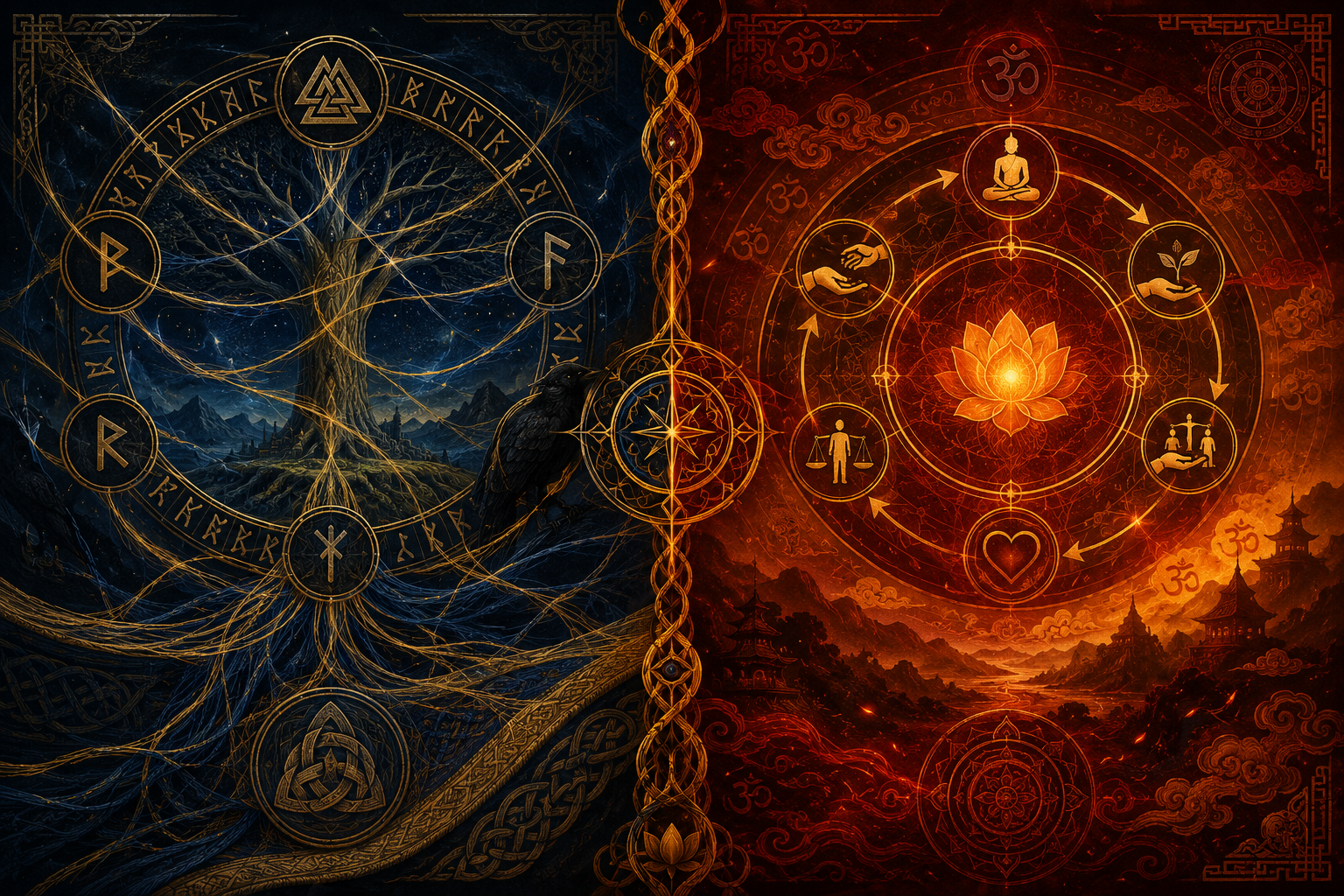
The wyrd meaning does not exist in isolation. Similar concepts appear across many cultures, which suggests this idea of woven, action-shaped fate is deeply human.
- Greek Moirai — The three Fates (Clotho, Lachesis, Atropos) spin, measure, and cut the thread of life. Very similar structure to the Norns.
- Roman Parcae — The Roman equivalent of the Moirai, with the same three-part structure.
- Hindu karma — Actions shape future circumstances, though the mechanism differs from wyrd.
- Celtic concepts of geis — A binding obligation or fate-curse that shapes a hero’s path, similar in function to wyrd.
The cross-cultural pattern is clear: humans across history have felt that life is neither purely random nor fully controlled. Wyrd is the Norse answer to that tension. You might also notice this tension in symbolic imagery like the crow tattoo meaning, where the crow often represents the threshold between fate and free will in multiple traditions.
FAQ: Wyrd Meaning — Common Questions Answered
How do you pronounce wyrd?
Wyrd is pronounced like the modern English word “weird.” The “y” in Old English was pronounced like a “u” or “ee” sound, so “wyrd” sounded close to “weerd.”
Is wyrd the same as doom in Norse mythology?
Not exactly. “Doom” in Old Norse (dom) meant judgment or decree, often a specific fate handed down. Wyrd is broader — it is the entire pattern of a life, not just a single judgment.
Did the Vikings believe in free will?
Norse thought held a nuanced position. Some things were set (birth, death, major events), but character and choice were still deeply valued. Free will existed within the framework of wyrd.
Why does the word “weird” come from wyrd?
Because things connected to fate were seen as uncanny and supernatural. Over time, “wyrd” shifted from meaning “fate” to meaning “strange” or “eerie” in Middle English.
Can wyrd be broken?
In the sagas, attempting to escape wyrd usually makes things worse. The Norse view was that accepting and meeting your wyrd with courage was wiser than fighting it.
Is wyrd only for Norse pagans?
No. Wyrd is a historical and philosophical concept that anyone can study and apply. Many people use it as a secular framework for thinking about accountability and the consequences of their actions.
What is orlog and how does it relate to wyrd?
Orlog is the layer of inherited fate the actions of your ancestors that become part of your starting wyrd. It is the foundation on which your personal wyrd is built.
Is wyrd mentioned in the Bible or Christian texts?
Wyrd appears in Old English Christian texts like Beowulf, where Christian scribes adapted it. It was sometimes used alongside concepts of God’s will, blending the two worldviews.
How is wyrd different from luck in Norse culture?
Luck (hamingja) in Norse culture was a kind of personal power or fortune that could be inherited or shared. Wyrd is the broader pattern of fate. Luck was one factor within wyrd, not a separate system.
What is the web of wyrd?
The web of wyrd is a visual metaphor for the interconnected fates of all beings. It is sometimes represented by a nine-stave symbol used in modern Heathenry to represent the runes and the interconnected nature of all things.
Conclusion: What the Wyrd Meaning Teaches Us Today
The wyrd meaning is not just an ancient curiosity. It is a practical framework for how actions, ancestry, and present choices combine to shape a life. In 2026, that idea is as relevant as ever.
Here is what you can take from this:
- Your past matters, but it does not lock you in. Wyrd acknowledges where you came from while insisting that what you do now still counts.
- Every choice adds a thread. The Norse understood that small daily decisions accumulate into a life pattern. That is worth remembering.
- Meeting hard things with courage is the point. Wyrd does not promise easy outcomes. It asks how you show up when things are difficult.
- You are connected to others. Your wyrd touches the wyrd of everyone around you. That is not a burden — it is a call to take relationships seriously.
If you want to go deeper, start with Paul C. Bauschatz’s “The Well and the Tree” for the academic side, or Brian Bates’s work for a more accessible entry point. And if you are drawn to symbolic systems that carry deep meaning across time, explore how similar ideas show up in owl tattoo meaning — symbols of wisdom, fate, and the unseen that have traveled across cultures for centuries.
Wyrd is not weird. It is one of the most human ideas ever put into words.